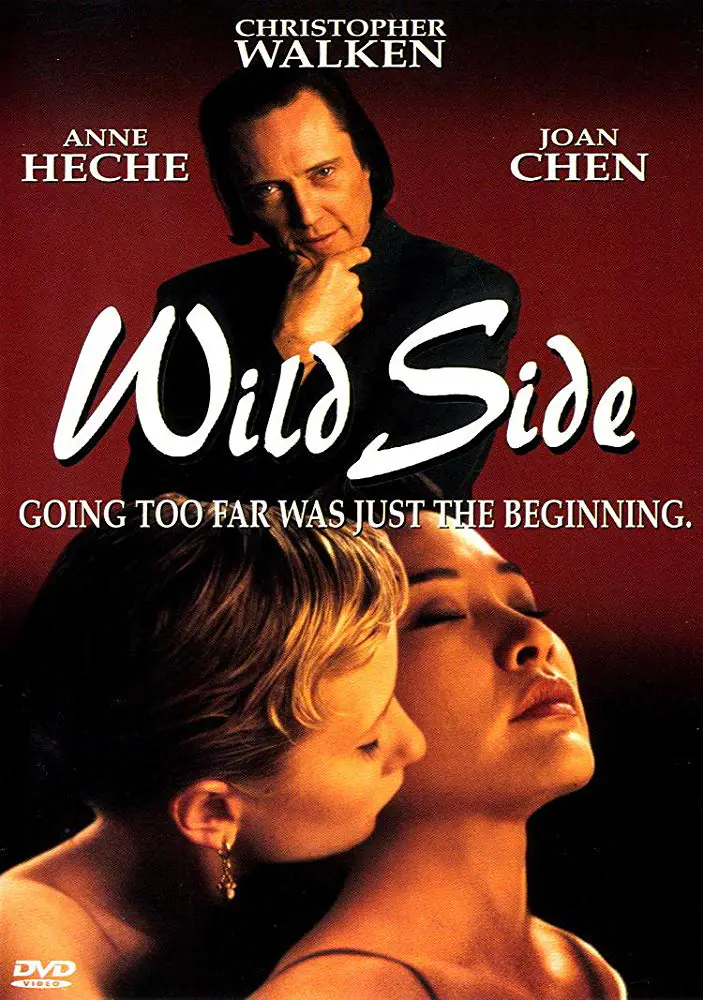
Wild Side (1995) Review: A Hidden Gem of Female-Centric Noir
In the cold concrete jungle of capitalism, where existence itself is reduced to a commodity, at what point can a human being finally confront their authentic self? The moment two souls, who have been erasing themselves to fulfill the desires of others, recognize each other’s deficiency, all taboos prescribed by the world lose their power.
The film Wild Side is a record of two women who, within the barbaric space of a harsh, male-dominated criminal underworld, paradoxically bring to fruition a narrative of the purest and most destructive salvation.
🌿 The Moments This Film Deeply Permeates
- When one feels a profound disillusionment with a life treated as a mere tool in a world saturated with the logic of capital and power.
- When one wishes to witness a sensual, exclusionary solidarity where characters detach from the gaze of others to immerse themselves solely in one another.
- When one desires to encounter a resistance narrative of agentic women who ultimately rescue each other from the abyss of ruin.
- Because it demands an examination of the true nature of humanistic insight and the liberation of queer identity hidden beneath the rugged exterior of neo-noir.
🎞 Note Before Viewing
Due to the conventions of the neo-noir genre involving money laundering and crime, this work features intense psychological warfare and provocative scenarios. However, unlike typical erotic thrillers that submerge themselves in visual stimulation, this film focuses on the internal wounds and emotional sharing experienced by the characters, as well as the deep emotional communion and autonomous relationship-building between women.
🎬 Film Information
- Title: Wild Side (1995)
- Director: Donald Cammell
- Screenplay: Donald Cammell, China Kong
- Country: United States, United Kingdom
- Genre: Erotic Thriller, Drama, Crime
- Running Time: 110 minutes
- Platform: Amazon Prime Video, Apple TV, Google Play Movies
- Cast: Anne Heche (as Alex Lee), Joan Chen (as Virginia Chow), Christopher Walken (as Bruno), Steven Bauer (as Tony)
📖 Wild Side, A Perilous Escape and Solidarity Faced by Two Suppressed Desires [No Spoilers]
Alex, who works coldly as a bank executive by day but leads a double life as a call girl by night to pay off her mortgage, becomes entangled with Bruno, the head of a money-laundering crime syndicate. In the process of managing Bruno’s funds, Alex experiences a fateful encounter with his wife, Virginia.
Virginia, who appears glamorous on the surface but is used as a pawn for her husband’s criminal plans and subjected to his perverse control, feels an inexplicable sense of kinship with Alex. The two share a lunch together, exchanging conversations about their innermost wounds and desires, confirming an impulsive attraction that breaks free from their regimented routines.
The situation escalates toward catastrophe as Tony, an FBI agent who blackmails Alex to catch Bruno, enters the fray. Amidst male-dominated subjugation and exploitation, the two women initiate a dangerous collaboration to save one another.
🌙 A First Meeting Shattering the Boundaries of Taboo and Impulse
The narrative of Wild Side begins by contrasting the rigorously calculated world of capital with the uncontrollable world of emotion. The initial meeting between Alex and Virginia occurs within the public sphere of business, yet what binds them is not social class, but a dense internal lack.
The language of unvarnished desire uttered by Virginia, who is trapped within the material affluence of male power, dismantles Alex’s fortified defenses. The impulsive kiss that explodes within the highly controlled space of an executive restroom is the crucial turning point that forces these two women, who had functioned as mere components of a system, to recognize each other as independent subjects.
📌 Overturning the Matrix of Domination and Exploitation: Female Solidarity
The first half of the film bleakly demonstrates how sex and capital are translated into instruments of power. Alex is situated within an exploitative structure where she must commodify her sexuality for survival, while Virginia is likewise nothing more than her husband Bruno’s possession and a tool for his crimes.
The engine that severs this chain of domination and subordination stems precisely from their mutual attraction. The intimate scenes, which sever ties with the male world that seeks to manipulate them to forge a space exclusive to the two of them, are not mere spectacle. They function as a sanctuary of genuine female solidarity and a space of resistance that excludes the voyeuristic gaze of the outside world to restore their absolute agency.
🔎 Reinterpretation of the Ending — The Structural Liberation of Escaping to the ‘Third World’
The ending of this film goes beyond a successful escape in a conventional crime drama or the conclusion of a melodrama. The monologue delivered by Alex as she crosses the Mexican border hand-in-hand with Virginia, bound ultimately for China—stating that she is finally moving into the “Third World” where she always knew she belonged—constitutes a significant declaration.
Here, the ‘Third World’ transcends a mere geographical boundary; it symbolizes a complete departure from and transcendence of the existing social norms governed by heteronormativity, capitalist exploitation, and the phallocentric framework of power.
Through a clever strategy, Alex destroys both Bruno and Tony, who had constrained them, and secures the funds, thereby disrupting the system from within. The freedom achieved by the two women at the conclusion is a record of victory predicated upon the total collapse of male power structures. The solidarity between Alex and Virginia is only rendered complete by overturning the values of the established order.
❓ Representation of Women and Narrative Interpretation in Wild Side
Q1. Why was this film misunderstood upon its initial release as a typical erotic thriller or a male-gazed exploitation film?
At the time, the production company (Nu Image) disregarded director Donald Cammell’s non-linear, experimental direction and deep psychological exploration, editing and releasing the film centered primarily on provocative sex scenes for marketability. Consequently, the initial home video release suffered from truncated narrative contexts, leaving it to be consumed as a sensationalist film for male consumers.
However, following the director’s death, when the Director’s Cut restored by his wife China Kong and his colleagues was made public, the film finally reclaimed its rightful place as a complex queer neo-noir centered on the emotional communion and autonomy of two women resisting capital and gendered power. It proved that the point of criticism lay not in the director’s intent, but in the distortions manufactured by corporate editing power.
Q2. What is the structural significance symbolized by the downfall of the two male characters, Bruno and Tony?
Bruno, played by Christopher Walken, symbolizes the oppressor holding the capital, while Tony, played by Steven Bauer, represents the predator exerting violence in the name of the law and public authority. They treat women as disposable commodities for their own profit and desire, yet they ultimately meet their demise by falling prey to the precise coordination and intellectual strategies of the women they believed to be weak.
This is a aesthetic device that exposes the internal contradictions and vulnerabilities of the patriarchal capitalist system and power structures that objectify women. Through their downfall, the audience is compelled to question where true power shifts.
✨ Wild Side: The Solitary Breath of Salvation Born Amidst the Madness of Ruin
Wild Side is a work where the grotesque criminal underworld channelled by Christopher Walken violently collides with the delicate, high-density eroticism crafted by Anne Heche and Joan Chen. While director Donald Cammell cynically depicts a human landscape captured by the barbaric order of capital and power, he presents the love between these two women as the sole key to crossing that hellish reality.
Their queer narrative extends beyond the mere validation of social identity; it is the most radical struggle to reject the rules of a distorted world and redefine their own dignity. The film eloquently demonstrates through its mise-en-scène that love can become the most potent revolutionary tool against a deeply contaminated world.
🌙 A Personal Sanctuary Found in the Dark
We have witnessed the choice of Alex and Virginia, who deviate from the safe orbit prescribed by society and cross a perilous border solely to save one another. If you were presented with a single opportunity to discover your own autonomous identity at the cost of abandoning all social conditions and stability, would you remain within the familiar confines of established restriction, or would you willingly walk toward an uncertain but liberated ‘Third World’?
🔑 Another Narrative of Solidarity Suggested by Violet Screen
- Bound (1996)
- Reason for Recommendation: A masterpiece that emerged in the same era as Wild Side, completely subverting the formulas of neo-noir. It charts the high-tension collusion between Corky, an ex-con, and Violet, the mistress of a mafia kingpin, as they join forces to steal mob funds. The intense solidarity and sensual synergy of the two women, who construct a sophisticated strategy that mocks the male-dominated criminal underworld, is magnificent.
- Rafiki (2018)
- Reason for Recommendation: It depicts the love and solidarity of two young women blossoming under Kenya’s conservative political and social pressures. While Wild Side envisioned liberation through the genre of the crime thriller, Rafiki utilizes a vibrant, intensely neon-colored mise-en-scène to demonstrate the agentic energy of women breaking through an oppressive reality.
TODAY'S QUESTION
What's your favorite line from a WLW movie or show?
Your answer isn't saved. Feel free to share it in the comments below.


You May Also Like
Love Is a Map (2022): The Aesthetics of Female Queer Narrative on the Coordinates of Loss
Farewell, My Queen Analysis: A Chronicle of Ruin Collapsing as Class Indulges in Obsession