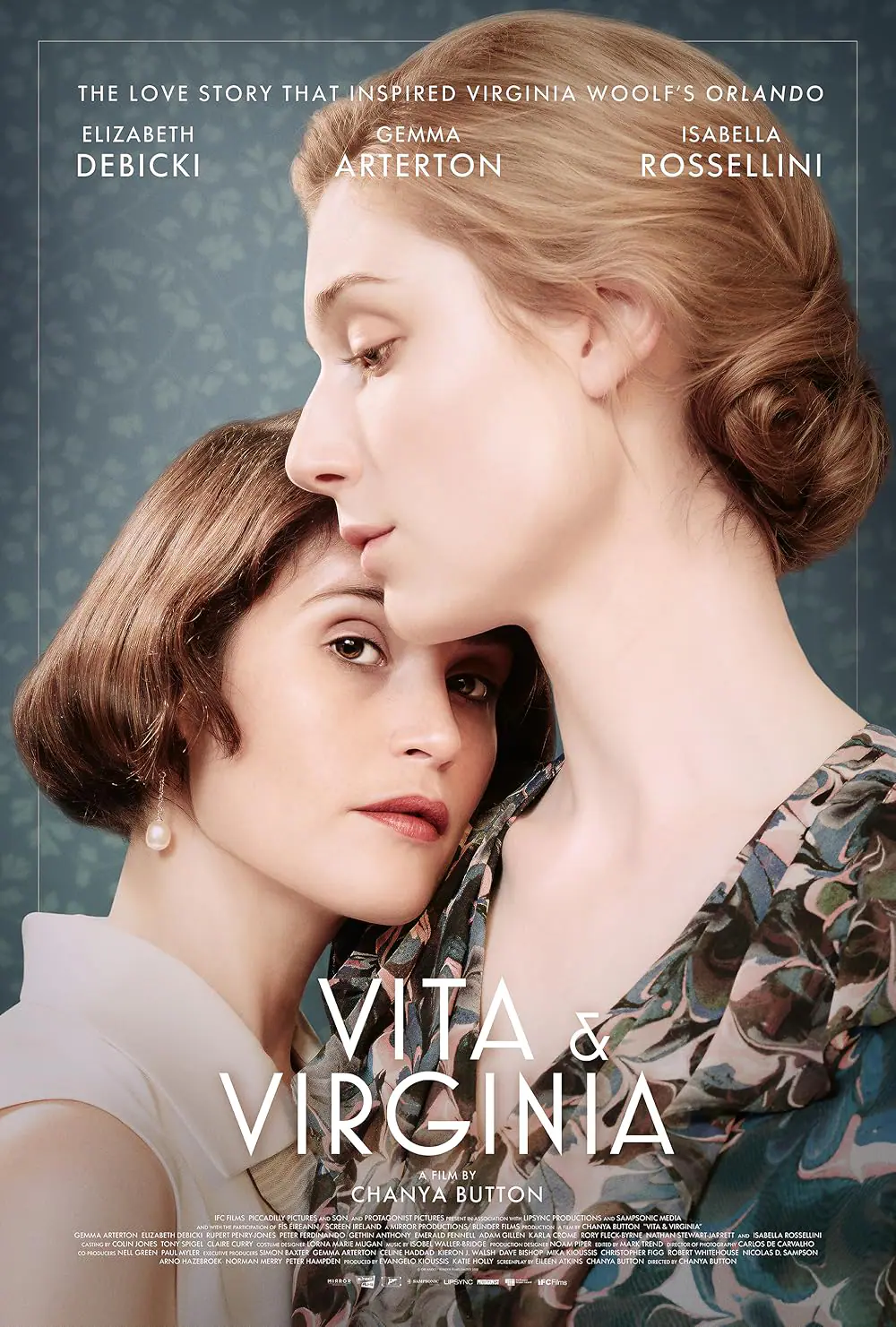
Vita & Virginia: Immortal Sentences Conceived Through the Intersection of Two Genius Souls
The longing to reach someone sometimes destroys language, and at other times, creates a new one. When a woman with an isolated interiority encounters a being possessing a vitality diametrically opposed to her own, the collision transcends a mere romantic affair and leads to a literary explosion.
This film is a record of how two women indulged in the truths hidden beneath each other’s skin, showing how they destroyed one another while simultaneously preserving each other for eternity. Through this fierce relationship, we witness the wondrous yet painful process of the boundaries of the “self” being dismantled by another.
🌿 Moments when this film resonates deeply:
- When your inner self has become so bloated that you have lost the link to the external world and have resigned yourself to isolation.
- When you have stepped back in fear of being consumed by the intensity of another, despite longing for a vitality entirely different from your own.
- When you wish to witness the moment the emotion of love goes beyond mere possession to become a catalyst that sublimates a life into artistic achievement.
The reason to read to the end of this piece is that the conclusion of this film is not a simple breakup, but a record of the raw and beautiful labor pains that birthed Virginia Woolf’s most brilliant masterpiece, Orlando.
🎞 Notes Before Viewing
Set against the backdrop of the Bloomsbury Group—the center of the British intellectual world in the 1920s—this work deeply explores the density of complex emotions and relationships among real historical figures. The narrative is emotion-centered, following the psychological shifts of the two protagonists, where spiritual communion and sexual tension through language and gaze take precedence over physical contact.
🎬 Film Information
- Title: Vita & Virginia (2018)
- Director: Chanya Button
- Screenplay: Chanya Button, Eileen Atkins
- Original Work: Eileen Atkins’ play Vita and Virginia (based on actual correspondence)
- Country: UK, Ireland
- Genre: Drama, Romance
- Running Time: 110 minutes
- Platform: Wavve, Google TV, etc.
- Cast: Elizabeth Debicki, Gemma Arterton, Isabella Rossellini
📖 Vita & Virginia: The Context of Longing Shifting into Literature [No Spoilers]
In 1920s London, at the center of the Bloomsbury Group—where the greatest intellectuals of the era gathered—stands writer Virginia Woolf, precariously oscillating between nervous exhaustion and genius. She lives submerged in her inner world, constantly pursuing the perfection of language.
Meanwhile, Vita Sackville-West, a star of high society and an aristocratic writer of bold character, approaches Virginia, captivated by her literary talent. The two women, possessing entirely different worldviews, feel an intense curiosity toward each other from their first meeting, and Vita incessantly knocks on Virginia’s closed door.
Vita’s aggressive courtship shakes Virginia’s quiet daily life, forming a complex relationship where friendship, love, and artistic inspiration intertwine. However, amidst the constraints of the era and their respective domestic situations, their passion gradually becomes a seed of anxious conflict. Virginia then begins a massive project to sublimate her feelings for Vita into literature.
🖋️ Vita & Virginia: The Language of Indulgence Breaking Down Boundaries and Artistic Sublimation (Psychological Interpretation)
The relationship between Virginia and Vita in the film does not follow a simple romantic trajectory. It is closer to a variation on deficiency and fulfillment. Virginia longs for the physical vitality and social confidence Vita possesses, while Vita craves the unapproachable intellect and depth of soul found in Virginia.
Their conversations provide a tension akin to walking on a blade. Virginia attempts to resolve her neurotic anxiety through Vita’s presence, but Vita’s free-spirited nature often drives Virginia into deeper isolation. The point to note here is the fact that their relationship is obsessed with a linguistic union that transcends physical coupling.
The numerous letters sent by Vita come to life as hallucinations within Virginia’s mind. The film visualizes this through surreal mise-en-scène, excellently demonstrating how Virginia’s mental world absorbs and reconstructs the presence of another. From an interpretative perspective, their relationship is closer to a creative invasion where one human uses another as a “text” to expand their own world, rather than love.
🎥 Unconventional Direction and Mise-en-scène: Modern Sensibilities Within a Classical Setting and Relationship Analysis
Director Chanya Button showcases an unconventional approach by introducing an electronic soundtrack and sensory editing techniques into the classical 1920s setting. This is a sensory attempt to convey how avant-garde Virginia Woolf’s literature was for its time.
The spaces where Vita and Virginia meet are starkly contrasted. While Vita’s space, the great manor of ‘Knole,’ is a symbol of history, authority, and possession, Virginia’s study is a space of abstract and fragmented thought. When the two characters overlap, the camera persistently captures the minute tremors and shifts in their gaze through close-ups.
In particular, the mise-en-scène utilizing mirrors and windows symbolizes the projection of the self that the two women discover while looking at each other. The core of this review lies in the point that they did not love each other, but rather loved the “other possibilities” of themselves finally completed through the other person. This asymmetry in the power structure reaches a turning point as Virginia begins to “objectify” Vita as literary material as the narrative progresses.
🔎 Reinterpretation of the Ending: ‘Orlando’ as an Eternal Tribute, Literary Permanence Completed by Physical Parting
In the film’s conclusion, Virginia finally completes the novel Orlando, modeled after Vita. The protagonist Orlando, who transcends centuries and even gender, is the result of Virginia eternally preserving Vita’s multi-layered identity in her own way.
This ending signifies a complete love left in their relationship, while simultaneously representing an eternal rupture. Instead of possessing Vita, Virginia succeeds in placing her under her control by substituting her with language. On the other hand, while Vita is moved by seeing herself in the novel, she realizes she has been “interpreted” and “defined” by the massive intellectual system that is Virginia.
After the conclusion, Vita will continue to live a glamorous life in high society, but she will live her entire life within the framework of ‘Orlando’ created by Virginia. Through this relationship, Virginia gained a literary life that transcends death, yet she returns to her lonely study by letting go of the real-world Vita.
For Virginia Woolf, Vita was not a life partner, but the most burning sentence she inevitably had to pass through to complete her inner self.
❓ Modern Controversies and Critical Interpretations in the Ending of Vita and Virginia
Q: What are your thoughts on the point that the modern electronic music and unique directing style hinder immersion in an authentic period drama?
Many viewers feel a sense of bewilderment when EDM sounds flow through a film set in 1920s England. This is certainly a divisive element for viewers expecting classical aesthetics. However, such direction should be understood as an attempt to cinematically translate Virginia Woolf’s stream-of-consciousness technique. The work sought to reinterpret their thoughts and passions—which remain innovative even today—with modern rhythms, rather than through fixed images of the past. While acknowledging the criticisms, it is necessary to consider the aesthetic context: this attempt allowed the “preserved” Great Figure of Virginia Woolf to be depicted as a living, breathing subject of modern longing.
Q: Is the opinion valid that Vita Sackville-West’s character was portrayed too flatly compared to Virginia?
As the film places its weight on Virginia’s psychology and literary agony, Vita tends to be consumed relatively as a mere ‘tempter’ or ‘source of inspiration.’ This is regrettable considering Vita was also an outstanding writer of her time with a complex interiority. However, the perspective of this film focuses strictly on Vita as seen through Virginia’s eyes. Vita’s flatness functions as a device to maximize the biased illusions and longings Virginia harbored toward her.
✨ Vita & Virginia: Souls Finally Set Free Within a Fortress Built of Language
This film shows in the most elegant yet cruel way how love destroys and rebuilds a human being. The relationship between Virginia and Vita still poses valid questions within the numerous relationships we form in modern society: “Do we love the other person entirely, or do we love the version of ourselves we want to see in them?”
The answer Virginia Woolf found amidst the confusion of identity and desire was, ultimately, recording. Bodies wither and relationships deteriorate, but the moment the pain and ecstasy left by that relationship are transferred into sentences, they become immortal. This film emphasizes that the end of a relationship is not a parting, but the ‘new self’ born through that relationship.
True solidarity does not stop at hearing the heartbeat of the other; it is finally completed when one translates that sound into one’s own language.
🌙 Is there someone who brought out your emotions, once trapped in silence, with a single sentence?
Sometimes, a single piece of insight that defines me accurately becomes a salvation more than a hundred words of comfort. Is the person who explains you best yourself, or the other person you love?
📽️ Violet Screen’s Next Curation
- Persona (1966): A classic psychological thriller exploring how two beings blend and transfer when the density of a relationship reaches its peak. It delivers overwhelming tension through silence and gaze alone.
- Lucky, Apartment (2025): A Korean film depicting the process of a lesbian couple living together in the mundane space of an apartment as they face each other’s rock bottom while experiencing unexpected events and economic pressure.
To provide a more stable publishing environment, multilingual content, and better communication with our readers, we have moved our official publication to Substack.
All new film reviews and critical essays will be published on our new platform. This website will be closing down soon, so we would greatly appreciate it if you subscribed to our new space.
TODAY'S QUESTION
Which ending has stayed with you the longest?
Your answer isn't saved. Feel free to share it in the comments below.


You May Also Like

Fall Risk (2024) Analysis: The Aesthetics of Isolation Forged by Bodily Betrayal and Relational Deception
Easy Abby: Lesbian Narrative and the Seduction of Anxiety