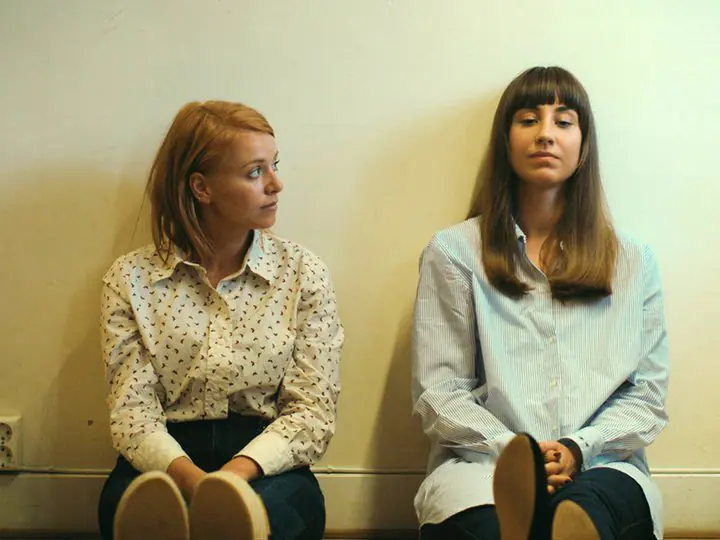
Sjukt oklar: Suspended Love Confronting an Incomplete Identity, a Queer Narrative of Growth and Lack
A bizarre journey where a twenty-four-year-old soul, wandering without having put a period on any path of life, walks back into a classroom of sixteen-year-olds to find the lost pieces of growth.
The Swedish drama Sjukt oklar goes beyond mere age deception, touching upon the universal human anxiety of lingering between self-deception and truth. Because we all live life somewhere incomplete, mimicking the garments of adulthood, the protagonist’s reckless silhouette soon reaches the deepest parts of our hearts, posing a chilling question.
🌿 Moments When This Web Drama Deeply Permeates
- Those who have experienced exiling themselves into another lie to conceal their own incompleteness.
- Those who, independent of the depth of love, have felt even the breathing of a lover to be burdensome due to the weight of reality and the confinement of space.
The reason to read until the end is that, moving beyond a simple high-school romance, it sharply pinpoints the structural meaning of “becoming a true adult” through the identity overload and relationship fractures experienced by the characters.
🎞 Notes Prior to Viewing the Web Drama
This work deals with the tension arising from a disguised relationship setup between teacher and student, and the psychological conflict that unfolds while concealing an adult identity. Although it includes a premise that could be somewhat provocative, the emotional stakes strictly focus on the psychological solidarity of the characters and the communication methods of immature relationships, making humanistic emotional lines the central focus rather than sensationalism.
🎬 Web Drama Information
- Title: Sjukt oklar (Season 1, 2018 / Season 2, 2020)
- Director: Andreas Öhman
- Screenplay: Andreas Öhman, Jonathan Sjöberg
- Country: Sweden
- Genre: High School Comedy, Coming-of-Age, Queer
- Running Time: Approximately 20 minutes per episode (16 episodes total)
- Platform: SVT Play
- Cast: Clara Henry (as Ellen), Madeleine Martin (as Vera)
📖 Sjukt oklar, the Trajectory of a First Love Re-encountered in a Classroom Begun with a Lie [No Spoilers]
Ellen, a twenty-four-year-old who has wandered the world without properly finishing anything, makes the extreme choice to lie about her age to be sixteen and re-enroll in high school in order to reset her incomplete life. She enters the classroom dreaming of a fresh start, but her plans begin to distort completely when Vera—her first love with whom she shared intense emotions during a backpacking trip—arrives as the new teacher.
Within the harsh realistic status disparity of student and teacher, Vera experiences severe turmoil between moral responsibility and an irrepressible personal attraction, while Ellen also falls into a dilemma where she must hide the truth to prevent catastrophe. As external blackmail threatening to expose minor misunderstandings and secrets tightens its grip on the two, this precarious relationship advances beyond a simple romance into a massive crucible that shakes their lives entirely.
🎭 Sjukt oklar Analysis: Fractures and Psychology of Queer Power Structures Blooming within Mimicked Status
Sjukt oklar seemingly follows the tropes of a typical high school romance on the surface, but intimately, it sharply captures the subversion of power structures that occurs when social status and actual age do not align. The vertical relationship of teacher and student is constantly collapsed and reassembled under the secret that their actual ages are equal.
Vera’s authority as a teacher becomes powerless before the “past truth” held by Ellen, which functions as an allegory for the “hidden identity” frequently appearing in queer narratives. Through this peculiar relational structure, the work humorously yet persistently delves into how fragile the moral purity we demand from our partners when we love truly is.
🌲 The Mise-en-Scène of an Isolated Space in the Forest Cabin and the Emotional Variance Curve
The “forest cabin,” where they get lost and stay during an outdoor class in the drama, exists as a neutral sanctuary where social norms and disguises are completely erased. If the classroom space was a place of falsehood and social duty, the cabin in primitive nature becomes a mirror where only the essential emotions of the two clash.
With this space as a turning point, the emotional variance curve of Ellen and Vera abruptly shifts from instability to certainty. The director contrasts the candlelight inside the dark cabin with the vast nature outside, visually implementing the perfect tranquility of queer solidarity that is completed only when isolated from the eyes of the world.
🔎 Reinterpretation of the Ending: The Eternal Fracture of Growth Left by an Incomplete Period
In the ending of Season 2, Ellen is still searching for herself within the fence of the school, while Vera moves forward to university and a new world, widening their physical and psychological distance once again. Instead of suspending the completion of a superficial romance, the ending of this drama leaves a deep resonance by throwing out the lonely task of internal maturity that each must bear.
The way Vera cherishes Ellen’s world yet does not stop her own trajectory demonstrates a dignified insight that love must not become a collateral that suspends another’s growth. Passing through jealousy and anxiety toward Vera, Ellen finally learns how to accept herself as she is, rather than possessing another person.
The ending of this play is not a happy ending where two entities combine, but a declaration of complete independence that forces them to face their own lack through each other.
❓ In-Depth FAQ on the Ending and Setup of Sjukt oklar
Q. How should we interpret the morally objectionable aspect of an adult lying about their age to go to high school?
To some viewers, this setup may come across as deceitful and contrived. However, the work utilizes this not as a criminal fraud, but as a directorial device to maximize the psychological regression and wandering of an adult who failed to put a period on adolescence. It needs to be viewed within an aesthetic context that satirizes rigid social age norms through the playfulness of disrupting the system, leaving the judgment entirely to the audience.
Q. Why did the ending leave Ellen’s wandering unresolved as an open ending?
For viewers expecting a typical happy ending where all conflicts are neatly resolved, it is an ending that may feel somewhat ambiguous or frustrating. However, this is an aesthetic choice implying that the character’s life does not stop with the end of the drama but will continue to expand beyond the finale. It shows that growth is not a result achieved in a single stroke but the very process of incessantly faltering, leaving a message to affirm the incomplete parts of our lives as they are.
✨ Sjukt oklar: Our Real Faces Confronted Through the Mirror of Falsehood
This drama proves how easily social signs like age and status distort our essence, and how dazzling the raw love remaining is when that disguise is stripped away. Ellen’s reckless wandering and Vera’s agony extend warm consolation to all those who have fallen behind the “normal speed of growth” demanded by modern society.
True growth is not erasing past failures, but the very process of fully welcoming another who approaches in an incomplete state.
💬 Where Was the Secret Forest Where You Stayed?
We sometimes create massive secrets out of fear that speaking the truth might mean losing someone precious. If you were in the same situation as Ellen, would you adhere to the secret until the end to protect the relationship, or would you risk the danger of being hurt and confess the truth?
🔮 Another Perspective from Violet Screen: Female Solidarity Curation
Skam France Season 6 (2020)
- Reason for Recommendation: A masterpiece that deeply captures the sharp emotional lines and intimate solidarity of wandering youths through the relationship between Lola, who experiences identity confusion and lack, and the surrounding characters.
Heartbreak High (2022)
- Reason for Recommendation: Set against the backdrop of a modern Australian high school, it depicts queer narratives, the complex and subtle friendship between women, and autonomous growth blooming amidst conflict in a sensuous and uninhibited tone, providing fresh stimulation.
To provide a more stable publishing environment, multilingual content, and better communication with our readers, we have moved our official publication to Substack.
All new film reviews and critical essays will be published on our new platform. This website will be closing down soon, so we would greatly appreciate it if you subscribed to our new space.
TODAY'S QUESTION
Which ending has stayed with you the longest?
Your answer isn't saved. Feel free to share it in the comments below.


You May Also Like

Marinette (2023) Review: A Record of Flamelike Desire Piercing Through Deprivation

Vita & Virginia: Immortal Sentences Conceived Through the Intersection of Two Genius Souls