Love’s Lone Flower (2005): A Sad and Radiant Chronicle of Women Who Bloomed and Faded Alone in the Midst of Turbulent History
When all the brilliance of the world is buried in darkness and the warmth of only one person becomes the sole signpost of life, what should we call that emotion? When devotion to someone goes beyond love and becomes salvation, and that salvation ultimately ends in loss, the silence that the one left behind must bear is deeper than the universe. This story is a heartbreaking record of women who tried to hold onto each other under the giant wheels of history, but were ultimately forced to be left alone.
🌿 Moments When This Film Seeps Particularly Deep
- When you are facing head-on the cold loneliness hidden behind the noise of a glittering city
- When you are silently enduring the pain of losing someone you wanted to protect more than yourself
- When you want to believe in the power of memory, where a momentary warmth sustains a lifetime
- When you want to peer into a facet of a soul mourning both a lost homeland and the breath of a past lover on a strange street in a foreign land
- Because we must watch to the very end the mortal aesthetics of how women’s solidarity and love fade away and yet are eternally engraved in the giant wave of turbulent modern history.
🎞 Note Before Watching the Film
This work deals with the deep solidarity, love, and ruin of women that bloomed in the harsh historical circumstances of war and exile. Although it contains somewhat dark and destructive sentiments, such as physical and verbal violence and depictions of drug use, it is an authentic emotional period drama that delves densely into the delicate psychological changes of the characters and the essence of their relationships, rather than focusing on provocative spectacles.
🎬 Film Information
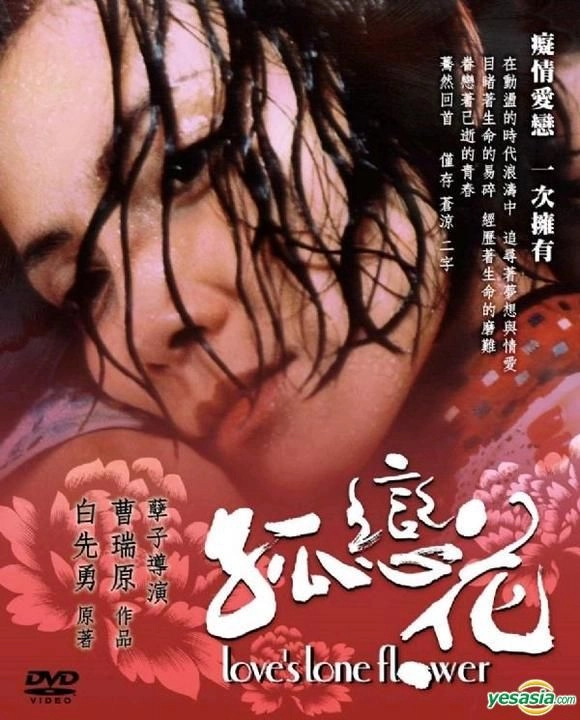
- Title: Love’s Lone Flower (孤戀花, 2005)
- Director: Tsao Jui-yuan (曹瑞原)
- Screenplay: Ke Shu-ching (柯淑卿)
- Original Work: “Love’s Lone Flower” (孤戀花), a short story included in Pai Hsien-yung’s (白先勇) short story collection Taipei People (臺北人)
- Country: Taiwan
- Genre: Period Drama, Romance, Drama
- Platform: CTS (華視)
- Cast: Anita Yuen (袁詠儀 as Yunfang), Angelica Lee (李心潔 as Wubao), Shu-shen Hsiao (蕭淑慎 as Juanjuan)
📖 Love’s Lone Flower, a Trajectory of Loss and a Tragic Duet Stretching from Shanghai to Taipei [No Spoilers]
In Shanghai in the late 1940s, immediately after the defeat of Japan, Yunfang, the madam of the luxurious ballroom “Paramount,” rescues Wubao—a pure and deeply scarred girl on the verge of being sold to a brothel—with a large sum of money. Yunfang lets Wubao stay at her house and takes care of her with utmost devotion, and the two become deep soul companions with no one else in the world but each other.
However, when the musician Sanlang appears and falls in love with Wubao, and the gunfire of the Chinese Civil War engulfs Shanghai, their relationship is swept into a whirlpool. They attempt a narrow escape, but after losing Wubao to a tragic illness on the road to exile, Yunfang flees to Taipei, Taiwan, in the 1950s, where she continues her weary life as a bar madam once again.
There, she meets Juanjuan, a young dancer who looks exactly like the shadow of Wubao, and reaches out with a hand of salvation once more. However, as Juanjuan also sinks into a swamp of brutal violence and drugs, another giant shadow of ruin begins to cast over Yunfang’s life.
🌺 Yunfang’s Sorrowful, Unspoken One-Sided Love that Budded Under the Lights of 1940s Shanghai
During her days at Shanghai’s Paramount, Yunfang was a lonely being who possessed everything but had no place to rest her soul. Wubao, who suddenly entered her life, was like a lily—fragile and pure, making Yunfang want to protect her all the more. The emotion Yunfang held toward Wubao was a devotion that projected the purest part of her own life, transcending simple pity or compassion.
Even when Wubao falls in love with the musician Sanlang, Yunfang chooses silence instead of jealousy, silently watching over their love. This is a selfless and deep form of love characteristic of women’s narratives, prioritizing the well-being of the other rather than putting one’s own desires first. However, the immense violence of war does not permit their precarious peace, and the loss of Wubao leaves a deep, unhealing crack in Yunfang’s heart.
🥀 The Projection of Wubao and the Ruin of Juanjuan Recreated at Taipei’s “Dongyun Pavilion” in the 1950s
Time passes, and in the 1950s, Yunfang, who has become an aging madam at the tavern “Dongyun Pavilion” in the unfamiliar foreign land of Taipei, encounters a young woman named Juanjuan. In Juanjuan’s precarious yet stubborn gestures, Yunfang instinctively seeks the clear, sad eyes of Wubao, whom she failed to protect in the past in Shanghai. The unconditional obsession and maternal affection Yunfang bestows upon Juanjuan are both an atonement for the lost past and a form of agonizing mourning.
However, the shackles of a gang leader and the cruel reality of drugs gradually tighten around Juanjuan. The harder Yunfang struggles to save her, the faster the cogs of tragedy turn. Ultimately, Juanjuan’s descent into ruin symbolically demonstrates how helplessly wounded souls can be shattered in the face of the violence of the times.
🔎 Reinterpretation of the Ending — The Eternal Silence and Dignity of Life Faced by Yunfang, Left Alone
At the end of the film, the image of the elderly Yunfang left completely alone on the streets of Taipei, having lost both Wubao and her projection, Juanjuan, is excruciatingly desolate. A former colleague, Meijun, whom she happens to meet on the street, has formed an ordinary family and is living peacefully, but for Yunfang, who has buried deep resentment and loss in her heart, only the ghosts of the past remain by her side.
This ending is not a simple exhibition of tragedy, but a scene that reveals the fundamental loneliness of a generation that lost both homeland and lover as exiles of the era. Her gaze as she silently endures life in Taipei despite having lost everyone she loved proves an inner dignity: even if life betrays us, the memory of having loved remains unblemished.
The loss of love dismantles the soul, but the time of mourning spent enduring that loss alone finally completes a human being.
💬 In-Depth FAQ on History, Women’s Solidarity, and Harsh Destiny
Q. Isn’t Yunfang’s devotion to these women closer to an obsessive lingering attachment?
Some viewers criticize Yunfang’s excessive obsession and salvation narrative toward Juanjuan after Wubao’s death as a lingering attachment that fails to face reality. However, structurally speaking, Yunfang’s behavior is not a simple personal attachment. She is a displaced person who has entirely lost her roots in her hometown of Shanghai amidst the country’s civil war and rapidly changing historical whirlpools.
For her, Wubao and Juanjuan were the only mediums to hold onto the purity of her lost homeland and the memories of her brilliant youth. Therefore, it is reasonable to interpret her devotion not as personal obsession, but as the last bulwark and a desperate aesthetic of resistance against the humanity stripped away by the era. Ultimately, the judgment is left to the audience who empathize with her lonely gaze in the drama.
Q. What are the distinguishing points of the TV drama version compared to the original short story “Love’s Lone Flower”?
Pai Hsien-yung’s original short story is set in a rundown tavern district in Taipei, compressing the tragedy briefly and intensely through Yunfang’s reminiscences. In contrast, Director Tsao Jui-yuan’s 12-episode drama and film meticulously reconstruct the glamor and decline of Shanghai’s Paramount in the 1940s, firmly solidifying the narrative of the first half.
Thanks to this, viewers can fully immerse themselves in how the emotional lines between Yunfang and Wubao were built up, experiencing the artistic effect of doubled loss in the second half in Taipei. If the original is a tragedy of a sharp cross-section, the drama can be called a grand epic written with a long breath.
✨ Love’s Lone Flower, the Breath of Red Blossoms That Refused to Be Broken Even in the Cold Darkness of the Era
Through the giant mirror of Taiwan’s turbulent modern history and the fall of Shanghai, this work illuminates the fragile yet beautiful lives of the women who were the first to shatter in the crevices. This sorrowful melody, in which love, identity, and nostalgia for lost spaces flow tangled together, resonates deeply with us living today.
Yunfang’s final steps, left alone on the streets of a foreign land, quietly eloquent the fact that even if the precious beings we wished to protect have vanished, the traces of the memory of having loved them remain forever as the territory of our lives.
History may destroy an individual’s love, but it cannot annihilate the dignity of the memories that love left behind.
🥀 Questions for You as You Face Your Inner Loss
- Have you ever willingly reached out to become someone’s salvation, even while knowing that loss was the foreseen path?
- Between silently embracing another’s sorrow in silence, and believing in the warmth of love once again even while knowing you will be hurt—which way does your soul move closer to?
💜 Another Deep Women’s Narrative Curation Suggested by Violet Screen
- The Handmaiden (아가씨, 2016)
- Reason for Recommendation: Set in 1930s Japanese-occupied Korea, it deals with the deception and fascination between an aristocratic lady who inherited a vast fortune and a handmaiden who intends to swindle her. Within the massive prison designed by patriarchal authorities, the two women transform from enemies deceiving each other into each other’s sole ally and salvation. Along with a thrilling narrative of liberation, you can taste the essence of sensuous and mesmerizing aesthetic production.
- Bound (1996)
- Reason for Recommendation: This is the brilliant debut film of the Wachowski sisters, directors of The Matrix. It is a thriller in which Corky, an ex-con plumber, meets and falls in love with Violet, the girlfriend of a mafia boss, and they engage in a sophisticated battle of wits to steal $2 million of the mob’s dirty money. It is a monumental neo-noir masterpiece in film history that portrays queer female characters not as passive victims, but as clever and autonomous criminal masterminds shaking up the male-centered criminal underworld. The sticky yet smart partnership between the two keeps viewers on the edge of their seats.
To provide a more stable publishing environment, multilingual content, and better communication with our readers, we have moved our official publication to Substack.
All new film reviews and critical essays will be published on our new platform. This website will be closing down soon, so we would greatly appreciate it if you subscribed to our new space.
TODAY'S QUESTION
Which couple, on screen or in real life, are you rooting for right now?
Your answer isn't saved. Feel free to share it in the comments below.


You May Also Like
The Curse of Styria (2014): Repressed Desire, Seductive Ruin, and an In-Depth Reading of a Gothic Vampire Text
Black Swan Analysis: Destruction Born of the Cruel Desire Named Perfection