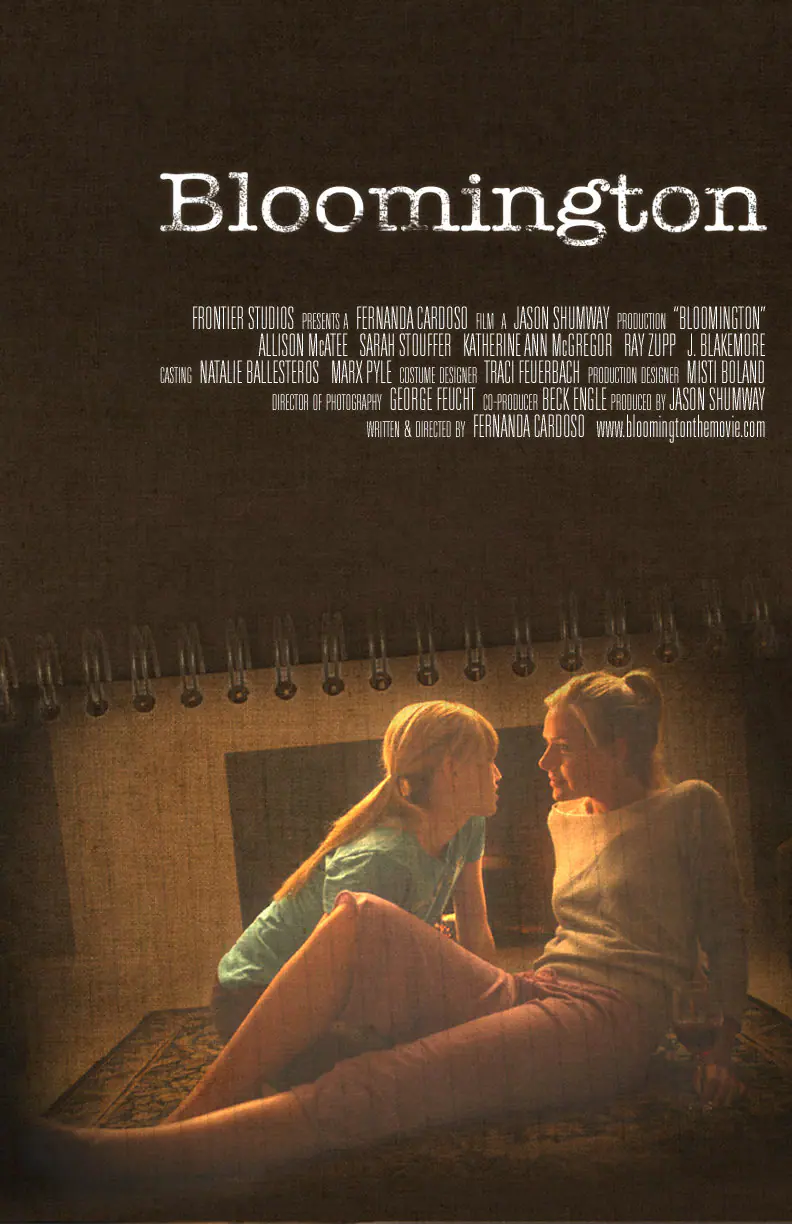
Bloomington Film Review: An Interpretation of Female Narrative Intertwined with Power Structures and Self-Independence
Those who have grown up confined by the gaze of others naturally yearn for a sanctuary entirely their own. Through the meeting between a college student and former child actress who fled the world’s glamorous spotlight, and a psychology professor who hides her loneliness behind intellectual authority, the film Bloomington relentlessly tracks how human beings validate and liberate themselves through another person. Moving beyond a forbidden romance based on a simple student-teacher relationship, this work portrays an emotional journey toward independence, where two women confront their own deficiencies by serving as mirrors for one another.
🌿 Moments When This Film Deeply Permeates
- When you desire to escape the prison of scrutiny and exist solely as your authentic self
- When you wish to look beneath the surface of salvation named love and inspect the power structures within it
- When you want to confront the sweetness brought by a deep bond with another person, along with the severe price that follows
Why you should read until the end: Because it pierces beyond the superficial romance of a student-teacher relationship, sharply dissecting the psychological fractures a woman had to pass through to achieve complete independence, as well as the structural significance of the ending.
🎞 Notes Prior to Viewing
The central axis of this film is a forbidden relationship that violates social conventions and campus regulations regarding professors and students. While some intimate physical contact and romantic scenes are included to express emotional density and psychological tension, these function as narrative devices to visualize the loneliness and mutual dependence of the two characters rather than focusing on provocative staging. It is a work that concentrates on the emotional repercussions of the relationship rather than physical explicitness.
🎬 Film Information
- Title: Bloomington (2010)
- Director: Fernanda Cardoso
- Screenplay: Fernanda Cardoso
- Country: United States
- Genre: Drama, Romance, Queer
- Running Time: 83 minutes
- Platform: Amazon Prime Video
- Cast: Allison McAtee, Sarah Stouffer
📖 Bloomington, the Perilous Independence of a Child Star Who Left Her Suppressive Nest [No Spoilers]
Jackie Kirk, who enjoyed brilliant fame during her childhood by starring in a famous sci-fi TV series, feels disillusioned by her mother’s thorough control and a life stripped of privacy, leading her to attend college in Bloomington, Indiana. Although she dreams of a fresh start as an ordinary college student, Jackie faces deep alienation among peers who consume her merely as a celebrity.
At this moment, Catherine Stark, a young and intellectual psychology professor, appears before her, and the two experience an irresistible attraction from their very first encounter. Jackie, who had been trapped in the gaze of others, and Catherine, who lived amidst rumors and solitude, begin to fill each other’s deficiencies, developing into secret lovers.
However, within the closed space of the campus, their precarious positions as professor and student gradually begin to pressure their relationship. When an opportunity to return to Hollywood approaches Jackie, the world of the two individuals is placed at an uncontrollable crossroads of choice.
🔑 Clash of Crouching Deficiencies: Character Psychology and Asymmetry of Power
The film Bloomington delicately captures how the psychological voids of the two protagonists intersect and collide. For Jackie, Catherine is the first “selective relationship” she encounters away from her mother’s control, as well as a channel through which her adult ego is validated.
Conversely, for Catherine, who carries the trauma of losing her parents and a fear of flying, Jackie is a safe refuge where she can hide her unstable inner self. The setting of a psychology professor and a child actress implies from the outset that this relationship cannot be equal; Catherine’s intellectual superiority and Jackie’s emotional vulnerability form a subtle power structure embedded beneath the sentiment of love.
🚁 A Confession Buried in Silence: The Symbolic Mis-en-scène of the Helicopter Sequence
The helicopter flight scene prepared by Jackie for Catherine’s birthday offers the most philosophical sense of space in this film. Catherine’s fatal flaw, her fear of flying, is exposed and simultaneously healed in the most vulnerable space—the sky—under Jackie’s initiative.
At this moment, when the professor who held control overcomes her fear in the arms of the student, a temporary inversion of power occurs. Furthermore, Catherine’s confession, buried in the silence of the night while Jackie is asleep, functions as a tragic symbol implying that the communication between the two ultimately fails to connect fully and can only wander on separate orbits.
🔎 Reinterpretation of the Ending — The Intrusion of the External World and the Complete Separation of Self
The offer to return to Hollywood and the scandal on campus become the decisive catalysts that shatter their enclosed paradise. Due to the exposure of the relationship, Catherine loses her professorship, and Jackie steps back into the center of the public eye. The final night shared by the two when they reunite in the library months later is not a mere confirmation of lingering lingering attachment, but a ritual of mourning that acknowledges the end of their influence over each other.
The two do not hold onto each other, choosing a calm parting instead of tearful promises. This final separation is not the extinction of emotion, but an inevitable severance chosen to discard the immature self that depended on another and to protect their respective dignity. By passing through the mirror that was Catherine, Jackie is finally able to choose her own career as an independent agent, rather than as her mother’s doll or the professor’s lover.
💬 Perspectives on Bloomington’s Power Dynamics and Representation of Women
Q. What are the limitations of the queer representation regarding the power dynamics of a professor-student relationship?
Some viewers criticize the work for overly romanticizing the precarious moral boundaries of a student-teacher relationship or bystander-ing Catherine’s irresponsible attitude. Indeed, Catherine’s lack of responsibility as an adult serves as a decisive cause that leads the relationship toward catastrophe. However, rather than glorifying this, the film structurally examines the internal limitations and loneliness of the characters, psychologically deconstructing the fear hidden behind an immature adult and inducing the reader to view the relationship between the two from an objective standpoint.
Q. Are the price Catherine paid and the choice Jackie made a fair outcome at the end?
Compared to Catherine, who lost both her social reputation and her career, some voices point out a narrative imbalance in that Jackie makes a glamorous comeback. However, this must be interpreted as the result of autonomous growth, where Jackie, whose life had been mortgaged to others since childhood, finally chooses her career on her own. Moving beyond binary judgments of who lost or gained more, it allows readers to savor the manner in which they fully bear the cost of the relationship.
✨ Bloomington, a Declaration of Independence Blooming Where Illusion is Stripped Away
The ending of this film poses a question to us, not about the expiration date of love, but about the “establishment of subjectivity through a relationship.” The narrative of Jackie and Catherine neatly shatters the Hollywood illusion that romantic union is the only salvation, proving that parting can sometimes be the completion of self-growth rather than the failure of a relationship.
True solidarity and independence are achieved not by submerging oneself into the other person’s world, but when two people step out into their respective wildernesses using each other as a stepping stone.
💬 Toward what choice is your solitude flowing?
- Have you ever felt the fear of losing yourself by loving someone deeply?
- Between a life of gaining stability by deeply depending on another, and a life of standing entirely on your own strength despite the solitude, which side does your heart lean toward right now? Please share your story in the comments.
🎥 Violet Screen Recommended Curation
- The Feels (2017)
- Reason for Recommendation: This work deals with the process where the secrets and internal deficiencies of a lesbian couple approaching their wedding explode within the confined space of a bridal shower. While Bloomington addresses power and growth, this piece wittily yet sharply pierces the weight of communication and honesty within a relationship.
- First Girl I Loved (2016)
- Reason for Recommendation: Set in a high school, this film depicts the fresh yet fierce vortex of emotions between two female students. As a narrative of finding oneself while conflicting between social scrutiny and one’s own identity, it shares a deep resonance with the emotional nature of the early growing pains experienced by Jackie in Bloomington.
To provide a more stable publishing environment, multilingual content, and better communication with our readers, we have moved our official publication to Substack.
All new film reviews and critical essays will be published on our new platform. This website will be closing down soon, so we would greatly appreciate it if you subscribed to our new space.
TODAY'S QUESTION
What genre or mood do you always reach for when you're alone?
Your answer isn't saved. Feel free to share it in the comments below.


You May Also Like
TÁR: An Analysis – The Dissonance of Power and the Abyss of a Fallen Maestro

A Bizarre Love Triangle: An Interpretation of an Alternative Family Blooming from a Bizarre Tragedy