A Bizarre Love Triangle: An Interpretation of an Alternative Family Blooming from a Bizarre Tragedy
There is a strange form of salvation that sprouts only at the exact site where all conventions have collapsed. Do we not live in a state of constant deficiency, trapped inside standardized social frameworks and the selfish impulse to fully possess another human being?
The film A Bizarre Love Triangle (2002) completely dismantles and reassembles the imperfect institutions of love and family within the radical B-movie sensibilities of the early 2000s, questioning those relentless moments of solidarity reached only at the absolute depths of degradation.
🌿 Moments When This Film Sinks in Deeply
- For those who have experienced accepting another person’s desires and deficiencies as they truly are, moving beyond the narrow fence of so-called normalcy.
- When you wish to persistently interrogate the ambiguous boundary between violence and devotion enacted in the name of love.
- If you are curious about the bizarrely beautiful ending forged by those who shattered the framework of the “ideal family” dictated by the world to write a narrative entirely their own.
- Therefore, the reason you should read this review to the very end is that it structurally reinterprets the true meaning of family—blooming from the lowest depths of moral conventionality—and the questions it poses to contemporary society.
🎞 Note Before Watching
Rated 18, this work contains sexual metaphors, radical narrative setups, as well as scenes of character nudity and physical contact. However, rather than stopping at mere visual stimulation or sensationalism, it is an emotion-driven dark comedy and drama that navigates the intense emotional waves and the formation process of non-traditional relationships experienced by the three main characters.
🎬 Film Information
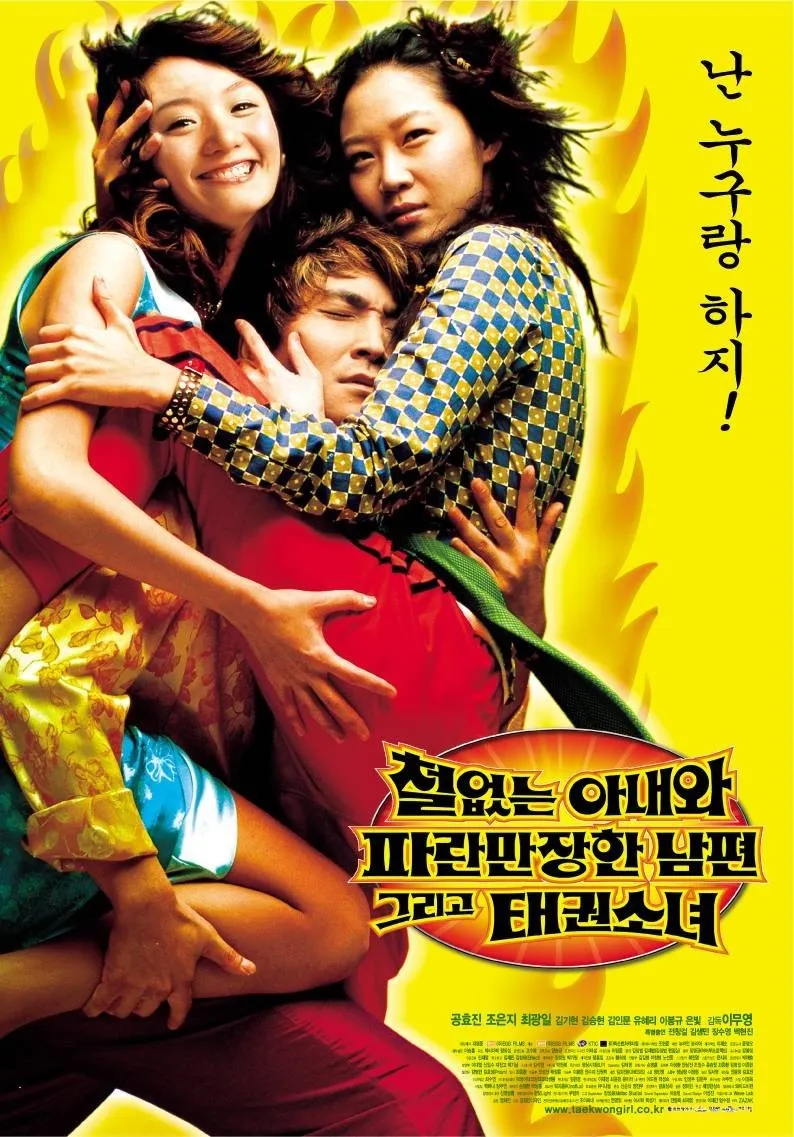
- Title: A Bizarre Love Triangle (철없는 아내와 파란만장한 남편 그리고 태권소녀, 2002)
- Director: Lee Mu-young
- Screenplay: Park Chan-wook, Lee Mu-young
- Country: South Korea
- Genre: Comedy, Drama, Romance
- Runtime: 92 min
- Platform: Naver Series On, Wavve, etc.
- Cast: Gong Hyo-jin (as Hwang Geum-suk), Jo Eun-ji (as Bae Eun-hee), Choi Kwang-il (as Oh Doo-chan)
📖 A Bizarre Love Triangle, The Narrative Context Where a Bizarre Triangle Meets Turbulence [No Spoilers]
Hwang Geum-suk, a Taekwondo prodigy who protected Bae Eun-hee—a girl constantly entangled in trouble due to her striking beauty since their school days—gradually develops a deep emotional and physical relationship with Eun-hee out of pure devotion. Despite Eun-hee’s childish extravagance and erratic behavior, Geum-suk gives everything to stay by her side, yet Eun-hee chooses a worldly marriage with the popular comedian Oh Doo-chan.
Even after the marriage, Geum-suk and Eun-hee’s secret relationship continues. Once her husband Doo-chan senses this and witnesses the two together on site, their peaceful life faces a massive rupture. Swept up in feelings of betrayal, Doo-chan’s bizarre demands for revenge and the unexpected events arising from them push the three characters into extreme conflict and a crossroads of new choices that cannot be explained through traditional moral standards.
🧩 The Intersection of Desire and Sacrifice: The Ruptured Ending and Interpretation of Hwang Geum-suk and Bae Eun-hee
🥊 A Duet of Violence and Devotion: The Shadow Left by Geum-suk’s Blind Love
The character of Hwang Geum-suk represents a rejection of traditional femininity and a projection of an intense desire to stand in the position of a savior. The unconditional sacrifice she performs for Eun-hee appears noble on the surface, but in reality, it forms a subtle power dynamic that dismantles the other person’s independence and renders her subordinate.
What Geum-suk protected, even while cycling in and out of prison, was not merely the entity of Eun-hee itself, but Eun-hee as “a being that I must save.” This relentless devotion traces a complex emotional curve in which pure affection and distorted possessiveness are inextricably intertwined.
This film’s ending represents a non-traditional solidarity achieved through the complete dismantlement of the traditional family system.
💔 A Contract Under the Name of Revenge: Doo-chan’s Betrayal and the Restructuring of Relationships
The husband, Oh Doo-chan, appears to be the primary victim, but he too sought to consume Eun-hee as an instrument to fulfill his own worldly desires. The bizarre condition for revenge he proposes after witnessing his wife’s infidelity marks the destruction of a “normal” relationship while simultaneously serving as the starting point for a strange sense of solidarity shared among the three.
By directly intervening in the desire of others through the extreme format of revenge, Doo-chan paradoxically penetrates the lives of Geum-suk and Eun-hee as an inseparable axis through that very process of infliction.
🔎 Reinterpretation of the Ending: The Dignity of an Alternative Family Launched from Space in 2030
At the film’s conclusion, the frame story set on the moon in 2030 and the three characters in their old age deliver a symbolic message. The cohabitation of these three, finalized after going through the massive chaos of past betrayals, revenge, and pregnancy, was accompanied by social ostracization and condemnation. However, the life they chose was not a simple surrender or compromise, but the birth of an “ideal community” that filled each person’s deficiencies with the presence of one another.
In the ending, the scene where the son they raised together holds a wedding with another man, and the three characters in their old age hold hands to celebrate it, serves as a clear counterstrike against worldly moral standards.
What they gained was not societal validation, but a complete mutual understanding and dignity; what they lost was merely the illusion of “other people’s gazes.” As if mocking the limitations inherent in bloodline- and heteronormative-centered concepts of family, this ending leaves a lingering resonance regarding how far the outer boundaries of acceptance can expand under the name of love.
💬 A Bizarre Love Triangle: Issues Read Through Interpretation and Implications
❓ How should we interpret the criticism that the radical setup and B-comedy direction of that time dilute the depth of the themes?
The bizarre narrative and exaggerated comedic tone of this work reflect the transitional experimentation of the Korean commercial film industry in the early 2000s. While some criticize that the superficial exaggeration and provocative setups diminish the sincerity of the narrative, these function as dark comedy devices designed to dismantle moral solemnity.
By bringing relational structures that could be deeply uncomfortable or grotesque into the framework of conventional comedy, director Park Chan-wook and director Lee Mu-young paradoxically lead the audience to reach the bold theme of “redefining the family” without moral repulsion.
✨ A Bizarre Love Triangle, The Value of True Solidarity Salvaged from an Ocean of Shame and Lust
This film tells us that the emotion of love does not necessarily have to exist in a clean, refined form. At the destination reached after human beings’ most degraded desires—extravagance, selfishness, violence, and revenge—clashed against one another, the three characters learned how to embrace each other’s wounds.
When modern society still insists on a single framework called the “normal family,” the strange question posed by this work over twenty years ago resonates even more powerfully. This radical tragedy proves that the essence of love lies not in its form, but in the attitude of embracing the other.
In the place where all shame, lust, and greed have passed through, what ultimately remains is only a relentless love that accepts each other’s wounds exactly as they are.
🔮 In a Contradictory Relationship, What Method of Salvation Would You Choose?
In a relationship where relentless selfishness and devotion are confusingly intertwined, would you choose the path of embracing even the fatal flaws of the other person to face destruction together, or would you choose to preserve yourself by maintaining a safe distance?
💜 Violet Screen Curation: Another World of Female Narratives and Alternative Solidarity
- Who’ll Stop The Rain (青春并不温柔, 2023): Set on a university campus shortly after the lifting of martial law in 1990s Taiwan, this passionate romance follows two women who stand in solidarity, reclaiming art, freedom, and desire for one another amidst the era’s institutional oppression.
- The Dream Songs (너와 나, 2023): Capturing the clumsy yet desperate emotions blooming beyond language between two high school girls on the day before a field trip through incomparable mise-en-scène and camera angles. A work that perfectly portrays the intimate, radiant, yet heartbreaking psychology between women.
TODAY'S QUESTION
What changed the most for you after coming out?
Your answer isn't saved. Feel free to share it in the comments below.


You May Also Like

Love Sick: Between Taboo and Longing, an Interpretation of the Pathological Narrative of Isolated Souls
Birds of Paradise: The Chilling Aesthetics of Liberation Met at the Edge of Desire