Gigola (2010): An In-Depth Interpretation of Female Narrative, A Solitary Walk Between Greed and Freedom
Sometimes, we borrow the masks of others to save ourselves. When the grief of losing a loved one is too immense, the bereaved often destroy their original selves and sculpt a new identity to fill that void.
Set against the backdrop of the glamorous night streets of 1960s Paris, this work tenaciously tracks how a wounded soul dons the mantle of a ‘master’ to build her own kingdom. It is not a simple transformation, but a record of a painful struggle to reject socially defined femininity and usurp the status of a ‘masculine predator.’
🌿 Moments When This Film Sinks Especially Deep
- In the dawn when you wish to cast yourself into extreme coldness to forget the pain of loss.
- When you dream of a radical liberation because the framework of ‘womanhood’ set by the world feels suffocatingly oppressive.
- When you wish to witness a purity that refuses to be lost, even within relationships where power and desire are entangled.
- The reason you should read to the end is that this piece pierces through the essence of a woman’s agonizing solitude hidden behind provocative intensity, and the peculiar liberation she encounters at its end.
🎞 Note Before Viewing
This work is set in the underground culture of 1960s Paris and contains a high level of physical exposure and sexual depiction. However, these serve not as mere provocation, but as essential devices to reveal the characters’ power dynamics and psychological deficiencies.
🎬 Film Information
- Title: Gigola (2010)
- Director: Laure Charpentier
- Screenplay: Laure Charpentier
- Original Work: Based on the novel Gigola by Laure Charpentier
- Country: France
- Genre: Drama, Erotic
- Running Time: 102 minutes
- Platform: VOD, International Streaming
- Cast: Lou Doillon, Marisa Paredes, Ana Padrão, Eduardo Noriega
📖 Gigola Synopsis: Aesthetic Wandering Governing the Parisian Night [No Spoilers]
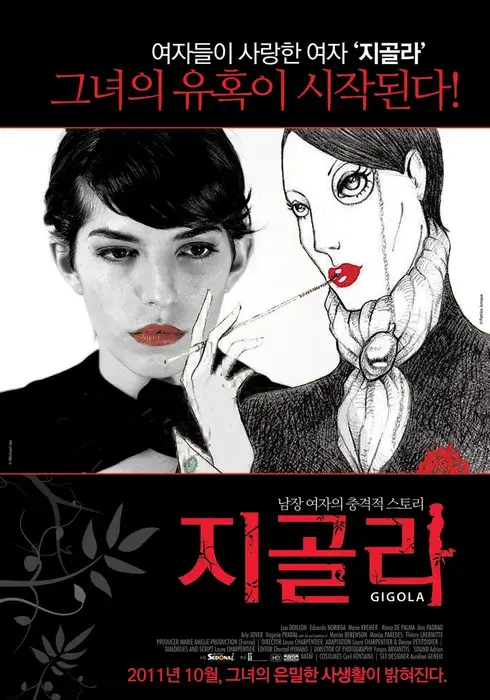
In 1960s Paris, George, a medical student from a devout Catholic family, awakens to her identity as she falls into a forbidden love with Sybil, her school principal. Sybil introduces George to the lesbian world, gifting her a short butch cut, but their passionate relationship meets a tragic end with Sybil’s sudden suicide.
The shock of her first love’s death completely transforms George’s life. Dropping out of medical school, she retreats into the dark night streets of Pigalle, renames herself ‘Gigola,’ and begins a life as a gigolo for women, clad in masculine suits and carrying a silver cane.
While reigning as a queen of the night under the patronage of the wealthy aristocrat Odette, Gigola begins to waver once more under the influence of true love as she rescues Dany, a young woman held in the grip of the pimp Tony, and renames her Cora. Under the lights of glamorous cabarets, Gigola walks a precarious tightrope between the collapse of her family and her own twisted desires.
🎭 Gigola’s Suit and Cane: A Gender-Performative Mask Concealing Loss
The tailored suit and silver cane Gigola wears do not merely signify cross-dressing. They are a defense mechanism born from the helplessness of failing to protect Sybil, and an armor-like declaration that she will never be hurt again.
She maintains a position of dominance over her partners, never undressing even in bed. This can be interpreted as an expression of psychological deficiency—an attempt to hide her internal vulnerability by exerting control over others rather than seeking physical pleasure.
For Gigola, gender is not a fixed essence but a garment to be changed as needed. By performing a male role, she stands on equal footing with the pimps of a male-dominated society, while simultaneously taking on the form of a paradoxical savior who liberates women from them.
🍷 Subverting Dominance and Submission: Power Dynamics Between Odette and Cora
Odette and Cora represent the two extremes of Gigola’s life. The elderly aristocrat Odette provides Gigola with financial abundance and seeks to possess her, yet Gigola maintains a strict emotional distance as a ‘service provider’ within that relationship.
In contrast, Cora—purchased from a gangster—is the only being for whom Gigola disarms herself and shows her true heart. By protecting Cora, Gigola seeks to wash away the debt of failing to save Sybil in the past; in this process, her dominant position gradually crumbles, giving way to an equal solidarity.
This shift in relationship reveals how fragile the ‘kingdom of the night’ Gigola built truly was. Love is ultimately an uncontrollable domain, and the point where the feminine sensibility she so vehemently rejected re-emerges through Cora becomes the film’s most critical emotional turning point.
🔎 Reinterpreting the Ending: The Full Stop of Eternal Wandering Declared by a Silent Birth
The ending, in which Gigola chooses to become pregnant through a relationship with her nemesis Tony, leaves many viewers bewildered. However, this should not be seen as a simple return to heterosexuality or a compromise. Her pregnancy is a product of existential curiosity—a desire to know the ‘feeling of becoming a mother.’
She gives birth, leaves the child with her own mother, and takes to the streets again. This is an act of direct negation of the myth of maternal love imposed by patriarchy. For Gigola, the child is not a reason to settle, but an empirical badge of honor proving that she has performed every role the world has to offer.
Ultimately, the film’s conclusion suggests that the protagonist has chosen an absolute freedom untethered by any framework. She was a daughter, a lover, and a master; finally, after performing the function of a mother, she strips away all labels and disappears back into the anonymous night. Gigola’s wandering is a solitary victory completed by the refusal to settle.
🚬 Gigola’s Provocativity Controversy and Ending Interpretation: On the Boundary Between Obscenity and Art
Q: What are your thoughts on the criticism that the film’s sexual depictions are excessive?
A: It is a valid point to some extent. The cabaret performances and bed scenes may give the impression of being excessively long and explicit. However, these are essential devices to reproduce the decadent aesthetics of 1960s Paris and to demonstrate how the protagonist acquires power through sexual acts. The very intensity being criticized can be seen as representing the weight of the precarious life Gigola leads.
Q: Is the setting where Gigola has a relationship with Tony and gives birth not a character collapse?
A: On the surface, it may appear so, but it actually emphasizes Gigola’s lack of boundaries. She did not want even the label of ‘lesbian’ to become a prison that confined her. The relationship with the man is closer to an instrumental choice than love, and her act of leaving the child after birth should be interpreted as a device proving she remains a ‘free, solitary individual.’
✨ Gigola: The Portrait of a Woman Who Rejected All Definitions and Became a Legend
This work follows the grammar of queer cinema but ultimately refuses to settle within that category. Gigola craves love yet refuses to be subordinate to it; she mimics men yet does not assimilate into the male world. This double negation insists to those of us living in modern society that identity is not a fixed thing, but a process of constant performance.
In an era where we measure ourselves against the gaze of others, Gigola’s radical actions provide us with a chilling sense of liberation. The final footprint she leaves reminds us that true freedom comes from the courage to betray every expectation surrounding oneself. Another name for freedom is exercising the right to be understood by no one.
🌙 On the Way of Rising Above Wounds
What mask are you wearing to forget your sorrow? Is that mask protecting you, or is it slowly suffocating you?
If the defensive wall built to protect yourself is instead blocking true happiness, are you ready to tear that wall down?
📽 Violet Screen Recommendations: Other Perspectives Piercing the Essence of Relationships
- The Five Devils (2022): A work that unravels suppressed desires and past wounds between women through sense and memory with original mise-en-scène.
- Lizzie (2018): Depicts the dark, intense solidarity and destructive narrative of two women blooming within an oppressive domestic environment.
To provide a more stable publishing environment, multilingual content, and better communication with our readers, we have moved our official publication to Substack.
All new film reviews and critical essays will be published on our new platform. This website will be closing down soon, so we would greatly appreciate it if you subscribed to our new space.
TODAY'S QUESTION
Which couple, on screen or in real life, are you rooting for right now?
Your answer isn't saved. Feel free to share it in the comments below.


You May Also Like

Bandaged (2009) Analysis: Tearing Through Suppressed Oppression Hidden Beneath Bandages—Two Women’s Destructive Indulgence and Its Ultimate Conclusion
Review of Carol (2015): The Irresistible Liberation Forged Through Gaze and Silence