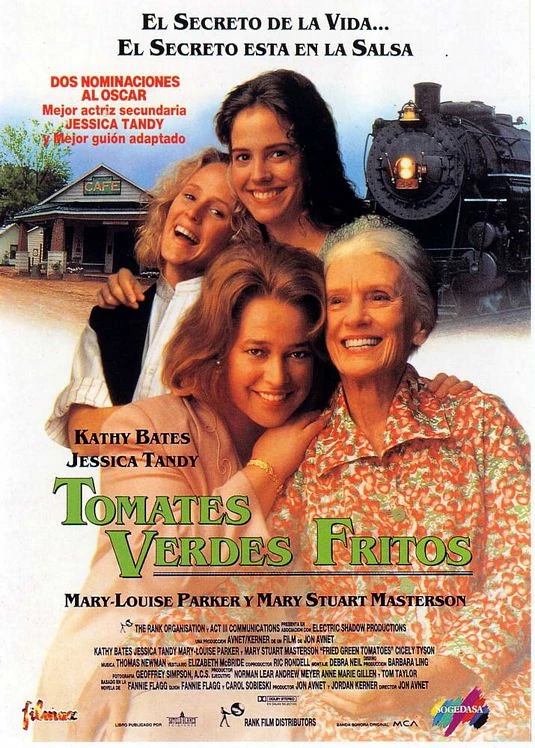
Fried Green Tomatoes — A Classic of Female Narrative, the Aesthetics of Solidarity and Filling the ‘Hunger’ of Lack
To satisfy someone’s hunger is more than a simple act of sharing food; it is a most solemn promise to rebuild a world that has collapsed for another. We all live with our own respective voids, yearning for the warmth of others to fill those hollow spaces.
This work dissolves the boundaries between past and present, youth and old age, and life and death through the medium of ‘food,’ depicting the brilliant resistance of women blooming in unseen places. Witnessing the immense energy that occurs when isolated souls discover one another creates a deep resonance within our weary daily lives.
🌿 Moments When This Film Sinks Especially Deep
- When you feel your inner self has withered away from living according to the expectations of others, having lost your own voice.
- As a warm consolation to those who dream of their own ‘Whistle Stop Cafe’ in the face of the world’s prejudice and oppression.
- When you wish to reaffirm the value of sublime solidarity—an emotional bond thicker than blood relations.
- The reason to read until the end: This provides a structural answer as to why this 30-year-old classic still offers the most powerful courage of ‘Towanda’ to modern women today.
🎞 Note Before Viewing
While the film is set against the backdrop of racial discrimination and patriarchal violence in the 1920s American South, it is a warm and profound human drama that focuses on the relationships between characters and the process of emotional overcoming rather than utilizing provocative depictions.
🎬 Film Information
- Title: Fried Green Tomatoes (1991)
- Director: Jon Avnet
- Screenplay: Fannie Flagg, Carol Sobieski
- Original Work: The novel Fried Green Tomatoes at the Whistle Stop Cafe by Fannie Flagg
- Country: USA
- Genre: Drama
- Running Time: 130 minutes
- Platform: Google TV, Apple TV (VOD)
- Cast: Kathy Bates, Jessica Tandy, Mary Stuart Masterson, Mary-Louise Parker
📖 Fried Green Tomatoes, a Recipe for Salvation Crafted by Hungry Souls [No Spoilers]
Evelyn (Kathy Bates), a middle-aged woman losing her self-esteem amidst a monotonous daily life, obesity, and a distant relationship with her husband, happens to meet an elderly woman named Ninny (Jessica Tandy) at a nursing home. Ninny begins to tell Evelyn the story of two women, Idgie (Mary Stuart Masterson) and Ruth (Mary-Louise Parker), who lived in the small town of ‘Whistle Stop,’ Alabama, during the 1920s.
The free-spirited and irrepressible Idgie shuts herself off from the world following the death of her beloved brother, but faces a new turning point in her life upon meeting Ruth, the woman her brother loved. Idgie helps Ruth escape from an abusive husband, and together they run the ‘Whistle Stop Cafe,’ embracing the marginalized members of the town.
The lives of these resilient women from the past are transmitted to the Evelyn of the present, awakening her suppressed self and giving her the courage to step out into the world. Moving beyond simple recollection, this story as told through Ninny’s eloquence is a process of proving the enduring vitality of women across eras.
🍅 Idgie and Ruth, the Victory of a ‘Non-Kinship Community’ that Erased Social Stigma
The core of this work lies in the structural solidity of the relationship established between the two characters, Idgie and Ruth. In the conservative environment of the American South at that time, two women without husbands raising a child and running a cafe together was, in itself, a massive challenge and an act of resistance.
Idgie is a wild, tomboyish figure who refuses to succumb to social conventions, while Ruth hides a strength of character firmer than anyone else beneath her ladylike exterior. The two complement each other’s deficiencies, creating a ‘sanctuary for women’ that seemed impossible for the time.
Their relationship goes beyond mere friendship; it is interpreted as a strategic solidarity for survival and a union of soul companions. This provides a prototype for the ‘non-marital communities’ or ‘alternative families’ discussed in modern society, vividly demonstrating how relationships protect and grow an individual’s identity.
🥘 Whistle Stop Cafe: Mise-en-scène and Symbols that Break the Barriers of Discrimination
The cafe’s signature dish, ‘Fried Green Tomatoes,’ symbolizes beings that are not yet ripe—those who are socially incomplete or marginalized. Idgie serves food regardless of whether the patron is Black or white, a vagrant or a settler, establishing the cafe as a space where all discrimination is suspended.
The space of the kitchen, once a place of labor where women were confined, is reinterpreted at Whistle Stop as a plaza of liberation where power is exercised and solidarity is formed. In particular, the role the kitchen plays in the disappearance of Ruth’s abusive husband is a subversive device symbolizing the communal judgment of women against patriarchal violence.
This mise-en-scène asks the audience: Is it food that we are truly hungry for, or a ‘space’ that will fully accept us? Behind the warm-toned frames, the director hides a sharp eye for social criticism, capturing a revolution occurring in the most mundane of places.
🔎 Reinterpretation of the Ending — The Spirit of ‘Towanda’ Resurrected into the Present Beyond Death
At the conclusion of the film, the story told by Ninny is summoned into reality through fresh ‘fried green tomatoes’ and a letter placed at Ruth’s grave. The hint that Idgie might still be alive sends shivers not only through Evelyn but through the audience as well.
The cry of rage Evelyn used to shout, “Towanda!”, is no longer a mere exclamation but has transformed into a declaration to take subjective control of her own life. Ruth’s death does not end in sorrow; it was passed down through Idgie’s life and now flows through Evelyn’s veins via Ninny.
This ending reminds us that the ‘transmission of narrative’ is more important than physical survival. When someone remembers our name and speaks of our struggle, we never truly disappear. The ending of this film achieves a perfect emotional union between generations by transmuting the pain of the past into the courage of the present.
💬 Subtle Fractures and Representation Between the Original Work and the Film
Q1. What are your thoughts on the criticism that the homoerotic depiction of the two protagonists was weakened compared to the original novel?
This is one of the most significant points of contention regarding the work. While the romantic relationship between Idgie and Ruth is more explicitly depicted in the novel, the film transposes this into a metaphorical and emotional bond. While this may be a limitation of commercial Hollywood cinema at the time, it also achieved an aesthetic feat by adding the mystery of an ‘unnamable, deep relationship,’ expanding it into the universal power of female solidarity.
Q2. What is your view on the perspective that the way racial issues are handled is overly paternalistic?
There is certainly a risk that Idgie’s treatment of Black staff as family may be seen as a ‘White Savior’ narrative. However, in the historical context of the time, the act of Black and white people sharing a kitchen and defending one another in court was a life-risking resistance that went beyond mere paternalism. The film chooses to stimulate humanistic sensibility by focusing on the revolution of personal relationships rather than structural solutions.
✨ Fried Green Tomatoes, the Most Delicious Consolation to Awaken the Giant Within
Fried Green Tomatoes is not simply a nostalgia movie longing for days gone by. It is a tribute to all women wandering because they have not found their place, and a report on the most dignified way to resist oppression.
The film proves that love is sometimes an act of breaking the law for someone, sharing secrets, and willingly bearing the weight of a life together. The solidarity of women is the most powerful language to break the silence, and that language remains a valid tool for survival across the ages.
❣️ The Weight of the ‘Cry’ to Protect Oneself
To you, who believed that enduring in silence was a virtue: what is the ‘Towanda’ you need most right now? When you hit the walls of the world, will you choose a safe silence, or will you start a ruckus to create your own Whistle Stop?
📽 Violet Screen Curation: Other Female Narratives with Similar Textures
- May December (2023): A work that sharply dissects the hidden sides of a relationship and the subtle psychological warfare that occurs as two women observe and project onto each other.
- The Watermelon Woman (1996): A masterpiece of indie cinema that captures the process of searching for one’s identity while tracing the history of a forgotten Black actress.
To provide a more stable publishing environment, multilingual content, and better communication with our readers, we have moved our official publication to Substack.
All new film reviews and critical essays will be published on our new platform. This website will be closing down soon, so we would greatly appreciate it if you subscribed to our new space.
TODAY'S QUESTION
Is there a hidden gem you always recommend to friends?
Your answer isn't saved. Feel free to share it in the comments below.


You May Also Like
Tierra firme (2017) and Seeking a Path on the Edge of Non-Traditional Families
Nathalie…: An Anatomy of Relationships Forged by Transference of Desire and Isolated Truths