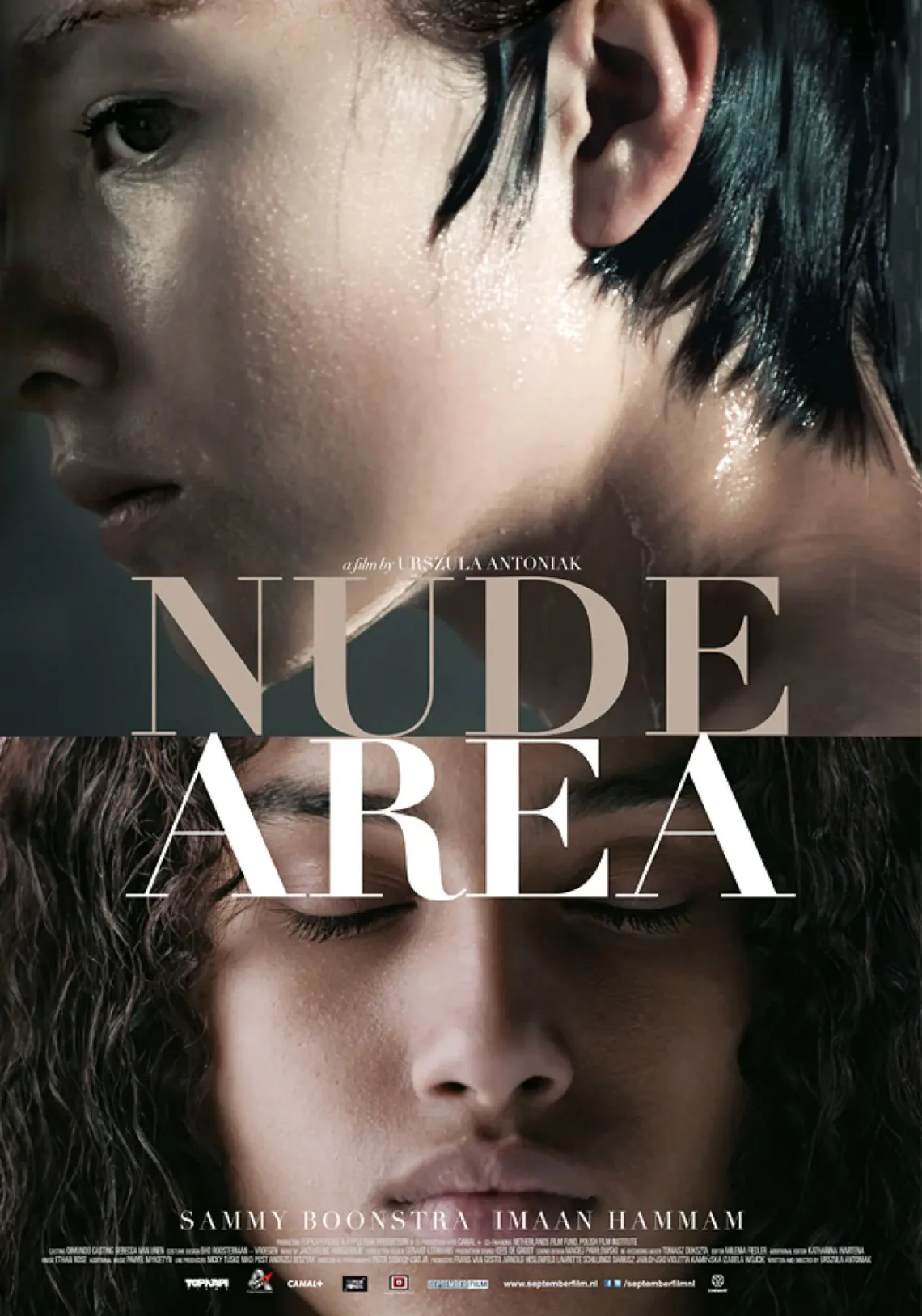
Nude Area: An Interpretation of Sensory Liberation Painted by the Gaze of Desire and Isolated Skin
Can we ever truly sense another person in their entirety? What remains when we strip away the shells of social status, the clothes we wear, and the cultural backgrounds to which we belong? The film Nude Area begins at that very point—the “time of the skin,” where all modifiers have been excised.
Discarding the imperfect tool of language, this work tenaciously tracks how two souls permeate and isolate one another through the primal instincts of gaze and touch.
Desire sometimes reveals its true nature most sharply amidst silence. This record of two girls lost between the cold urban landscape of Amsterdam and the hot steam of a sauna forces the viewer to confront the fundamental loneliness hidden within themselves. This is no simple romance; it is a sensory essay on how the self is deconstructed and reconstructed through the mirror of the “Other.”
🌿 Moments When This Film Especially Seeps In
- On a lonely night when you wish to escape the noise of the world and focus solely on the breath and gaze of another.
- When you long for the thrill of a fleeting communion and the palpable tension conveyed without words.
- When you remember feeling an inexplicable attraction to someone from a completely different background.
- The reason to read this article to the end: To understand the “aesthetics of loss” reached by the purest form of female narrative that blossoms where language has vanished.
🎞 Note Before Viewing
This work adopts a form close to a silent film with almost no dialogue, developing its narrative through the texture of the body and visual mise-en-scène. While nudity is included, it functions not for provocative purposes but as an artistic device to explore quintessential human relationships that transcend class and culture.
🎬 Film Information
- Title: Nude Area (2014)
- Director: Urszula Antoniak
- Screenplay: Urszula Antoniak
- Country: Netherlands, Poland
- Genre: Drama, Romance
- Running Time: 78 minutes
- Platform: Major arthouse streaming services and VOD
- Cast: Sammy Boonstra (as Naomi), Imaan Hammam (as Fama)
📖 Nude Area: A Silent Hide-and-Seek Where the Gaze Becomes Power [No Spoilers]
Naomi, a white girl living surrounded by books in an affluent area of Amsterdam, and Fama, an Arab girl living under the discipline of a Muslim household in a slum apartment, lead lives like parallel lines with no point of contact. However, the worlds of these two collide in the specific space of the “nude area” in a women-only sauna. There, where all signs of clothes, the hijab, and social status have disappeared, Naomi becomes intensely captivated by Fama’s presence.
Through 15 fragmented episodes inspired by Roland Barthes’ A Lover’s Discourse, the film depicts without dialogue the process of the two girls exploring, seducing, and repelling one another. Naomi’s obsessive observation soon leads to Fama’s conscious response, and an invisible emotional game of chess begins between them.
In the process of an accidental encounter transforming into an inevitable conflict, the audience stands on a blurred boundary, uncertain whether their relationship is reality or a fantasy conjured by someone’s longing.
👁️ Power Woven Through the Gaze: An Interpretation of the Subversive Relationship Between Naomi and Fama
Within the film, the gaze is used as a tool of power to possess the other beyond simple observation. In the beginning, Naomi occupies the position of the proactive “hunter” who “discovers” and “observes” Fama from her standing as an upper-class white person. Her camera fragmentally collects the movement of Fama’s skin, hair, and lips, projecting her own desire.
However, as the narrative progresses, this axis of power becomes subtly twisted. As Fama, who was being observed, recognizes Naomi’s gaze and begins to use it to seize the initiative in seduction, Naomi instead falls into the role of a passive being trapped by her own desire.
This subversion of the relationship creates explosive energy even within static frames, proving that true seduction is not the act of making the other look at me, but the process of becoming trapped within the other’s gaze.
💧 Mise-en-scène in Water and Steam: The Aesthetics of the Language of the Body
In Nude Area, the swimming pool, shower room, and sauna are not mere backgrounds but emotional battlegrounds. Water is the medium that blurs the boundaries between the two, and steam symbolizes the uncertainty of a desire that is barely visible. Director Urszula Antoniak captures even the trajectory of water droplets flowing over the skin through close-ups, completing a sophisticated psychological portrait that dialogue could never achieve.
Particularly, nudity in the nude area signifies an ontological equality that goes beyond sexual stimulation. Fama, having removed her hijab, and Naomi, having stripped off her luxury clothes, face each other solely as human to human. This eloquently demonstrates how powerless cultural taboos and class distinctions are in the face of the massive wave of desire.
This unique direction, where the mise-en-scène itself becomes the narrative, offers the audience the marvelous experience of the act of watching becoming an experience in itself.
🔎 Reinterpretation of the Ending — The Act of Cutting Hair and the Union of Loss
The ending of this film focuses on “exhaustion” and “letting go” rather than the fulfillment of love. Fama’s act of cutting her own hair is the most intensely symbolic event in this relationship. For a Muslim woman, hair is the core of hidden femininity and identity, yet she boldly cuts it and hands it to Naomi. This is Fama’s final response to the “possession” Naomi craved and a ritual announcing the end of the relationship.
Naomi obtains Fama’s hair, but she loses the entity of Fama herself. This illustrates the paradoxical truth that the fulfillment of desire leads directly to the loss of the object. The taut tension between the two is finally resolved through this ritual of parting, but what remains is not growth, but a deep lingering resonance and solitude. Fama gains freedom through severance, while Naomi gains a taxidermied memory.
The expiration date of love is finalized by that momentary sacrifice—cutting away a part of oneself to hand to the other just before destroying one another completely.
❓ Interpretation of Ambiguity and Narrative Devices in Nude Area
Q: Does the unfriendly format, almost entirely devoid of dialogue, pose a limit to communicating with the audience?
A: At first glance, it may seem so. The absence of information carries the risk of boring the audience. However, this film chooses the method of making one “feel” instead of “explaining.” A significant portion of the conversations we have when we love someone is often just noise that obscures the essence. The director exposed the pure core of desire by removing that noise. This unfriendliness instead functions as a vast void where the audience can project their own experiences, elevating the act of watching the film into a meditative experience.
Q: What are your thoughts on the criticism that the treatment of Fama’s hijab and religious background is superficial?
A: From a sociological perspective, there is plenty of room to criticize Fama’s background as being consumed as a mere “exotic device.” However, this film is not a social critique drama but a strictly arthouse film dealing with individual eroticism and psychology. Before it is a political symbol, the hijab functions as a “barrier” and a “secret” that Naomi’s gaze must overcome. The director utilized the cultural difference between the two girls not as a conflict to be resolved, but as an aesthetic distance that makes them crave each other more. This should be seen as an intentional choice to construct an archetypal discourse on love rather than a representation of reality.
✨ Nude Area: A Lonely Voyage Toward the Unreachable Other
The film has ended, but we still find ourselves chasing the back of Fama through Naomi’s eyes. Nude Area tells us that love is ultimately the process of exploring the unknown territory of the “Other” only to eventually confirm the limits of one’s own self and return. It asks whether we, living in a world of countless connections in modern society, have ever truly touched the loneliness hidden beneath someone’s skin.
This work focuses on how the “afterimage of sensation” left by the relationship changes an individual’s life more than the continuity of the relationship itself. The true depth of a relationship is determined not by the amount of shared language, but by how deep an abyss one has witnessed within each other’s silence.
💧 Do you remember the temperature of silence?
When the gaze of another person scans through your deepest interior, have you ever felt more exposed than when you were clothed?
Is love to you a process of possessing the other, or a process of completely losing yourself?
💜 Violet Screen’s Curation: Other Narratives of Sensation
- Water Lilies (2007): A work by Céline Sciamma that sensually depicts the desires and gazes of girls against the backdrop of synchronized swimming. Feel the sensuality provided by the space of water.
- Summertime (2015): Set in 1970s Paris, this film deals with the intense and fierce solidarity of two women from different social backgrounds as they find their identities through love.
To provide a more stable publishing environment, multilingual content, and better communication with our readers, we have moved our official publication to Substack.
All new film reviews and critical essays will be published on our new platform. This website will be closing down soon, so we would greatly appreciate it if you subscribed to our new space.
TODAY'S QUESTION
Which film feels like your 'first love' story?
Your answer isn't saved. Feel free to share it in the comments below.


You May Also Like

The Deep Sky: The Illusion of Non-Monogamy and the Interpretation of Emotional Isolation

The Dream Songs (2023) — Love Traversing the Realm of Loss, and Absolute Salvation