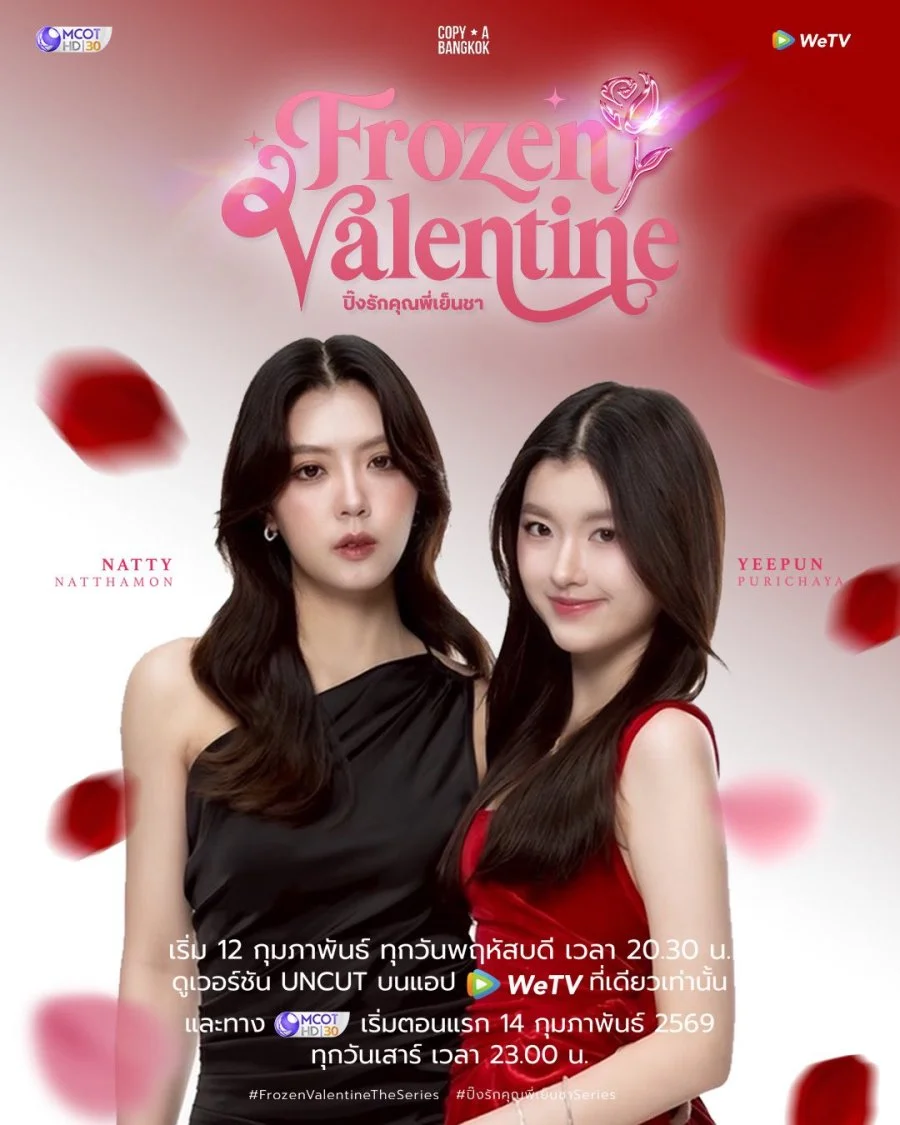
Frozen Valentine: First Love, and the Totality of Relations Proven by a GL Drama
Every human being harbors a profound yearning to be remembered by others in their most beautiful state. This desire becomes exponentially more acute when the object of remembrance is a past first love. However, can the superficial transformations we present to the world truly and completely heal our internal deficiencies?
The drama series Frozen Valentine (2026) sharply captures the precise intersection where past inferiority complexes collide with present-day splendor. Moving far beyond a simple romance, this work deeply interrogates the fracturing of relationships engendered by the asymmetry of memory.
🌿 The Moments This Drama Deeply Permeates
- For those who have ever felt a long-harbored, solitary unrequited love freeze over upon crashing against the cold wall of reality.
- For those who have concealed their most honest inner selves out of a desperate desire to show only a flawless exterior to others.
- For those who wish to simultaneously enjoy the meta-fictional behind-the-scenes machinations of a glamorous entertainment industry alongside intense emotional tension.
- Why you must read to the end: Rather than offering a reductive Cinderella story, this review provides a multi-dimensional analysis of the psychological unification of two women who confront past wounds to seek their authentic selves.
🎞 Pre-viewing Notes
This work is an emotionally driven romantic drama distinguished by the subtle orchestration of the characters’ gazes and a sophisticated emotional push-and-pull. While highly immersive scenes emphasizing emotional and physical intimacy transpire in certain episodes, these are directed with decorum and aesthetic grace—serving as narrative devices to articulate the resolution of long-standing conflicts and the deepening of interpersonal bonds, rather than merely indulging in sensationalism.
🎬 Drama Information
- Title: Frozen Valentine (2026) / Original Title: ปิ๊งรักคุณพี่เย็นชา
- Director: Ta Kling Kaem Chai
- Screenplay: Ta Kling Kaem Chai
- Original Work: The eponymous novel by Ta Kling Kaem Chai
- Country: Thailand
- Genre: Romance, Drama, Meta-fiction
- Running Time: 10 Episodes (approx. 45 minutes per episode)
- Platform: WeTV
- Cast: Natty Natthamon Jantraviphart, Yeepun Purichaya Saranark
📖 Frozen Valentine: A Tale of Past Deficiency Reunited on the Stage of the Present [Spoiler-Free]
During her high school years, Pingrak was an invisible bookworm who harbored a solitary, unrequited love for her senior, Charm—the school’s star, widely known as the “Ice Princess.” However, Pingrak met her graduation bearing the deep trauma of having her feelings seemingly rejected and ignored.
As time marches on, Pingrak achieves a flawless transformation into the dazzling heiress of a major department store empire. By a stroke of fate, she is reunited with Charm, now a rising model, as they are cast as the lead couple in a new Girls’ Love (GL) drama.
Charm fails to recognize the radically transformed Pingrak as the timid junior from her past and begins to find herself intensely drawn to this new version of her.
As Pingrak conceals her true identity—the ghost of a wounded past—a delicate web of tension and conflict begins to sprout between the two women, fueled entirely by the profound asymmetry of their shared memories.
❄️ The Space Where the Power Structure of the Gaze Inverts: The Aesthetics of Meta-Drama
The most compelling dimension of Frozen Valentine lies in its self-reflexive, meta-fictional structure—a drama operating entirely within the production of another drama. In their historical relationship, Charm occupied the position of the one who unilaterally received the gaze, while Pingrak was merely the passive observer. Yet, the moment the mediator of the camera lens intervenes, their positions undergo a total inversion.
The production set and acting workshops, which forcibly compel them to lock eyes as actors, become the pivotal arena through which Charm slowly assimilates Pingrak into her own hermetic world. Surrounded by the scrutiny of the media and the relentless pressure of fandom, the two women actively shut out the external noise to focus entirely on each other’s essence. This functions as a clever piece of mise-en-scène; it circumvents banal romantic tropes to simultaneously expose the artificiality of the entertainment industry while maximizing the authentic emotional evolution of the two women blooming within that very fiction.
🔍 Reinterpreting the Ending: Complete Unification Reached Beyond the Asymmetry of Memory
The latter half of the drama meticulously tracks the psychological fracture that erupts the moment Charm is forced to confront Pingrak’s past identity. The void in Charm’s memory was not a product of simple indifference, but rather a structural symptom of the profound isolation that kept her imprisoned in her youth. Conversely, Pingrak’s concealment was a fortified wall erected by a wounded ego to protect herself from further harm. The resolution—wherein Charm repents for her past emotional clumsiness and consciously chooses to fully embrace both the past and present iterations of Pingrak—shatters the romanticized illusion of a first love, forcing them to confront a raw, human-to-human sincerity.
The intimacy they share behind the cameras in their private domain during the final movements proves a total liberation from both socially mandated roles and historical stigmas. Pingrak overcomes the victim mentality of her unrequited past to mature into an active agent of her own desire, while Charm thaws her icy defense mechanisms to attain the dignity of radical vulnerability.
The docking of these two individuals—mending past deficiencies through present-day introspection—triumphs over the asymmetry of memory to achieve an absolute emotional resonance. This conclusion leaves a powerful, lingering resonance, assuring the audience that even after the screen fades to black, these characters will continue to navigate their lives together, loving even the scars left upon one another.
💬 Critiquing Narrative Methodologies and Contemporary Representation in Frozen Valentine
Q. How should we interpret the narrative limitations and polarized audience reception regarding the “ugly duckling” physical transformation (Glow-up) trope?
Certain viewers criticize the narrative premise, arguing that Pingrak only receives Charm’s affection after discarding her glasses and undergoing a stylistic overhaul, thereby reinforcing lookist clichés. While this critique is entirely valid, a close interrogation of the text’s internal architecture reveals that Pingrak’s transformation transcends mere superficial aesthetics.
The physical alteration operates as a visual externalization of Pingrak’s internal struggle to break free from her past trauma. Charm is drawn to the contemporary Pingrak not merely because of her external silhouette, but due to the poised confidence she radiates and her tender, healing disposition. Ultimately, the narrative secures its thematic validity by demonstrating that Charm grows to love the historical version of Pingrak as well, successfully transcending the initial superficial conditions of their reunion.
✨ Frozen Valentine: An Unbroken Mirror Confronting the Stranger Within
This drama demonstrates that the emotion of love is, fundamentally, a process of gazing into the most painful and fiercely hidden dimensions of oneself through the mirror of another human being. Superficial alterations and material success cannot suture internal wounds. True salvation occurs only when there exists a single, singular gaze capable of recognizing us at our most vulnerable. Standing hand-in-hand under the brilliant glare of the spotlight, the narrative of these two women poses a weighty question to contemporary audiences regarding the very nature of identity and relationship.
The solitary method to erase the version of yourself etched into the memory of another is to completely overwrite that memory with the full force of your present dignity.
💬 To Those Waiting for the Singular Person to Love the Self Behind the Mask
We frequently don tight, flawless masks to render ourselves worthy of affection. If your first love—the person who remembers your most destitute and unpolished past—were to suddenly materialize before you today, would you possess the courage to confess the truth, or would you retreat further behind your mask? Please share your choices and insights in the comments section below.
🍇 Alternate Perspectives from Violet Screen: Curation of Women-Centric Relational Texts
- Blank The Series (2024)
- Curation Note: This text is distinguished by a fierce, delicate psychological tension between two women navigating age disparities and societal scrutiny to mutually mend their internal voids. Those who appreciated the depth of the emotional push-and-pull in Frozen Valentine will find a profound, lingering resonance here.
- Reverse 4 You (2024)
- Curation Note: Utilizing the speculative framework of temporal manipulation, this drama explores the gravity of sacrifice and agency required to preserve a loved one within a fated relationship. It offers significant narrative gratification as the causal loops between past and present untangle to reveal the core of the self.
To provide a more stable publishing environment, multilingual content, and better communication with our readers, we have moved our official publication to Substack.
All new film reviews and critical essays will be published on our new platform. This website will be closing down soon, so we would greatly appreciate it if you subscribed to our new space.
TODAY'S QUESTION
Which character has comforted you lately?
Your answer isn't saved. Feel free to share it in the comments below.


You May Also Like
Felizes para Sempre? : The Aesthetics of Isolation and Liberation Encountered at the Boundaries of Desire

Mate the Series: Reunion and Healing of Wounded Souls—In-Depth Analysis and Ending Interpretation