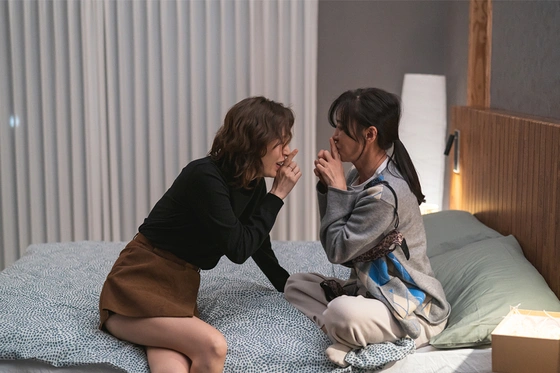
Homeward Bound (2025) Analysis: The Aesthetic of Cracks Created by Isolated Truths and the Desire for Solidarity
We are contradictory beings who long to be perfectly understood by others while simultaneously wishing to hide our deepest selves. In particular, the ‘well-intentioned deception’ practiced under the name of family often becomes the sole pillar supporting a relationship.
The film Homeward Bound tenaciously traces the process of characters, living on their own isolated islands behind a veneer of tranquility, encountering an unexpected storm and eventually reaching each other’s shorelines.
🌿 Moments When This Film Settles Deep Within
- When your throat tightens because you cannot divulge your suffering (illness) and your love (identity) even to those closest to you.
- When you feel the heavy atmosphere where a sense of duty to family stifles individual desire.
- When you feel the exhaustion of having to adjust your mask daily to maintain the social norm of ‘ordinarily.’
- By the end of this piece, we will discover the reasons why life can persist even after hidden truths are exposed.
🎞 Note Before Viewing
Rather than physical exposure or provocative depictions, this work is a drama focused on the taut psychological confrontation between characters and the emotional stakes. It is a densely packed, relationship-centered film dealing with deep bonds between women and power structures within the family.
🎬 Film Information
- Title: Homeward Bound (비밀일 수밖에, 2025)
- Director: KIM Dae-hwan
- Screenplay: KIM Dae-hwan
- Country: 🇰🇷 South Korea
- Genre: Drama, Mystery, Family
- Running Time: 114 minutes
- Platform: Theatrical Release
- Cast: JANG Young-nam, OK Ja-yeon
📖 Homeward Bound Synopsis: The Start of a Strange Coexistence That Cracks a Peaceful Daily Life [No Spoilers]
Jeong-ha, a high school art teacher in Chuncheon, lives a quiet life after being widowed. However, her peace is shattered by the unannounced return of her son, Jin-woo, from Canada with his fiancée Jenny, and the arrival of his future in-laws, who end up staying at Jeong-ha’s house due to a lodging issue.
Gathered in a cramped space, the two families constantly clash due to cultural differences and the authoritarianism of the patriarchal father-in-law, Mun-cheol. Amidst this uncomfortable coexistence, Jeong-ha desperately tries to hide her breast cancer and her long-term relationship with her partner, Ji-sun. As each person’s secrets reach a breaking point, the film begins to question the essence of family amidst suffocating tension.
🎨 Social Persona and the Private Self: A Portrait of Isolation Shown in Homeward Bound
The film Homeward Bound aesthetically captures the process of the solid fortress built by the character Jeong-ha being dismantled by outsiders. For Jeong-ha, Chuncheon is both a sanctuary and a massive prison. She functions as a respected teacher in the public space of the school and as a devoted mother at home, but she strictly excludes her physical pain (cancer) and her emotional support system (Ji-sun).
In this work, the motif of art visualizes Jeong-ha’s inner world. Like paint layered upon a canvas, she strives to maintain the form of a ‘normal family’ by layering lies over the truth. However, the forced intimacy with strangers neutralizes the defense mechanisms she has built, leading the audience to ask: “For whom do we keep these secrets?”
🗝 Subversion of Power and Expansion of Female Narrative: Interpreting the Relationship Between Ji-sun and Jeong-ha
The most noteworthy aspect of any review of Homeward Bound is the relationship between Jeong-ha and Ji-sun. The film directly confronts the social gaze that seeks to dismiss Ji-sun as a mere ‘friend’ and Jeong-ha’s own self-censorship. While patriarchal authority, represented by the father-in-law Mun-cheol, dominates the household, Ji-sun’s presence—silently guarding Jeong-ha’s side from outside that authority—is both alien and redemptive.
The relationship between the two provides an emotional density that traditional male-centered family narratives cannot offer. Ji-sun is the sole witness to Jeong-ha’s secrets and the being who fully accepts her ailing body. Their solidarity is built on an emotional foundation stronger than blood ties or legal contracts, serving as the only unwavering axis amidst the conflict structure that explodes in the latter half of the film.
🔎 A Place for Dignity Left Behind Scattered Truths
The film’s ending rejects the formula of a typical family drama where all misunderstandings are resolved through reconciliation. When Jeong-ha reveals her identity and illness, what returns is not total acceptance, but embarrassment and awkwardness. Her son, Jin-woo, leaves after telling Ji-sun to “take care of Mom,” but this is closer to a cowardly evasion or a reluctant acknowledgment than a full understanding.
Nevertheless, the greatness of this ending lies in the fact that Jeong-ha begins to face her own life independently of the gaze of others. The exposed secrets leave a permanent crack in the fair-weather community of the family, but through that crack, Jeong-ha’s ‘real life’ begins to breathe. Ultimately, Jeong-ha gains self-esteem not as a son’s mother, but as Ji-sun’s partner and an individual battling illness.
The ending of this film does not declare the stitching up of a relationship, but rather the dignity of the individual achieved by destroying a false peace.
💬 Interpretation of the Homeward Bound Ending and the Ambiguity of Female Representation
Q. Does the process of Jeong-ha’s secrets being revealed feel somewhat abrupt or unfriendly?
From a critical perspective, there may be points of dissatisfaction, suggesting the resolution of conflict is too open-ended and thus hollow. However, this appears to be an intentional choice in direction. The moments when truth is revealed in life usually do not follow a sophisticated narrative arc; instead, they tend to emerge crudely through ordinary conversation or accidental occurrences. The work focuses on representing the uncomfortable truth of reality itself rather than a polished conclusion.
Q. Is it not a limitation that the relationship between the two women is treated only as a ‘secret’?
This work is not a chronicle of a struggle where two women boldly stand against the world. Rather, it hyper-realistically depicts the social pressure that forces them to live in hiding and the tenderness that blossoms within that space. This suggests that ‘narratives of survival’ are just as important as ‘heroic narratives’ in female representation, prompting readers to reconsider the current status of minorities in Korean society.
✨ <Homeward Bound> A Transparent Morning Reached Only by Those Who Endured the Weight of Silence
This film demonstrates how firmly the system of family stands upon prejudice and how painful a task it is to dismantle that system. Jeong-ha’s confession proves how deeply personal values like love and identity are butchered before the violence of ‘normalcy.’ However, the gaze shared between Jeong-ha and Ji-sun amidst the ruins symbolizes a fundamental human solidarity that no secret can imprison.
A true relationship begins not in a state where there are no secrets, but in respecting the courage to share them.
💡 Are your secrets doing well?
Have you ever stayed in a space where your love for someone or your own pain had to remain a ‘secret’? Between silence to protect love and confession to protect yourself—which side are you standing on now?
🎬 Violet Screen’s Curation Recommendations
If you wish to delve deeper into similar emotional temperatures and intimate psychological depictions of women, I recommend these works:
- Moonlit Winter (윤희에게, 2019): Through a middle-aged woman’s journey to find her lost first love, you can experience another lyrical peak of middle-aged queer narratives similar to Homeward Bound. The snowy landscape of Otaru contrasts with Jeong-ha’s Chuncheon, leaving a deep resonance.
- The Dream Songs (너와 나, 2023): This film captures the subtle emotions, love, and sense of loss between two high school girls through fantastical direction. It is recommended for those who want to sensually experience the process of how secret emotions become the driving force of a relationship.
To provide a more stable publishing environment, multilingual content, and better communication with our readers, we have moved our official publication to Substack.
All new film reviews and critical essays will be published on our new platform. This website will be closing down soon, so we would greatly appreciate it if you subscribed to our new space.
TODAY'S QUESTION
If you could say one thing to someone today, what would it be?
Your answer isn't saved. Feel free to share it in the comments below.


You May Also Like

First Girl I Loved: Transparent Growth Left by Clumsy Desires and Relational Isolation

The Summer (2023) — The Thermal Gap of Seasons and the Radiant Cracks of First Love