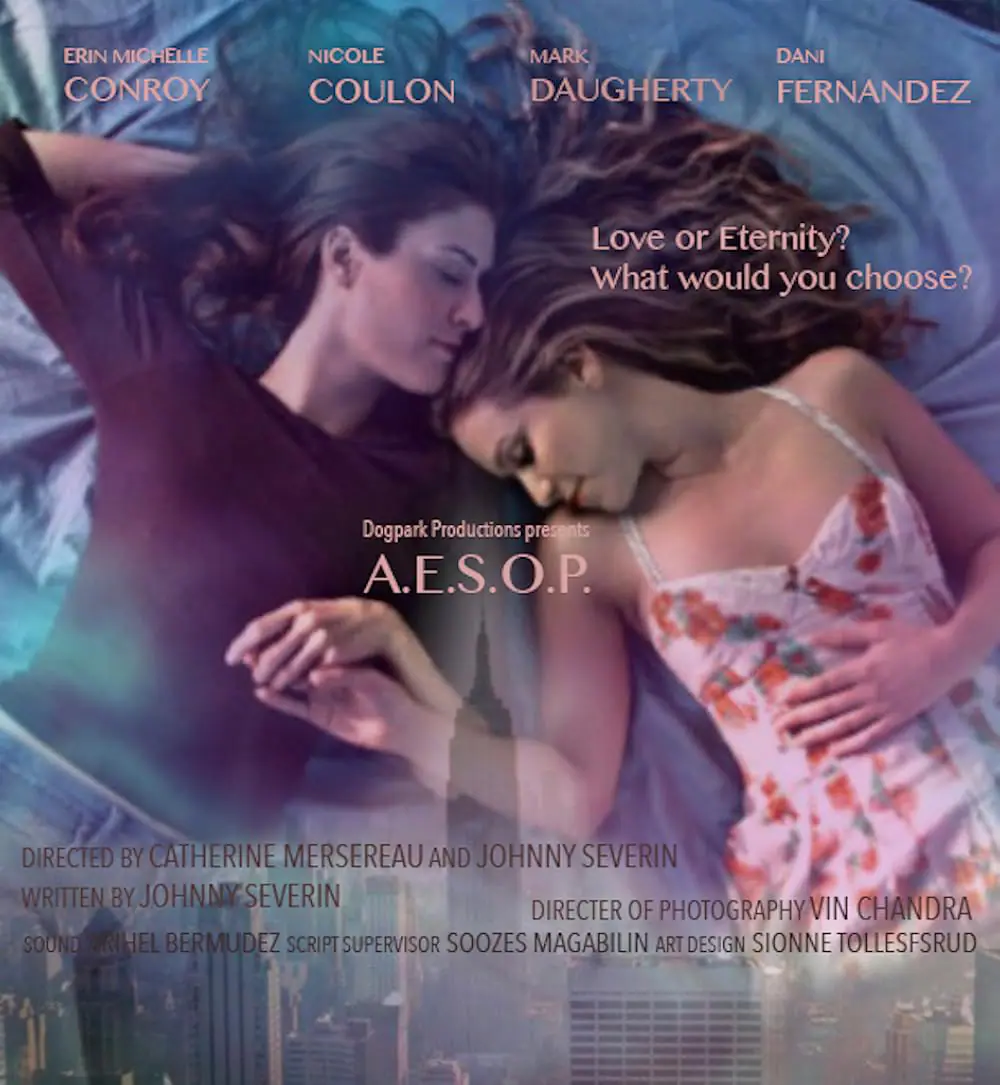
A.E.S.O.P.: Obsession Between Eternity and Finitude, Solidarity Blooming Amidst the Control of Immortality
The finitude of time is both a source of dread for humanity and the most powerful engine that sustains life. If everything could last forever, would the kisses we share today and the promises we make for tomorrow carry the same weight they do now?
Within a cold system that reduces the survival of others to mere numerical values, the moment we begin to listen to the beating of an individual’s heart, we finally stand at the crossroads of a “humane choice.” Set against a dystopian backdrop where technology encroaches upon the divine realm, this film tenaciously traces how love expands beyond individual selfishness into a form of social sublimity.
🌿 Moments When This Film Deeply Permeates
- When one who has lived as a mere cog in the system, castrating their own emotions, crumbles in the face of unexpected warmth.
- When confronting an agonizing moral fastidiousness between one’s own eternal happiness and the justified deaths of others.
- The instant one discovers a “momentary truth” more precious than “eternity” within the eyes of a loved one.
- Why you must read until the end: Because the conclusion of this work is not a simple sacrifice, but a demonstration of resistance in its most beautiful form—by creating a fissure in the system.
🎞 Note Before Viewing
This work is a psychological drama that utilizes a sci-fi setting to minutely depict the psyche of characters and the dynamics of their relationships. Rather than provocative imagery, the film focuses on the emotional tension between the two female protagonists and the heavy resonance of their ethical choices.
🎬 Movie Information
- Title: A.E.S.O.P. (2019)
- Director: Catherine Mersereau, Johnny Severin
- Screenplay: Catherine Mersereau
- Country: USA
- Genre: Romantic Sci-Fi Drama
- Running Time: 78 min
- Platform: Prime Video and other major VOD services
- Cast: Nicole Coulon (Marie), Erin Michelle Conroy (Ruth)
📖 A.E.S.O.P. Plot: Eternal Life for the Chosen 88% and the Discarded Truth [No Spoilers]
In a near future where anti-aging and immortality drugs are provided to only 88% of the global population, the mega-corporation A.E.S.O.P. wields absolute power in deciding who enjoys eternal life. The protagonist, Ruth, works as a statistician at the core of this system, living a mechanical life where she judges the eligibility for survival through data, completely excluding emotion.
During this time, Ruth meets the free-spirited and passionate Marie, and the rigid inner walls she built begin to waver. Despite corporate regulations prohibiting deep relationships with others, the two grow rapidly closer. However, the relationship spirals toward catastrophe when it is revealed that Marie is “ineligible for immortality” due to a past organ transplant history.
To save her beloved partner, Ruth attempts to accept a clandestine trade offer from the corporation, but in the process, she confronts a hideous truth—akin to ethnic cleansing—hidden by A.E.S.O.P. Faced with a massive tide consisting of personal eternal love and universal human justice, the choice of these two women flows in an unpredictable direction.
🔒 The Illusion of the Utopia Designed by A.E.S.O.P. and the Deconstruction of the Ending
The core of this film lies in the eugenic control hidden behind the sweet fruit of immortality. While the corporation claims to exclude 12% under the pretext of resource scarcity, the reality is that they seek to construct their own perfect world by removing “impurities” plagued by disease or the potential for crime.
What Ruth discovers behind the data is not a mere error, but a record of intentional massacre. Here, the weight of the ending stems from Ruth’s transformation. Having once worshipped “efficiency” while hiding behind a fortress of statistical figures, she witnesses the dignity of an individual human being—which the numbers had erased—through the concrete existence of Marie.
🧬 The Value of Noble Moral Finitude Over Technological Immortality
Marie serves as the moral compass of this work. Knowing she is destined to die, she refuses the immortality offered in exchange for overlooking the system’s corruption. This is an act of connecting love not just to “the well-being of myself and my partner,” but to the justice of the world upon which we stand.
The scene where Ruth finally takes Marie’s hand and decides to expose the system suggests that love can transcend private emotion to become the engine for public revolution. By choosing the spread of truth over the immortality drug, they opt for the immortality of memory rather than the immortality of the flesh.
🔎 Reinterpreting the Ending — Choosing the Immortal Exposure Over Eternal Silence
The landscape Ruth and Marie face at the end of the film may be one of physical ruin, but mentally, they reach a state of perfect union. This choice—kicking away the “immortality of a comfortable slave” offered by the corporation and accepting the “death of a truthful human”—demonstrates that the essence of love lies in testimony, not possession.
The data they expose becomes a fissure that shakes the very foundation of the system; it is a paradoxical victory that completes the meaning of life through death. Unjust silence maintained for the sake of individual well-being is the most cruel punishment, one that causes the soul to wither.
❓ Questions on the Interpretation of A.E.S.O.P.’s Ending and the Expansion of Female Narratives
Q1. Was the point where Ruth initially tried to accept A.E.S.O.P.’s offer a cowardly compromise?
From a critical perspective, Ruth’s early choice can be seen as an egoistic escape. However, this is a deeply realistic setting reflecting the most fundamental human fear: the dread of losing a loved one. By portraying Ruth not as a finished hero but as a wavering individual, the director maximizes the catharsis provided by her final awakening.
Q2. What is the metaphor behind Marie’s organ transplant setting?
Marie’s body symbolizes the providence of nature, which defies “perfect control.” The setting—where even a mechanical immortality drug cannot stop the aging of a transplanted organ—implies that technology can never fully replace the mystery of life and the aesthetics of finitude. This is read as a circuitous critique of a system that seeks to treat the human body as an object of control.
✨ A.E.S.O.P. Love is Not About Defeating Death, but Standing Proudly Before It
This film borrows the form of dystopian sci-fi to ask about the “authenticity of relationships.” To truly love someone does not only mean staying with them forever. Rather, it asserts that the courage to walk a path of thorns together to ensure the values shared with that person are not tarnished is a higher stage of love.
Transcending simple romance to handle the collision between power structures and ethics, this work evokes the values of minorities that modern society is abandoning for the sake of efficiency. True immortality is completed not by a heart that never stops, but by the contagion of a conviction that never breaks.
💬 The Choice Between Silence and Truth
If you had to turn a blind eye to the sacrifice of countless others to save the life of the person most precious to you, which path would you take?
If you were Marie, would you take Ruth’s hand and leave for a quiet paradise, or would you jump into the flames together?
🌐 Violet Screen Curation: Gazing into the Abyss of Relationships
- Blue Jean (2022): Deals with the conflict of ‘Jean,’ a teacher who had to hide her identity amidst the conservative social atmosphere of 1980s Britain. Like Ruth in A.E.S.O.P., it is a masterpiece that meticulously depicts the process of a character who conformed to the system facing her own truth through relationships with those around her.
- Drive-Away Dolls (2024): Recommended if you want to shift the mood and enjoy a more lighthearted and audacious journey of women. A road movie about two women caught up in an accidental incident, it is a charming work that humorously twists social taboos without losing sight of their solid solidarity.
To provide a more stable publishing environment, multilingual content, and better communication with our readers, we have moved our official publication to Substack.
All new film reviews and critical essays will be published on our new platform. This website will be closing down soon, so we would greatly appreciate it if you subscribed to our new space.
TODAY'S QUESTION
What genre or mood do you always reach for when you're alone?
Your answer isn't saved. Feel free to share it in the comments below.


You May Also Like
Gigola (2010): An In-Depth Interpretation of Female Narrative, A Solitary Walk Between Greed and Freedom

The Monkey’s Mask: An Erotic Noir of Destruction Written in the Poetics of Desire