Mine (2021): Beyond Jung Seo-hyun and Choi Su-ji’s Closed Doors, a Reinterpretation of Repressed Desire
Love is sometimes proven more by absence than by presence itself. The narrative of a woman who possessed everything yet could not possess ‘herself’ paints a picture of profound solitude against the backdrop of a glittering chaebol landscape.
The drama Mine does not merely settle for depicting the power struggles of a conglomerate family; it tenaciously tracks the innate human desires hidden behind social masks and how those desires are redeemed through solidarity with others. In particular, the relationship between Jung Seo-hyun and Choi Su-ji is the sharpest, yet most beautiful, fissure running through this play.
🌿 Moments When This Drama Deeply Permeates
- When you are living a ‘correct’ life as defined by the world, yet suddenly feel a hollow void in a corner of your heart.
- For those who have felt the most devastating loneliness at their most glamorous moments.
- For the adults who have let go of their true selves because they had too many things to protect.
- The reason to read to the end: Because it proves that the ‘Mine’ chosen by Jung Seo-hyun is not mere power, but a process of reclaiming the self that was once lost.
🎞 Note Before Watching
This work densely handles emotions that are taboo within the strict hierarchy and order of a chaebol family. Rather than physical exposure or provocative depictions, it possesses the character of a psychological drama that expresses the depth of relationships through sophisticated gaze processing and the use of negative space between characters.
🎬 Drama Information
- Title: Mine (2021)
- Director: Lee Na-jeong
- Screenwriter: Baek Mi-kyeong
- Country: South Korea
- Genre: Drama, Mystery
- Running Time: 16 Episodes (Approx. 70 mins per episode)
- Platforms: tvN, Netflix, TVING
- Cast: Lee Bo-young, Kim Seo-hyung, Ok Ja-yeon, Kim Jung-hwa
📖 Mine: Confronting the Past and Facing the Present That Breaks Jung Seo-hyun’s Rigid Walls [No Spoilers]
Jung Seo-hyun, the eldest daughter-in-law of the Hyowon Group, is a figure who maintains the order of the household with perfect rationality and elegance. Into her life, lived under strict emotional control, a crack begins to form one day when her past lover, Choi Su-ji, reappears as a painter. Having fulfilled the role-play of ‘Hyowon’s Mistress’ while erasing her sexual identity within the closed structure of a chaebol family, Seo-hyun faces the true desires she had long ignored through her reunion with Su-ji. Amidst the massive whirlwind of a murder case, Seo-hyun makes the decision to escape the prison of prejudice that has confined her for a lifetime while simultaneously protecting her family.
🖼️ Jung Seo-hyun and Choi Su-ji, a Portrait of Sad Desire Preserved Through the Medium of Art
In the drama Mine, art for Jung Seo-hyun is not a simple hobby but a record of loss. In her youth, the communion she shared with the painter Choi Su-ji was the only moment Seo-hyun could truly breathe, but the wall of reality—the chaebol world—placed a crown on her head instead of love. The reason Seo-hyun stopped painting was not because she lost Su-ji, but because she realized that in a world without Su-ji, art was merely an empty shell.
The reunion of the two is also treated with great importance in terms of mise-en-scène. Their meetings in narrow galleries or inside closed cars visually demonstrate that their relationship is still trapped in isolation from the social gaze. However, the act of Seo-hyun taking out Su-ji’s painting, which she had hidden in her study, is an expression of her will to no longer turn away from her suppressed essence.
🚪 Courage to Open Closed Doors: Interpretation of Social Masks and Identity
Jung Seo-hyun is a character who constantly closes doors until the middle of the series: her study door, the door to her heart, and even the secret room harboring mysteries. However, through solidarity with Seo Hi-soo and the advice of Mother Emma, she realizes that ‘my truth’ is more precious than ‘the world’s prejudice.’ In particular, the scene where Seo-hyun confesses to Su-ji, “It wasn’t that I loved painting; I loved the memories I shared with you,” marks the point where she declares love as a subjective human being, moving beyond objectified art.
Their narrative does not stop at merely consuming a queer trope; it deeply analyzes how the identity of a minority is suppressed and then liberated within the power structures held by the ruling class. By meeting Su-ji again, Seo-hyun is finally completed as a human being rather than a ‘decorative object’ of the Hyowon family.
🔎 Reinterpretation of the Ending — The Final Step Toward Complete Independence
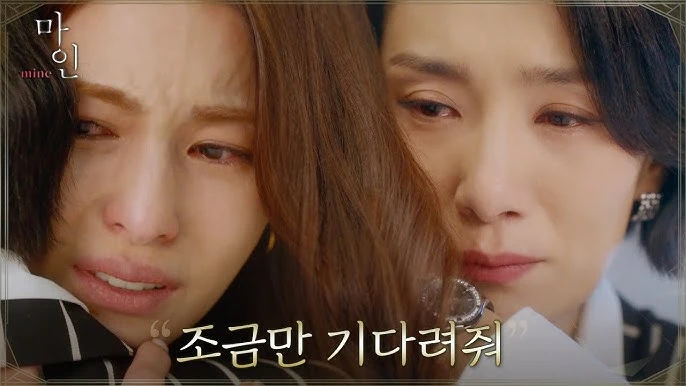
In the ending of Mine, Jung Seo-hyun ascends to the position of Chairperson of the Hyowon Group. In a typical drama, one might have chosen to throw everything away for love, but Seo-hyun does not give up either power or love. Her appearance as she sends Su-ji abroad, saying “Please wait just a little longer,” implies a strategic judgment: to protect her love, she must first become the master who governs this rigid fortress.
Seo-hyun’s life after the conclusion is no longer a life swayed by others. She becomes a subject who integrates two worlds, without separating her public responsibility as Chairperson from her private feelings for Su-ji. Su-ji’s departure is not a permanent farewell, but a consideration that gives Seo-hyun time to establish what is truly ‘hers.’ Jung Seo-hyun finally earns the right to love by breaking the chains of oppression and building her own kingdom.
❓ Inquiries Regarding the Ending of <Mine> and the Representation of Women’s Narratives
Q1. Is Jung Seo-hyun’s acceptance of the Chairperson position instead of following Su-ji immediately a renunciation of true love?
From the perspective of a conventional melodrama, but it is different in the context of this work. For Seo-hyun, becoming the Chairperson of Hyowon Group is a declaration that she will stand at the apex of the system that oppressed her and change its rules herself. While some might view this as a ‘capitalist compromise’ from a critical perspective, it is more valid to interpret it as an aesthetic choice reflecting a social structure where it is difficult to protect a minority’s love without realistic power.
Q2. What are your thoughts on the criticism that Choi Su-ji was consumed only as a ‘tool’ for Seo-hyun’s awakening?
Admittedly, Su-ji’s screen time is significantly less than Seo-hyun’s, and the focus is weighted toward her role in stimulating Seo-hyun’s emotions rather than her own personal narrative. However, Su-ji symbolizes the ‘artistic soul’ that Seo-hyun had lost. Her appearance serves as a mirror reflecting Seo-hyun’s inner self, and her choice to leave at the end can be seen as an active exit that helps Seo-hyun reshape her life autonomously. While the judgment is up to the viewers, the weight of the relationship between the two leaves a resonance that far exceeds their screen time.
✨ Mine: The True ‘Self’ Possessed Only by Those Who Have Opened All the Doors
This drama begins with a question asking what is ‘mine’ and concludes with the answer of becoming ‘myself.’ The narrative of Jung Seo-hyun and Choi Su-ji asks us: Will you die comfortably within a fortress built by others, or will you head out into the rough wilderness and call out your true name? True independence is a territory of the soul that is completed only when one becomes perfectly free from the gaze of others.
🗝️ The Strength to Endure Absence Ultimately Comes from the Belief That We Will Meet Again
Has there been a moment when you had to choose a temporary farewell to protect what was most precious to you? Please pause for a moment and reflect on whether what you were trying to protect was the expectations of others or your own true heart.
🌌 Violet Screen Curation: In Search of Another Aesthetic of Relationships
- Drama <Kill Heel> (2022): A desperate battle of desires among three women in the jungle of home shopping. You can feel a sharper power dynamic and more complex, subtle tensions between women than in Mine.
- Film <Moonlit Winter> (2019): If you appreciated the emotional lines of Seo-hyun and Su-ji, this is a must-watch. Through the journey of seeking a long-buried letter from a first love, it delves quietly and deeply into the essence of identity and longing.
To provide a more stable publishing environment, multilingual content, and better communication with our readers, we have moved our official publication to Substack.
All new film reviews and critical essays will be published on our new platform. This website will be closing down soon, so we would greatly appreciate it if you subscribed to our new space.
TODAY'S QUESTION
What's the most memorable new release you watched this year?
Your answer isn't saved. Feel free to share it in the comments below.


You May Also Like
Verbotene Liebe: The Aesthetics of Identity and Tragedy in the Narrative of Carla and Hanna

Frozen Valentine: First Love, and the Totality of Relations Proven by a GL Drama