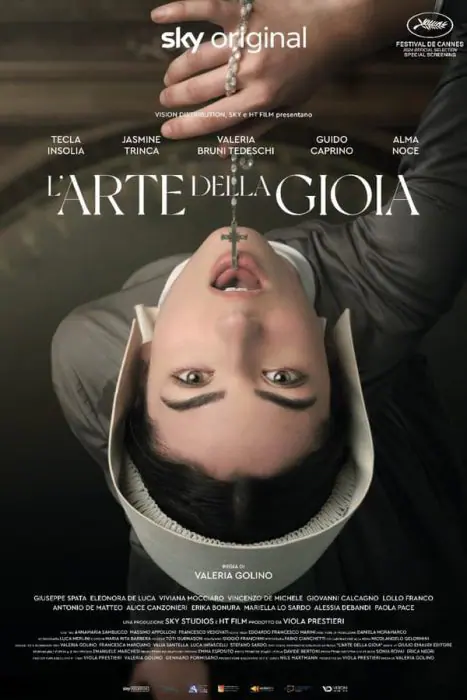
The Art of Joy: Liberation in the Name of Desire, An Artistic Narrative of Seizing Joy
From the moment of birth, human beings are cast into a predetermined yoke of destiny. Within that yoke—which becomes a warm cradle for some and a suffocating prison for others—we must choose: will we conform and vanish, or will we break taboos and become the masters of our own ‘joy’?
Aired in 2024, The Art of Joy (L’arte della gioia) boldly depicts the life of a woman born into the lowest depths who eventually grasps the highest rungs of power in early 20th-century Sicily. This is more than a mere record of social climbing; it is a desperate and beautiful declaration of independence from an individual who prioritized her own desires over conventional morality.
🌿 Moments When This Drama Deeply Permeates
- When you feel a profound weariness toward the world’s prescribed frame of the ‘virtuous victim.’
- When you wish to trace the trajectory of explosive energy generated by the fusion of intellect and desire.
- When you want to indulge in the intimate narratives between women flourishing within the closed spaces of convents and aristocratic estates.
- The reason to read to the end is to move beyond moral judgment and share in the chilling sense of liberation brought by the price a woman pays to protect her ‘joy’ and the resulting conclusion.
🎞 Note Before Watching
This work describes a woman’s body, her desires, and her struggle for power in a highly realistic and bold manner. While the level of explicit content may be high in certain scenes, these serve not as obscenity, but as essential devices symbolizing the protagonist’s subjective awakening and resistance against social taboos.
🎬 Drama Information
- Title: The Art of Joy (L’arte della gioia, 2024)
- Director: Valeria Golino, Nicolangelo Gelormini
- Screenplay: Valeria Golino, Francesca Marciano, Valia Santella, et al.
- Original Work: The novel L’arte della gioia by Goliarda Sapienza
- Country: Italy, United Kingdom
- Genre: Drama, Historical, Female-centric Narrative
- Running Time: 6 episodes (approx. 50 minutes each)
- Platform: SkyShowtime, Apple TV
- Cast: Tecla Insolia (as Modesta), Jasmine Trinca (as Leonora), Alma Noce (as Beatrice), Giovanni Alfieri (as Ippolito)
📖 The Art of Joy: The Craft of Joy Written as a Chronicle of Desire [No Spoilers]
On January 1, 1900, alongside the dawn of a new century, Modesta is born into a destitute peasant family in Sicily. After losing her entire family to a violent domestic environment and a tragic accident, she reaches a turning point when she is sent to a convent. There, Modesta discovers the power of knowledge through the Abbess Leonora and establishes a unique set of values—rejecting the harsh fate dealt to her and prioritizing her own happiness above all else.
Later, upon entering the prestigious Brandiforti estate, she refuses to remain a mere maid. Utilizing her innate intelligence and cold powers of observation, she begins to seize the actual power of the household. Amidst the ugly secrets hidden behind aristocratic dignity and the oppression of patriarchy, Modesta ascends to the pinnacle of power, using both men and women like pieces on her chessboard. Her evolving relationships with Leonora and Beatrice during this journey serve as both the fiercest engine of her life and the symbols of the old world she must dismantle.
🌹 Modesta’s Audacious Provocation: A Predator Hacking the Patriarchal System
Modesta, the protagonist of The Art of Joy, flatly rejects the image of the ‘passive victim’ we often see. She does not stop at destroying the systems that oppress her; she masters their rules perfectly and demonstrates the qualities of a strategist who takes control from within.
To her, ‘Joy’ (Gioia) is not an emotion granted by others, but a state of power where one can completely control one’s own life. Her survival instinct, forged in the trauma of poverty and sexual violence, dismisses moral fastidiousness as a luxury. The murder and deception she commits are not acts of pure malice, but rather an essential evolutionary process to become the sole predator in a jungle full of them.
🔗 Leonora and Beatrice: The Oppressed Mirror and the Liberated Alter Ego
In Modesta’s narrative, her relationships with women have an absolute influence on her self-formation. First, the Abbess Leonora is both a mentor who hands Modesta the weapon of knowledge and a tragic portrait of a woman castrated of her own desires within the framework of religion. While Modesta admires Leonora, she clearly recognizes her limitations and eventually breaks free from the constraints of the past by usurping Leonora’s position.
Conversely, her relationship with Leonora’s daughter, Beatrice, manifests as the purest form of attachment in Modesta’s life. Cloistered in the estate due to a physical disability, Beatrice is the only person upon whom Modesta projects her own vulnerability. Their relationship transcends mere Sapphic desire to become the only sanctuary where they can prove each other’s existence within an oppressive patriarchal family. Modesta displays a certain ruthlessness by marrying Beatrice’s brother for power, yet simultaneously seeks to protect Beatrice entirely within her own world.
🔎 Reinterpreting the Ending: ‘Perfect Union’ Remaining After Burning All Deficiencies
In the latter half of the drama, following the death of Princess Gaia, Modesta—now in full control of the family’s power—stops Beatrice, who tries to leave out of fear. Here, Modesta’s confession is not a mere outpouring of romantic sentiment. It is a sovereign’s declaration of her intent to merge the person she loves into the empire she has built.
Ultimately, the two leave for a new city, Catania, with a child. This ending signifies the dissolution and reconstruction of the traditional family, hinting at the birth of a new community based on ‘choice’ and ‘will’ rather than bloodline and norms. By disguising the child she had with the estate manager, Carmine, as her husband’s, Modesta secures the family’s legitimacy. She has brought social stigma and moral condemnation under her sphere of control; now, a vast ‘territory of joy’ lies before her, free from any interference.
Modesta’s life is not an object for moral judgment, but a record of the most extreme victory achievable by a human being who has seized the right to self-determination.
🗳️ Interpretation of Ethical Ambiguity and Female Representation in The Art of Joy
Q: How do you view the criticism that Modesta’s actions are excessively unethical and glamorize crime?
A: Modesta’s acts of murder and exploitation for the sake of her ambition certainly deviate from universal ethical standards. However, the value of this work does not lie in distinguishing ‘right from wrong.’ Considering how violent the oppressive mechanisms of sexual purity, motherhood, and obedience imposed on women in the early 20th century were, Modesta’s lack of ethics reads as the only survival grammar available to counter that system. While the points of criticism are clear, the author achieves an aesthetic feat by breaking the mold of conventional female narratives and representing a woman with ‘relentlessly human desires.’
Q: Wasn’t the relationship with Beatrice ultimately used for Modesta’s lust for power?
A: While the relationship had a utilitarian character in terms of accessing power early on, as the drama progresses, Beatrice becomes the only person with whom Modesta shares the ‘truth.’ Modesta deceives everyone else, but to Beatrice, she reveals both her ambition and her love simultaneously. This suggests that power and love are not separate; rather, it highlights a point of realistic solidarity in Modesta’s style—where one can truly protect the beloved only when one holds power.
✨ The Art of Joy: An Aria of Joy Tearing Through the Taboos of the Era
This drama pierces through the class divides and gender barriers hidden behind Sicily’s beautiful landscapes through the physical body of a woman named Modesta. Her journey poses a crucial question to those of us living in modern society: “Are you ready to step out of the prison of others’ perceptions and struggle entirely for your own joy?”
The Art of Joy is not just a period piece. It is a provocation toward all those living without a sense of self and a chilling encouragement that one must sometimes become a destroyer to sublimate one’s life into art. True liberation does not begin with the mercy of the system, but with the courage to face one’s own desires head-on.
💭 The Weight of Relationships and the Boundaries of Possession
Have you ever experienced trying to possess or control someone in order to love them fully? Or do you believe that true love lies in allowing the other person their freedom?
Would you, like Modesta, willingly take on the role of the villain to protect the one you love, or would you remain a bystander to love to maintain your moral innocence?
💜 Violet Screen’s Curated Recommendations
If you were captivated by Modesta’s intense survival and the visceral bonds between women, add these two works to your list:
- The Lines (La Ligne, 2022): A work that chillingly digs into the violent love-hate between a mother and daughter and the power structures inherent in relationships between women.
- My Brilliant Friend (L’amica geniale, 2018–): An epic saga set in Italy covering the lifelong friendship, jealousy, and growth of two women. Modesta’s intellectual longing and will to survive find a different variation within the relationship between Lila and Lenu.
To provide a more stable publishing environment, multilingual content, and better communication with our readers, we have moved our official publication to Substack.
All new film reviews and critical essays will be published on our new platform. This website will be closing down soon, so we would greatly appreciate it if you subscribed to our new space.
TODAY'S QUESTION
What's your favorite line from a WLW movie or show?
Your answer isn't saved. Feel free to share it in the comments below.


You May Also Like

Harmony Secret, a Business Romance of Desire and Redemption—The Aesthetics of Exclusive Relationships in Female Narratives

Analysis and Review: A Tender Record of ‘Isolation’ and ‘Solidarity’ Retreived from the Sea of Loss