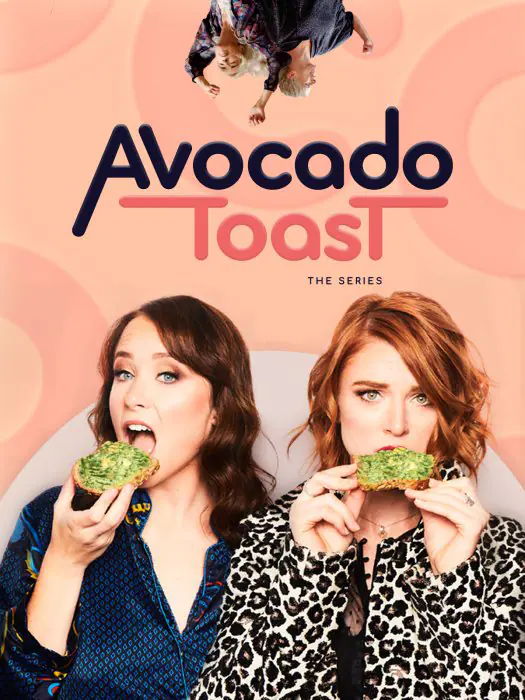
Avocado Toast the series: Recommended Queer Drama, a Recipe for Growth Crafted from Secrets and Isolation
We often live under the illusion that we know exactly who we are and who the parents who raised us are. However, the truths we encounter at certain corners of life sometimes shake our peaceful daily lives to their very foundations. At the moment the world one has built collapses, one finally faces oneself, rather than others. In that ambiguous period of the 30s—a time when one is still too clumsy to be called an adult, yet knows too much to be considered a child—what color does “the real me” take on?
The Canadian web series Avocado Toast the series depicts this unsettling yet brilliant process of self-discovery with a blend of cynical humor and a warm perspective.
🌿 Moments when this web drama resonates deeply:
- When you feel like everyone else in the world is moving ahead at their own pace, except for you.
- When the closest community, the family, feels like a group of strangers, creating a sense of alienation.
- When you want to find the “me” defined by yourself, not by someone else.
- When you want to understand the consolation provided by imperfect relationships and the weight of a “friendship breakup.”
🎞 Note Before Watching
This work candidly discusses adult sexual discourse and sensitive topics such as open marriage, abortion, and sexual identity. It is an “interpersonal-oriented” narrative that focuses on the psychological changes of characters and the dynamics of relationships rather than provocative depictions.
🎬 Drama Information
- Title: Avocado Toast the series (2020–2022)
- Director: Sam Coyle
- Screenplay: Heidi Lynch, Perrie Voss
- Country: Canada
- Genre: Intergenerational sex comedy-drama
- Running Time: 10 episodes per season (approx. 15 minutes per episode)
- Platforms: OutTV, Prime Video, etc.
- Cast: Heidi Lynch (as Molly), Perrie Voss (as Elle), Mag Ruffman (as Patricia), Brenda Bazinet, Alexander Nunez
📖 Adolescence in the 30s and the Reconstruction of Identity [No Spoilers]
Molly, having returned to Toronto after teaching in the UK, stands at a major turning point in her life. Having lived as a heterosexual her entire life, she realizes she is bisexual through her love for a woman she met in England, “The One.” However, the pain of the breakup and an unexpected outing throw her daily life into chaos.
Simultaneously, her best friend Elle also faces a crisis. A free spirit, Elle is shocked to learn that her mother, Patricia, has declared a divorce and started dating a younger man. To make matters worse, Elle herself finds herself at a crossroads, facing an unexpected pregnancy and the heavy choice of abortion.
As the hidden sexual lives of the parental generation (swingers, open marriage) collide with the new sexual identity of the younger generation, the two face a situation where they must redefine both their traditional views on family and their friendship. Where will this “adult adolescence” that arrives in their 30s lead them?
🥑 The Flipped Mirror: When Parental “Freedom” Meets Filial “Confusion”
The most intriguing aspect of Avocado Toast is its subversion of the common cliché of “conservative parents and progressive children.” Molly intends to confess her queer identity, but instead, she is horrified to face the reality of her parents, who have maintained an open marriage for over 40 years and have lived lives far more sexually liberated than her own.
The reversal of power structures occurring here is truly peculiar. The child expects moral rigidity from the parents, but the parents are expressing desires more freely than the child. Through this, the work argues that aging does not equate to sexual regression or becoming conservative.
The disgust and confusion Molly feels are not merely a rejection of her parents’ sexual lives. It is closer to an existential dread stemming from the collapse of the solid myth of “family” she believed in. The director wraps this in the guise of comedy, asking if we are ready to accept the full truth of others—even if they are our parents.
🌪️ Bonding in the Name of Friendship and the Interpretation of Its Cracks
The core thread running through Seasons 1 and 2 is the evolution of the relationship between Molly and Elle. While they share each other’s darkest secrets, the weight of their respective lives—Molly’s diagnosis of endometriosis and Elle’s nervous breakdown and escape into a cult-like wellness group—gradually creates an unbridgeable gap between them.
In particular, the “friendship breakup” explored in Season 2 is depicted as harrowing as any romantic breakup. While it is easy to dismiss female friendship as unconditional solidarity, this work shows that friendships can also reach a catastrophe when growth stagnates or when there is no capacity to tend to each other’s wounds.
The process of recognizing a relationship that has become toxic and temporarily distancing oneself is portrayed not as a betrayal, but as a final means of preserving individual dignity. This is a psychological depiction that accurately pierces through the “relational fatigue” experienced by women in modern society.
🔎 Reinterpretation of the Ending — Independent Subjectivity Blooming at the End of Eternal Fissures
The finale of Avocado Toast does not opt for the cliché of the two protagonists holding hands again for a perfect happy ending. At the end of Season 2, when they reunite at a friend’s wedding, an awkward atmosphere and past wounds still float between them.
The structural meaning of this ending is clear. Molly and Elle have moved past the stage of defining themselves through each other and have learned to stand entirely on their own. Molly begins to accept her physical pain (illness) and sexual identity without seeking approval from family or friends, while Elle breaks away from the “boss vibe” that was desperate for external validation and learns to admit her weakness.
Ultimately, the cracks in their relationship become a passage for a new form of growth rather than destruction. Their relationship may not have the same sticky synchronization as before, but it secures a mature distance that acknowledges each other’s differences. Growth is not the ability to combine with others, but the process of cultivating the strength to exist without them.
❓ Avocado Toast: Interpretation of Queer Narrative and Female Representation
Q: What is your take on the criticism that the “open marriage” setting of the parents’ generation dilutes the queer child’s narrative?
A: Some express concern that the parents’ unconventional sexual lives are highlighted more than Molly’s coming out. However, this appears to be an intentional direction. Instead of confining the queer narrative within the frame of a “special and difficult confession,” it expands it to a perspective of universal equality: “all human beings possess their own secret desires and identities.” The parents’ narrative serves as a mirror that allows Molly to accept her bisexuality not as something “unusual,” but as “one of many forms of life.”
Q: Some suggest the wellness retreat (cult group) episode in Season 2 was somewhat exaggerated. What is its aesthetic context?
A: The “Eaden” community that Elle falls into satirizes the capitalist healing industry that preys on the extreme anxiety and “grindset” (god-saeng) obsession of modern women. This is a device to show how deep Elle’s internal emptiness truly was. This setting, which might seem unrealistic, vividly demonstrates how easily humans lean on false solidarity when they are most vulnerable, paradoxically highlighting the preciousness of true friendship.
✨ Avocado Toast: The Period at the End of the Journey to Find Myself in 30s Adolescence
Like its title, “Avocado Toast,” this work looks sophisticated but contains the fragile and sometimes bitter taste of reality. The direction, which intersects the identity confusion of the millennial generation with the desires of the parental generation, reminds us of what an arrogant illusion it was to think we understood another human being.
Through the repetition of numerous misunderstandings and reconciliations carried out under the names of love, friendship, and family, we gradually become stronger. Avocado Toast binds all those noisy processes under the single word “growth,” offering a kind cynicism to everyone who is currently lost.
The discovery of the true self is the act of tearing down the moral walls built by others and learning to dance alone upon the ruins.
🗳️ Between Silence and Revelation, What Is Your Choice?
Is “silence”—hiding your true self in the closest relationships like family or lovers—better, or is “revelation”—exposing the whole truth even at the risk of the relationship’s collapse—the better path?
Would you keep a secret until the end to protect someone you love, or would you choose the destruction of that relationship to stand as your authentic self?
📽️ Violet Screen Recommendation: Other Female Narratives with Similar Tones
- The Bisexual (2018): A masterpiece that uses black comedy to explore the psychology of a woman experiencing confusion after realizing her sexual identity late in life. It shows a growth trajectory similar to Molly’s in Avocado Toast.
- Feel Good (2020–2021): A work containing the autobiographical story of comedian Mae Martin, delicately exploring addiction, recovery, and the complex nature of queer romance.
To provide a more stable publishing environment, multilingual content, and better communication with our readers, we have moved our official publication to Substack.
All new film reviews and critical essays will be published on our new platform. This website will be closing down soon, so we would greatly appreciate it if you subscribed to our new space.
TODAY'S QUESTION
Which character has comforted you lately?
Your answer isn't saved. Feel free to share it in the comments below.


You May Also Like

Depois da Meia Noite — When Coincidence Becomes Fate: An Interpretation of Love Filling the ‘Void’

40 Love (2014): An Interpretation of Fateful ‘Love’ Engineered by Chance on the Tennis Court