Black Mirror: San Junipero Interpretation—The Desire of Two Women Who Chose an Eternal Paradise Beyond Death
At the edge of an isolated reality, what is the most earnest fantasy we wish to encounter? Every human fears loss and yearns for the brilliance of bygone times.
Perhaps the most cruel yet beautiful gift technology can bestow upon us is an ‘eternal reprieve’ that restores a deficient past into a perfect present.
The virtual world known as ‘San Junipero’ is not a mere place of escape. It is a record of a desperate longing to break free from the physical and social constraints that have suppressed one’s life, finally connecting with another as one’s true, whole self.
🌿 Moments When This Drama Truly Sinks In
- On nights when you are exhausted by the pace of the world and desperately need your own sanctuary.
- When past choices remain as regrets and you wish to turn back time.
- When you want to believe in the possibility of mental solidarity and love that transcends physical limitations.
- When you support a salvation created by individual will rather than a destiny designed by a system.
- Why you should read this to the end: To prove why the ending of San Junipero is a victory that directly confronts human existential dread, going far beyond a simple happy ending.
🎞 Note Before Viewing
While this episode carries a rare hopeful sentiment within the Black Mirror series, it poses heavy ethical questions regarding death and the afterlife. It deeply explores human dignity and choice through the relationship between two women.
🎬 Show Information
- Title: San Junipero (Black Mirror Season 3, Episode 4, 2016)
- Director: Owen Harris
- Writer: Charlie Brooker
- Country: United Kingdom / United States
- Genre: Sci-Fi, Drama, Romance
- Running Time: 61 min
- Platform: Netflix
- Cast: Gugu Mbatha-Raw, Mackenzie Davis
📖 San Junipero: A Crossroads of Two Souls Meeting Across the Barrier of Time [No Spoilers]
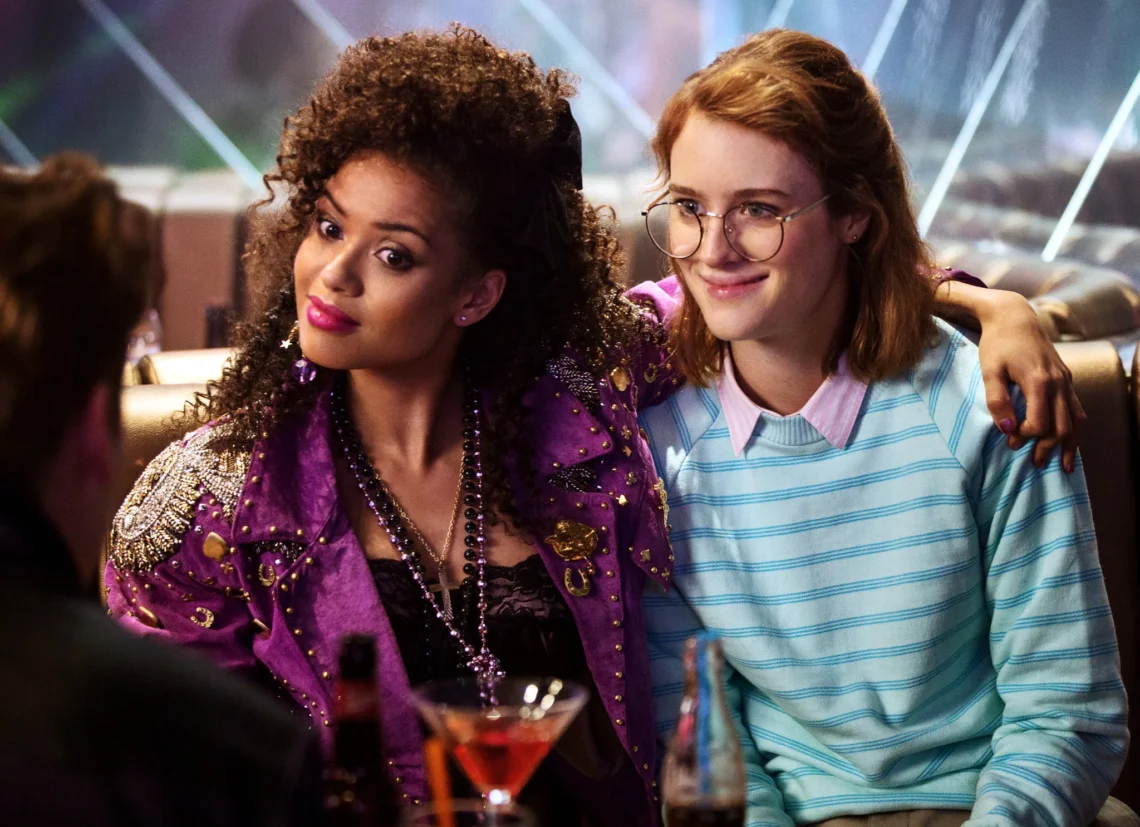
In 1987, the seaside town of ‘San Junipero’ glitters with neon signs and pop music. Yorkie (Gugu Mbatha-Raw), shy and introverted, meets Kelly (Mackenzie Davis), who radiates free-spirited energy in a boisterous club.
Despite their contrasting personalities, the two are instantly drawn to each other, sharing a brief but intense connection. However, this city holds a secret. At midnight, everything vanishes, and people must return to their physical bodies in reality.
In this fantastic space permitted for only five hours a week, Yorkie begins a desperate journey across time and space to find Kelly again. For these two, each carrying immense tragedy and physical limitations in the real world, San Junipero becomes the only exit and a final crossroads of choice.
The conflict faced by those at the end of their lives is clear: Will they perish in a reality containing painful truths, or exist in eternal love within a fabricated paradise?
🔒 The Subversive Function and Interpretation of Virtual Reality Liberating the Oppressed Body
San Junipero functions as a space of liberation that neutralizes social oppression, going beyond how technology supplements human deficiency. In reality, Yorkie is a quadriplegic patient who has spent 40 years in bed due to an accident, an individual who had to hide her identity under a conservative family.
Conversely, the Yorkie within San Junipero runs, dances, and confesses her love freely. What must be noted here is the psychological structure of their relationship. Kelly exhibits a defense mechanism of pursuing only fleeting relationships to forget the pain of loss, while Yorkie fights to protect the freedom she has encountered for the first time in her life.
The core of this drama’s interpretation lies in the question: ‘Can a self uploaded as data be viewed as a real human?’ The system reduces them to a combination of 0s and 1s, yet the intensity of the emotions they share is more vivid than in physical reality. This paradoxically suggests that technology does not destroy humanity, but rather serves as a tool to complete the true self that could not manifest due to an imperfect body.
💾 Eternal Life Within the System: An Existential Review of Radiant Isolation
The mise-en-scène within the work stimulates nostalgia by perfectly recreating the trends and culture of specific years. This is not merely a device for visual pleasure. The background of each era represents the ‘psychological prime’ when the characters wished to shine most brilliantly.
In particular, the logic Kelly presents while refusing ‘Permanent Upload’ represents traditional values—that human finitude makes life precious. However, the moment she chooses union with Yorkie, these values are subverted by the greater value of ‘solidarity.’
In the flow of the plot, the peak of the conflict is Kelly’s sense of guilt toward her late husband and daughter. Yet, the work chooses to rescue the suffering other currently before one’s eyes instead of remaining buried in past sorrow. This does not mask the inevitable fear of death with technical optimism; rather, it provides a humanistic insight that even the cold metal interior of a server room can become heaven if one is with a loved one.
🔎 Reinterpreting the Ending: Eternal Union Achieved in a Sea of 0s and 1s
The ending of San Junipero concludes by showing countless blinking LED chips in a massive server center. This scene simultaneously contains extreme nihilism and dazzling romanticism. A cold mechanical device storing tens of thousands of souls could be a gruesome sight, but for Yorkie and Kelly, it is a symbol of ‘eternal freedom’ finally attained.
Instead of perishing through death, the two reach the realm of the divine that humans have craved for millennia by choosing eternal life through data. This ending removes all physical obstacles and the weathering of time from their relationship, leaving only the union of pure consciousness.
Ultimately, they are not subordinates to the system, but victors who used the system to construct their own universe. They prove that life is not beautiful because it is finite, but rather that it gains meaning regardless of its length when shared with a loved one. The digitalization of the self is not the loss of humanity, but an evolutionary choice to perpetuate love.
❓ San Junipero Interpretation: Does an Eternal Paradise Truly Make Humans Happy?
Q1. What are your thoughts on the view that the ending of San Junipero is ultimately a tragedy of becoming slaves trapped in a corporation’s server?
First, the critical view that technology can control and commodify human consciousness is entirely valid. As other episodes of Black Mirror have shown, technology can become a prison at any time. However, in this episode, the creators intentionally endowed their choice with ‘volition.’ Kelly and Yorkie chose each other, leaving behind the pain and vanity of reality after sufficient deliberation. While the critique focuses on structural limitations, in a mid-aesthetic context, this work places more weight on ‘individual will’ and the ‘salvaging power of love’ that transcends those limits.
Q2. Does replacing the afterlife with technology undermine religious or ethical dignity?
From a traditional perspective, this may be considered profane as it separates the dissolution of the body from the rest of the soul. However, this work rewrites the definition of ‘dignity.’ It demands a paradigm shift: that a life in a virtual world where one dances and loves by one’s own will can be more dignified than 40 years in a vegetative state without the ability to express any intent. This touches upon the issue of life-sustaining treatment faced by modern medicine and poses an open question to readers about what constitutes true ‘quality of life.’
✨ San Junipero: The Most Fervent Solidarity Born at the End of Technological Coldness
San Junipero breaks the existing grammar of the series that warned of a dystopian future, showing how technology can soothe the most fundamental human loneliness. The essence of a relationship is not physical contact but a connection of the heart; if that connection can be sustained, the virtuality of the space is no longer important.
We are now able to imagine an era where death is defined not as an ‘end’ but as a ‘transition.’ This work contains the human destiny of desire and isolation within a new vessel called data, asking us: In your final moment, in which season and with whom would you like to remain?
Love is the only existential evidence that proves the self by transcending the constraints of time and space.
💬 What does your paradise look like?
If you were given a ticket to return to the happiest time of your past and live there forever, would you choose that ‘fabricated eternity’? Or would you follow the natural providence of extinction?
💜 Violet Screen Curation: Recommended Works Capturing the Texture of Delicate Solidarity
- Bad Girl (2016): A work that navigates between thriller and drama, unraveling the boundaries of precarious obsession and desire between two women with sensuous visual beauty.
- Saving Face (2004): A film that warmly and humorously depicts the love between two women struggling between traditional values and personal identity, leaving a pleasant afterglow.
To provide a more stable publishing environment, multilingual content, and better communication with our readers, we have moved our official publication to Substack.
All new film reviews and critical essays will be published on our new platform. This website will be closing down soon, so we would greatly appreciate it if you subscribed to our new space.
TODAY'S QUESTION
Is there a film whose ending you wish had gone differently?
Your answer isn't saved. Feel free to share it in the comments below.


You May Also Like

Just Another Love Story (2019) — A Nepali Web Drama on the Boundary of Friendship and Love

Pretty Little Liars: Emily Fields’ Transparent Desire and the Purple Growing Pains