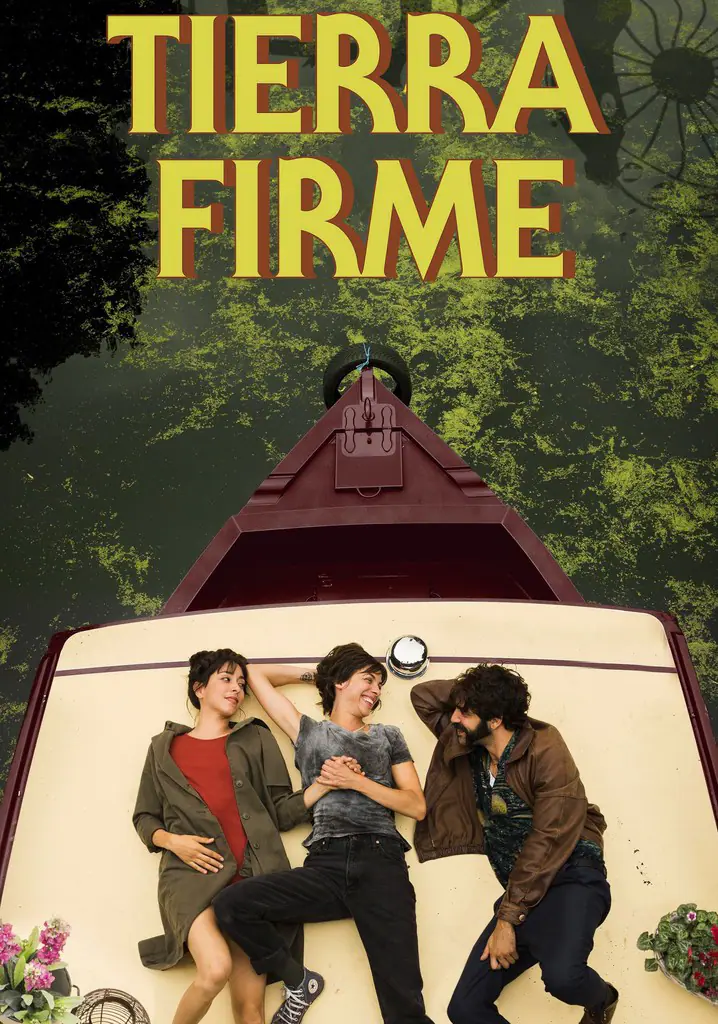
Tierra firme (2017) and Seeking a Path on the Edge of Non-Traditional Families
Love never stays in a fixed form. Like a small boat drifting on the waves, a relationship between two people always sails between lingering anxieties and the desires floating above them. When a couple, once absorbed solely in each other within an isolated space, faces the weight of the massive name ‘family,’ can their relationship maintain its former order?
Tierra firme (2017) deeply delves into the process of rupture and reconciliation that a seemingly perfect bohemian love experiences as it yearns for the solid ground of reality.
🌿 The Moments When This Film Sinks Deeply
- When two people, who believed they were free spirits, feel the differing weights before the social category of ‘parenthood.’
- The moment a conflict of identity arises from a place deeper than a lover’s bedroom.
- A time when the question ‘Can we live together?’ becomes more desperate than the words ‘I love you.’
- The reason you must read until the end: Because it analyzes the desperate yet beautiful struggle of those who attempt to dismantle the traditional definition of family and rebuild a solidarity of ‘us’ alone.
🎞 Notes Before Watching
This work is a Spanish-British co-production that maximizes the psychological pressure on its characters through the spatial claustrophobia of a narrow houseboat. Rather than physical intimacy, the film focuses on the emotional intensity during the process of conflicting values, serving as a drama that calmly yet tenaciously observes how the act of forming a family alters the dynamics of a relationship.
🎬 Film Information
- Title: Tierra firme (Anchor and Hope, 2017)
- Director: Carlos Marqués-Marcet
- Screenplay: Carlos Marqués-Marcet, Jules Nurrish
- Country: Spain, UK
- Genre: Drama, Romance
- Runtime: 112 minutes
- Platform: VOD (Streaming availability varies)
- Cast: Natalia Tena (Kat), Oona Chaplin (Eva), David Verdaguer (Roger)
📖 Tierra firme Plot and the Rupture of Relationships [No Spoilers]
Eva and Kat are a lesbian couple living a free-spirited life on a houseboat on a London canal. They love each other deeply, yet they lead a bohemian life that enjoys the present rather than having concrete plans for the future. However, triggered by the death of their pet cat, Eva is swept up by an intense maternal instinct to have her own child. Conversely, Kat, who does not want to abandon her current freedom, strongly refuses, convinced that having a child would mean the end of their relationship.
Amidst this tension, Kat’s old friend Roger visits from Barcelona, causing the situation to veer in an unpredictable direction. A joke about ‘sperm donation’ during a drinking session leads to an actual artificial insemination after the three reach an agreement, and Eva succeeds in becoming pregnant. However, the life that is the child forms invisible power structures and alienation between the three, and eventually, the long-hidden differences in their values explode, leading them to a catastrophe.
🌊 An Analysis of Traditional Family Narratives Breaking on a Boat
💡 The Love of Eva and Kat, an Analysis of the Clash Between Stability and Freedom
To Eva, a child signifies both a being that completes her inner self and an expansion of family, but to Kat, it is an external intrusion that destroys their romantic isolation. This film does not view the conflict between the two protagonists merely as a dispute between same-sex lovers, but expands it into a universal existential question of ‘how shall we live together?’ The relational rupture that occurs when the form of love does not align with individual desire serves as the key narrative device permeating the film.
⚓ A Review of the Third Party, Roger’s Entrance, and Changes in Power Structure
As Roger is introduced as the sperm donor, the space that was once exclusive to the two is instantly reorganized into a complex triangular configuration. As Roger attempts to acquire an identity as a father, Kat becomes alienated, and Eva experiences emotional exhaustion while playing the role of mediator between them. This observes closely how non-traditional family models face realistic difficulties and how biological bonds collide with emotional ones.
🌓 Deep Psychological Insight Thrown by the Incident of Miscarriage
The miscarriage that occurs during pregnancy acts as a decisive moment that ignites the masks of the three characters. The sense of loss signifies not just the absence of a child, but the collapse of the values each had been trying to uphold. At this point, where Eva’s maternal loss, Kat’s evasive relief, and Roger’s excluded sorrow intermingle, the director isolates the characters thoroughly and re-questions the essence of the relationship. This devastating catastrophe ultimately functions as a harsh rite of passage to rewrite the relationship.
🔎 Reinterpretation of the Ending
The process of the three gathering again at the end is not a return to the ‘normal family’ defined by society, but an experiment in a new, undefined form of solidarity. Eva’s recurring “I don’t know” is both the courage to acknowledge uncertainty and the will to sustain the relationship by reserving judgment.
Instead of enduring a life without each other, they move on to the next chapter of love by choosing a way to be together amidst imperfection.
💭 In-depth FAQ: Interpretation of the Ambiguous Ending of Tierra firme
Q: How should we interpret the criticism that this film’s ending is irresponsible or ambiguous?
A: While some viewers criticize this ending as an ‘ambiguous shrug,’ it is an intended directorial choice. Instead of providing the safe anchorage of traditional family norms, the director chose a restless reality where life continues on an endlessly rippling canal. That ambiguity is an aesthetic device showing the variability of modern family forms.
Q: Why does the emotional fatigue felt in non-traditional family narratives occur?
A: It is because the process in which characters fail to coordinate their respective desires (maternity, freedom, paternity) and fail to communicate is exposed completely. However, that fatigue is exactly what this film aims for. It emphasizes the importance of connection paradoxically through the pain brought by the lack of communication.
✨ Tierra firme, a Voyage of Love Made by Gathering Imperfect Fragments
Ultimately, Tierra firme proves that love is not a destination, but a voyage of constantly adjusting to understand one another. We often hope for love to become a ‘house’ of a completed form, but real life is closer to the act of constantly maintaining balance on a boat. The attitude of not letting go of each other’s hands even while answering “I don’t know” to unanswerable questions—that is perhaps the new form of relationship we should aim for in modern society.
🌊 What We Must Not Miss on the Ocean Called Relationship
Do you believe you are currently on the same boat as your loved one, or are you rowing toward separate islands? I suggest you ask yourself if you have ever brought out the true desires hidden in silence and questioned your lover.
🔍 Violet Screen Curation
- The Venus Effect (2025) Reason for recommendation: It unfolds the momentary flashes of falling in love and the realistic weight that follows through sensual cinematography. It is compelling to watch how two women expand and change their worlds through each other, rather than focusing simply on the ‘meeting.’ A work that shows a pinnacle of modern female narrative, leaving a deep lingering impression.
- A Year in London (2026) Reason for recommendation: Set against the backdrop of London, it deals with the intense and intimate bond between a fashion student from Italy and her mentor. It keenly captures the process of two figures, who come to rely on each other after a violent incident, walking a tightrope between ambition and emotion. It contains the painful contemplation of breaking down the boundaries of a relationship and naming it ‘love,’ making it a highly suitable film for analyzing the psychological transitions characters undergo within the heterogeneous spaces of Italy and the UK.
To provide a more stable publishing environment, multilingual content, and better communication with our readers, we have moved our official publication to Substack.
All new film reviews and critical essays will be published on our new platform. This website will be closing down soon, so we would greatly appreciate it if you subscribed to our new space.
TODAY'S QUESTION
What changed the most for you after coming out?
Your answer isn't saved. Feel free to share it in the comments below.


You May Also Like

Chloe (2009) Analysis and Ending: The Aesthetics of a Twisted Mirror Crafted by Desire

Season of Love (2019): Female Narratives in Holiday Romance