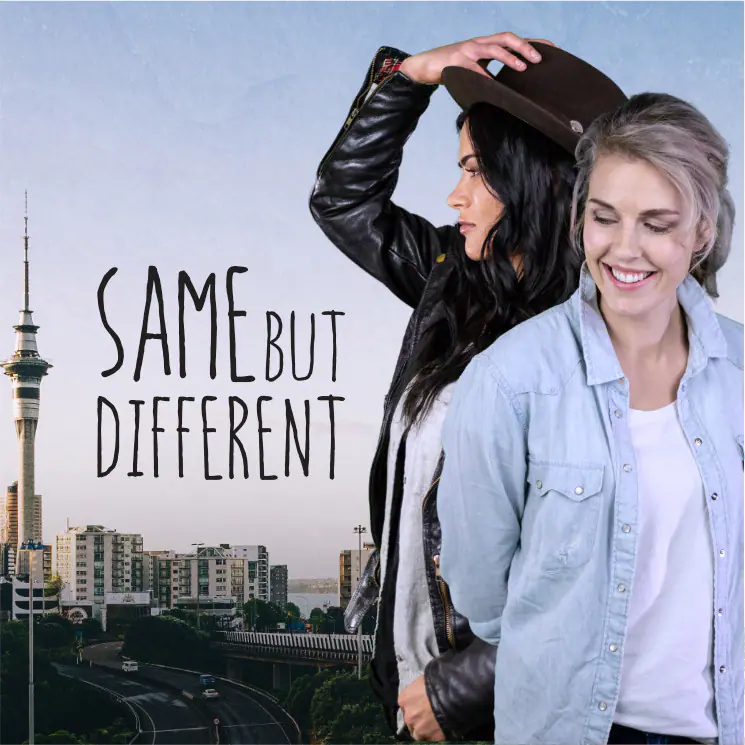
Same But Different (2019): Discovering Radical Hospitality and Love Beyond the Chaos of Identity
Love sometimes arrives without warning, instantly dismantling the order we have established in our lives. The journey of a woman who—living a perpetually disheveled life and defining herself as ‘lacking’—meets someone from an entirely different background and enters an orbit of love that is ‘different but the same,’ is a healing narrative in itself.
Beyond being a simple romantic comedy that crosses gender boundaries, this work depicts how hospitality toward another leads to an affirmation of the self, all set against the warm landscapes of New Zealand.
🌿 Moments When This Film Resonates Deeply
- To those who believed their identity was fixed, only to find themselves helplessly shaken by an unfamiliar flutter of the heart.
- To all single mothers who have lived lives of self-reproach, feeling clumsy and crushed by the obsession with ‘normalcy.’
- To those curious about how two beings with different cultures and languages can resonate within a single rhythm.
By the end of this text, we will confirm why ‘difference’ is not a hindrance to love, but rather its most powerful engine.
🎞 Notes Before Viewing
As this work is based on the real-life romance of an actual couple, natural physical contact and sexual tension are depicted as the relationship progresses. It is a warm and delightful romantic comedy that focuses on the process of overcoming cultural clashes and emotional bonding rather than provocative content.
🎬 Film Information
- Title: Same But Different: A True New Zealand Love Story (2019)
- Director: Nikki Si’ulepa
- Screenplay: Nikki Si’ulepa, Rachel Aneta Wills
- Country: New Zealand
- Genre: Romance, Comedy
- Running Time: 95 minutes
- Platforms: Netflix (varies by region), Apple TV+, and others
- Cast: Robyn Paterson, Hannah Martin, Michelle Hine, Frankie Adams
📖 Same But Different: The Aesthetics of Unfamiliar Attraction in a Clumsy Daily Life [No Spoilers]
Rachel, who lives a hectic life raising two children in Auckland, considers herself a ‘deficient being’ due to her dyslexia and her disorganized daily routine. One day, while attending a Maori film festival with her mother, she encounters Nikki, a confident and charming director.
Having never felt a romantic attraction toward a woman before, Rachel is bewildered by her feelings for Nikki, yet she soon decides to surrender to that irresistible pull. However, clumsy mistakes starting from the first date and the lingering shadows of past relationships stand between the two.
The process of these two women, who previously drew entirely different trajectories in life, identifying their ‘differences’ within the multicultural backdrop of New Zealand and translating those differences into the language of love unfolds humorously and sincerely.
🎨 The Reciprocal Compensation of Deficiency and the Interpretation of Relationships in 《Same But Different》
📍 Points of Collision Between Rachel’s Imperfection and Nikki’s Clarity
The core of this film lies in the social position and psychological anxiety held by the protagonist, Rachel. As a white single mother, she is constantly lost between childcare, making a living, and her own dreams. In contrast, Nikki is presented as a character with a clear sense of identity and professional achievement.
While this asymmetry of power and psychology creates a typical conflict structure for a romantic comedy, this work resolves it through the lens of ‘understanding’ rather than ‘conquest.’ Nikki does not attempt to correct Rachel’s clumsiness; instead, she waits for Rachel’s inherent rhythm. At this juncture, their relationship moves beyond simple romance toward a symbolic union that fills each other’s existential voids.
🌊 Mise-en-scène Imbued with New Zealand Landscapes and Cultural Identity
The elements of Maori and Samoan culture flowing throughout the work suggest that the union of the two protagonists is more than a mere meeting between individuals. The efforts of Rachel’s mother to find her Maori heritage and Nikki’s Samoan background form a common denominator: the ‘process of finding one’s roots.’
In particular, spatial backgrounds such as Waiheke Beach or the Marae show love expanding within vast nature, moving beyond confined interiors. This can be interpreted as a directorial intent to visually prove the vitality of a female narrative that refuses to be trapped by the walls of social prejudice, instead taking root proudly upon the earth.
🔎 Reinterpreting the Ending — The Grammar of Love Completed the Moment Difference is Affirmed
The film’s conclusion shows a happy ending for the two, but it carries a meaning beyond simple union. Throughout the film, Rachel does not hide the ‘dyslexia’ and ‘inadequacy’ that tormented her, revealing them fully to Nikki. Nikki, in turn, accepts Rachel’s confusion not as a misunderstanding, but as a process of growth.
The letters and conversations shared by the two at the end are closer to a declaration: not “we are the same,” but “because we are different, we can complete each other.” This demonstrates a mature attitude that accepts the fractures in a relationship as part of love itself, rather than struggling to mend them.
Love is not a process of erasing each other’s differences; it is an eternal voyage of filling the gaps of those differences with trust.
🧐 Narrative Devices and Questions of Realism in 《Same But Different》: Interpretive Issues of the Ending
Q1. Are Rachel’s ‘dyslexia’ and ‘clumsiness’ consumed merely as comedic devices?
From a critical perspective, Rachel’s mistakes might seem like typical romantic comedy slapstick. However, these are important devices expressing her psychological defense mechanisms. Through the process of her body and language malfunctioning when an uncontrollable emotion (love for Nikki) enters, the film vividly conveys the destructive power of ‘unfamiliar love.’ This is not mere humor, but an aesthetic choice that playfully transposes the pain of identity transformation.
Q2. What are the limitations and strengths of a narrative based on the stories of real people?
The balance between documentary reality and cinematic grammar is a challenge for all films based on true stories. While the resolution of conflict may sometimes give the impression of being too smooth, the strength of this film lies in its ‘ordinariness.’ Instead of a struggle against specific tragedy or hatred, it centers on the awkwardness of dates or misunderstandings over text messages that anyone might experience. This serves as a powerful political tool that brings the love of sexual minorities into the landscape of universal life, rather than treating it as an exceptional event.
✨ 《Same But Different》: Life Variations Created by the Blessing of Difference
This film does not ask how love evolves a human into a better version, but how it ‘allows one to comfortably affirm their true self.’ The solidarity between Rachel and Nikki symbolizes a complete hospitality between humans that transcends the boundaries of kinship, race, or gender.
We all live feeling ‘Different’ from others, yet we love for the sake of that momentary miracle of discovering ‘Same’ within that difference. This work gently reminds us that such a miracle is found not in grand revolutions, but in late afternoon lunch dates and clumsy first kisses.
True love begins not with fitting the other into my frame, but with the courage to willingly remain within theirs.
💬 Has your clumsiness ever become a lovely rhythm to someone else?
Have you ever experienced a moment where, upon falling in love, your most hidden flaw became a non-issue to that person? Like Rachel’s dyslexia, please share your memories of a moment when what you believed to be a ‘defect’ was read by someone else as ‘uniqueness.’
🔮 Violet Screen Curation: The World of Women Embracing ‘Difference’
- 《Tell It to the Bees》(2018): Set in 1950s Scotland, this is a dense drama depicting two women with different scars connecting through the medium of bees and transcending social oppression.
- 《The Half of It》(2020): A Netflix film that deals with the growing pains of two girls whose language, race, and personalities stand in stark contrast. It utilizes the romantic comedy framework to philosophically contemplate the ‘definition of love.’
To provide a more stable publishing environment, multilingual content, and better communication with our readers, we have moved our official publication to Substack.
All new film reviews and critical essays will be published on our new platform. This website will be closing down soon, so we would greatly appreciate it if you subscribed to our new space.
TODAY'S QUESTION
If you could say one thing to someone today, what would it be?
Your answer isn't saved. Feel free to share it in the comments below.


You May Also Like

Eileen, a Noir of Suppressed Desire and the Illusory Fissure Named Rebecca (Eileen, 2023)
Flames Burning the Chains of Oppression: The Liberation of Female Narrative and Subversive Interpretation Proven by Fire
