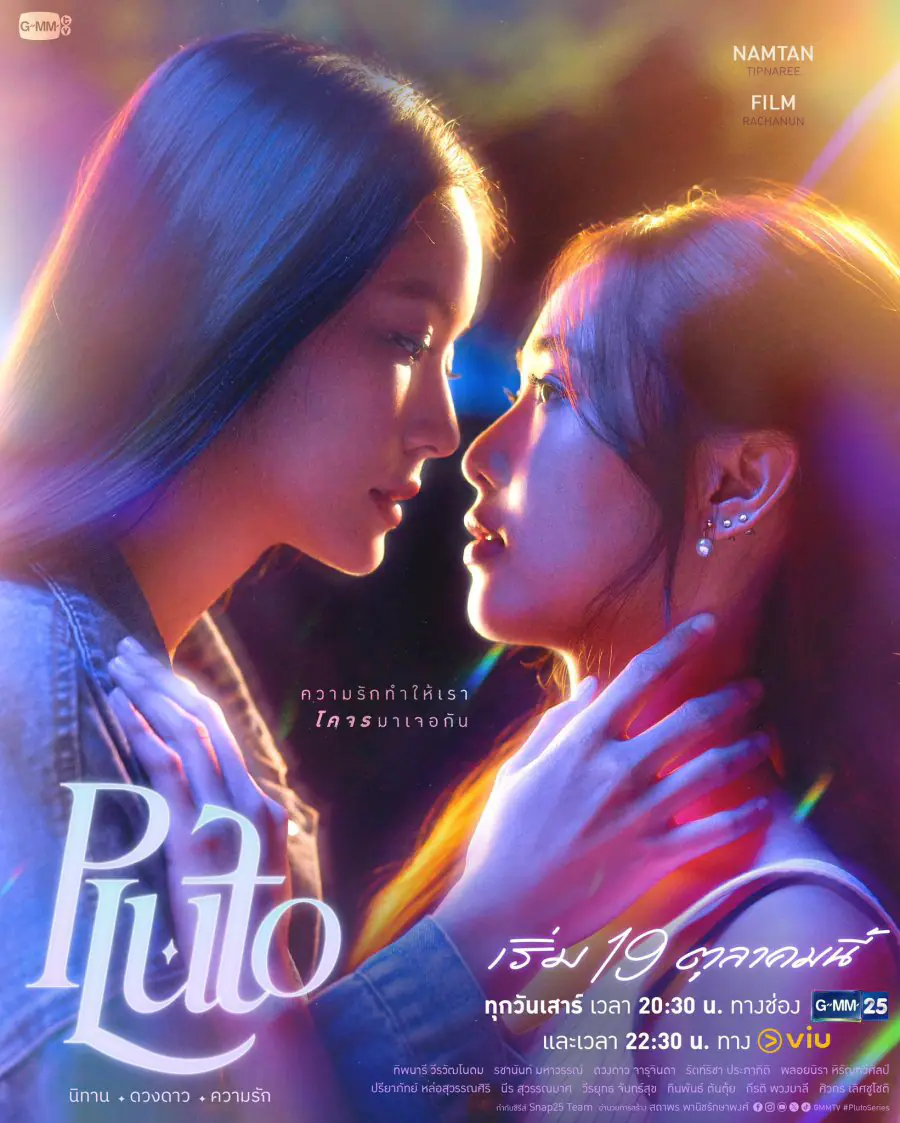
Pluto — An Interpretation of Obsession and Redemption Blooming from an Isolated Orbit Between Lies and Truth
Love sometimes begins upon a foundation of the cruelest form of deception. Is the act of staying by someone’s side under another’s name an act of devotion, or is it an obsession born of self-satisfaction? We find ourselves questioning how far one can distort the truth under the pretext of protecting a loved one.
GMMTV’s 2024 masterpiece, Pluto, poignantly depicts the process of beings pushed to the fringes of society and relationships—much like Pluto, expelled from the solar system—as they adjust their orbits, drawn by each other’s gravity. This record observes the sharp shards hidden within those orbits.
🌿 Moments When This Drama Deeply Permeates the Soul
- When the anxiety of being loved as “someone else” rather than oneself consumes the soul.
- When the debt of the past feels like a solid wall blocking present happiness.
- When one wishes to trust the warmth of a voice, clearer than light, even amidst the darkness of loss.
- The reason to read until the end: To witness the harrowing proof of how guilt is sublimated into love and how one attains the independence of the “self” beyond a mere romance.
🎞 Note Before Watching
This work dives deep into the emotional bonding between characters through the physical condition of visual impairment and the narrative device of a twin stand-in. Eschewing provocative depictions, it is an emotion-centered piece that delicately handles the irreversibility of relationships and psychological pressure.
🎬 Drama Information
- Title: Pluto (Original Title: Pluto นิทาน ดวงดาว ความรัก) (2024)
- Director: Lit Phadung Samajarn
- Screenplay: Lalil Kittitanaphan, Naphat Chitveerapat
- Original Work: Chaoplanoy (Novel Pluto)
- Country: 🇹🇭 Thailand
- Genre: GL, Melodrama, Mystery Drama
- Running Time: 12 Episodes
- Platform: Viu, GMMTV YouTube
- Cast: Namtan Tipnaree Weerawatnodom (Ai-oon / Ob-oom), Film Rachanun Mahawan (May)
📖 Pluto: An Orbit Started with a False Name, Progression Toward the Light of Truth [No Spoilers]
Ob-oom, the beloved younger sister, and Ai-oon, the elder sister who has lived in her shadow. The fates of these two sisters, whose lives were marked by distinct light and shadow, are reversed on the eve of Ob-oom’s wedding. Ob-oom falls into a coma following an accident, leaving behind a cruel and preposterous request: for Ai-oon to break up with her secret lover, May.
Ai-oon seeks out May to fulfill her sister’s final wish, only to encounter a visually impaired woman isolated in darkness. Unable to bring herself to say goodbye, Ai-oon enters May’s world by borrowing her sister’s name.
As time passes, the relationship built on lies flows in an unexpected direction. Faced with May’s pure affection, Ai-oon’s guilt only intensifies; to make matters worse, she discovers that the past tragedy behind May’s blindness is linked to herself. Thus begins the precarious voyage of a woman who must deceive to stay close, and a woman who must discern love solely through a voice.
🌑 The Solitude of One Who Stole Another’s Orbit: An Interpretation of Relationships in Pluto
In Pluto, Ai-oon’s dual role is not a mere disguise but signifies the deconstruction and reconstruction of the self. By performing the life of her sister Ob-oom, Ai-oon is finally “discovered” by May. Here, a paradoxical point arises: Is what May loves the shell of “Ob-oom,” or the sincerity of “Ai-oon” trembling within it?
The work utilizes May’s visual impairment as a narrative device to explore the truthfulness of auditory and tactile sensations conveyed when visual information is severed. Through the tone of Ai-oon’s voice, minute tremors, and body heat, May senses a different texture of kindness from the Ob-oom she once knew. The tension arising from this process constantly forces the viewer to question whether the “conditions for a truthful relationship” lie in outward appearance or in the vibrations of an invisible soul.
Ultimately, the pain Ai-oon feels stems less from the fact that she stole another’s orbit and more from the fear that her sincerity might remain eternally trapped within the frame of a “lie,” never to be truly conveyed. This symbolically illustrates the disparity between the “persona” we wish to show others and the “innate self” hidden behind it in modern society.
🔗 The Shackles of the Past and the Mechanism of Forgiveness: The Core of the Pluto Review
The point where this drama gains mythological depth beyond a simple melodrama lies in the shared wounds of the past. The setting—where Ai-oon’s bystander effect and guilt linger behind the accident that took May’s sight—expands the relationship between the two from simple lovers to a dynamic of “perpetrator and victim,” or “one with a debt and one to be redeemed.”
Ai-oon’s act of staying by May’s side initially carried a strong character of “atonement.” However, as love deepens, atonement turns into obsession, and that obsession leads back to the necessity of confessing the truth. Pluto shows that forgiveness does not merely mean forgetting the past, but begins only when the party who caused the wound fully reveals their own ugliness.
Particularly, the twist where May, after clearly realizing the person is Ai-oon, instead discovers that Ai-oon was her benefactor in the past, enhances the structural integrity of the narrative. This suggests that the starting point of the tragedy was actually the starting point of salvation, movingly portraying the process of untangling the threads of a complex fate in the name of love.
🔎 Reinterpretation of the Ending — Two Souls Finally Facing Each Other in the Dark
The ending of Pluto is not a simple closure of the “the lies were exposed but they lived happily ever after” variety. The moment Ai-oon reclaims her name and stands before May, the “Pluto” that was expelled from the solar system is granted its own independent orbit.
By forgiving Ai-oon’s lies, May moves away from the position of a victim and is reborn as an active subject of love. Conversely, Ai-oon escapes her sister’s shadow and attains the dignity of being loved as “herself.” Their reunion is a complete emotional union reached only after collecting all the fragments of the past.
The conclusion proves that the weight of the time the two shared was heavier than the magnitude of the lie. Even if the beginning was a staggering deception, the warmth of the emotions nurtured within it was real. The union of Ai-oon and May is a farewell to a wounded past and a sanctuary for those who have accepted each other’s deficiencies as a cosmic necessity.
❓ Curiosities Regarding the Pluto Ending and Narrative Structure
Q. Is Ai-oon’s deception love, or is it gaslighting bordering on a crime?
Ai-oon’s actions in the early part of the work certainly leave room for ethical criticism. Impersonating another person by exploiting the vulnerability of visual impairment is an act that violates May’s right to self-determination. However, rather than justifying this, the drama internalizes the point of criticism by depicting the horrific psychological hell Ai-oon endures. Consequently, this deception leaves room to be interpreted not as a destructive desire toward May, but as an immature devotion that attempted to protect the other person even at the cost of destroying oneself.
Q. Is the way visual impairment is handled overly idealized?
The drama does not depict May’s life as purely beautiful. It realistically exposes the poor sidewalk conditions in Thailand and the difficulties of using public transportation, awakening social awareness. Its aesthetic value is high in that it does not use disability as a romantic ornament but treats it as a core element that defines the “mode of communication” between characters.
✨ Pluto: We are all Plutos waiting to be discovered by someone
The drama Pluto starkly demonstrates how cowardly, and yet how brave, love can make a human being. Just as Ai-oon, wandering without a center, found her place upon meeting May’s gravity, we too finally confirm our own shape through the mirror of another.
This work sublimates provocative materials—disability, queerness, twin stand-ins—into the universal humanistic theme of “finding the self.” It shows that power structures within relationships collapse before the truth, and that true solidarity begins only upon those ruins.
Truth does not destroy relationships; it is the only tool that collapses false relationships and rebuilds a solid life in their place.
🎙 When Quiet Sincerity Knocks on Your Door
When you discover that the other person is someone entirely different from who you thought they were, which would you believe: the “weight of time” you’ve built up, or the “truth” before your eyes?
Ask yourself whether you are loving the essence of the person beside you now, or the illusion you have created.
💜 Violet Screen Curation: Another Gaze into the Depths of Relationships
- The Secret of Us (ใจซ่อนรัก) (2024): An intense melodrama of a doctor and an actress reunited with past misunderstandings and wounds. It deals with “forgiveness and reunion” with a different texture than Pluto.
- Gap The Series (2022): Deals with the fierce love of two women breaking taboos within social class and power structures. The way it handles the initiative in relationships and social pressure is impressive.
To provide a more stable publishing environment, multilingual content, and better communication with our readers, we have moved our official publication to Substack.
All new film reviews and critical essays will be published on our new platform. This website will be closing down soon, so we would greatly appreciate it if you subscribed to our new space.
TODAY'S QUESTION
Which character has comforted you lately?
Your answer isn't saved. Feel free to share it in the comments below.


You May Also Like

Orange Is the New Black Analysis: Piper and Alex, a Desperate Desire Blooming in Isolation

Show Me Love The Series: A Structural Review of Solidarity and Love Blossoming Behind a Glamorous Beauty Pageant