Girls in Uniform: Forbidden Love Piercing Through Oppression and the Hidden Truth of Female Narrative
We all live facing cold walls called our own respective disciplines. The moment one must erase oneself to fit into a mold defined by others, the soul experiences its deepest isolation.
The film Mädchen in Uniform (1958) meticulously traces how deprivation and desire recognize each other and ignite the sparks of solidarity within a massive, oppressive space of militarism. The sole warmth found by a girl standing alone before the grief of losing her mother and the coldness of the world—it was the beginning of a monumental love that went beyond mere admiration to shake an suppressed system.
🌿 Moments when this film permeates particularly deep:
- When you are enduring a suffocating daily life, having lost your own color amidst thorough control and discipline.
- When you want to immerse yourself in the delicate emotional lines of two women who could not hide their desperate glances toward each other, even under strict societal scrutiny.
- When you wish to witness the marvel of the moment when they become each other’s salvation and liberation, leaping over the barriers of conservatism and the limitations of the era.
The reason to read to the end is that you can discover the true value of the structural fissures left by the ending and the fierce psychological power dynamics of two women that survived without being erased, even under the temporal censorship of the 1950s.
🎞 Notes before viewing the film
Excluding physical touch or explicit stimulation, this work drives the drama entirely through the dense glances and emotional communion between characters. It is a deep, relationship-oriented drama centered around the shifting emotions and the bond of two women blossoming within the enclosed space of a strict boarding school.
🎬 Film Information
- Title: Girls in Uniform (Mädchen in Uniform, 1958)
- Director: Geza von Radvanyi
- Screenplay: Friedrich Dammann, Franz Höllering
- Original Work: Christa Winsloe’s play Gestern und heute and the 1931 film of the same name
- Country: West Germany (Federal Republic of Germany)
- Genre: Drama, Romance, Queer
- Running Time: Approx. 86 minutes
- Platform: Amazon Prime Video, YouTube (Selected Regions)
- Cast: Lilli Palmer (as Elisabeth von Bernburg), Romy Schneider (as Manuela von Meinhardis), Therese Giehse (as Headmistress)
📖 Girls in Uniform: A Confession that Shook the Walls of Discipline and the Beginning of a Fissure [No Spoilers]
Manuela, a young girl forced to enter a strict Prussian boarding school after losing her mother, experiences deep loss and isolation before the headmistress’s military control, which thoroughly crushes individual personality and emotion.
When every girl conforms to uniform rules, Teacher Bernburg—the only one who encourages the students’ autonomy with a warm gaze—enters Manuela’s life. Manuela begins to feel an uncontrollably intense affection for Bernburg, who treats her humanely, and Bernburg also forms a peculiar emotional bond while protecting her wounds.
Passing through rehearsals for a play, the annual school performance, the emotional distance between the two narrows rapidly. On the night of the festival, as Manuela shouts her hidden truth before the crowd, the school is swept into an uncontrollable vortex of scandal and conflict.
🔒 Desire and Gazes Hidden beneath the Uniform of Oppression
In the film Mädchen in Uniform, the boarding school uniform is not merely clothing to distinguish students, but a symbol of militaristic ideology enforcing control and obedience.
The process of Manuela having her belongings confiscated and putting on the uniform as soon as she arrives at school signifies the loss of autonomy. However, even in this oppressive space, Bernburg’s gaze continuously searches Manuela’s hidden interior.
Teacher Bernburg is depicted as the sole escape route from this suffocating space. Yet, her kindness operates within a power relation of teacher and student, rather than perfect equality. Her defense mechanism, “I am the teacher of all girls,” clashes with Manuela’s desire for exclusivity, deepening the internal conflict.
🎭 The Play as a Sanctuary: Mirror Therapy of Romeo and Juliet
The theater stage, the only artistic space permitted within the massive prison of the school, is a fictional world where the hidden emotions of the two can be legally expressed.
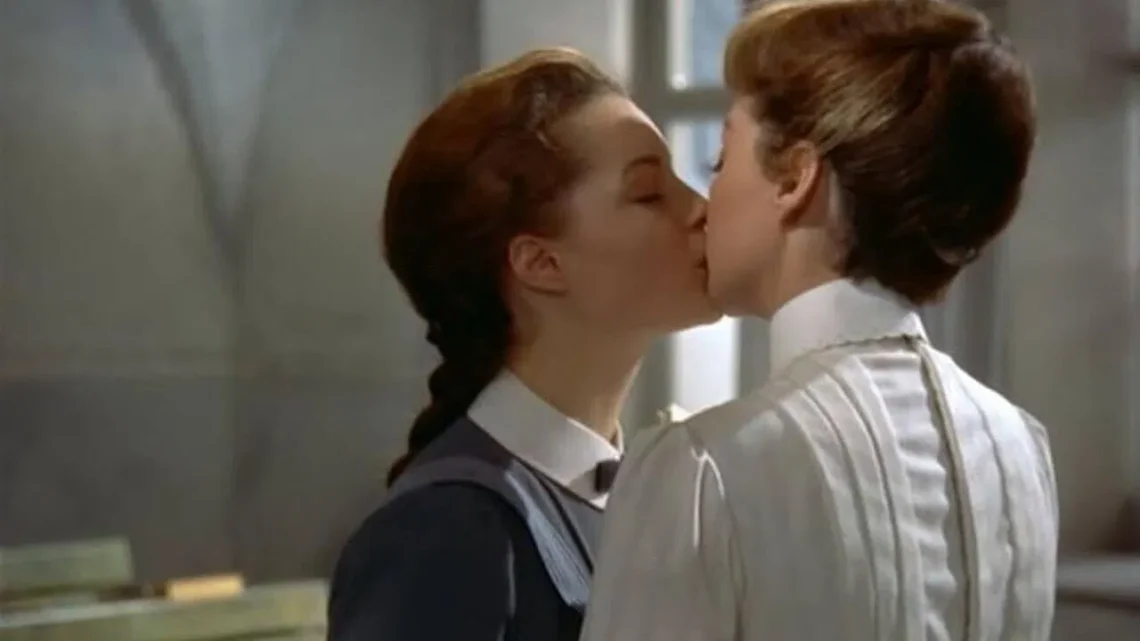
The scene where Manuela takes on the male role of Romeo, and Bernburg helps rehearse by filling in as Juliet, forms the most intense emotional climax of this film. Borrowing lines, their lip kiss and tears are a decisive moment that shatters the boundaries of a mere teacher-student relationship.
What must be noted in this review is the fact that the device of the play creates a paradox: by acting out what is false, it instead explodes the truest emotions. Under a controlled system, the two women finally face their complete longing for each other only after wearing the legal mask of the stage.
🔎 Reinterpreting the Ending: Eternal Fissures Engraved upon a Steadfast System of Control
The ending of the film concludes through Manuela’s extreme attempt to throw herself down, Bernburg blocking it, and the headmistress showing a humane wavering for the first time.
This ending should be interpreted not simply as a happy ending that prevented a young girl’s tragedy, but as an event that caused an irreversible, fatal fissure in the Prussian patriarchal authoritarian system that seemed absolute. Bernburg remaining at the school and the headmistress taking Manuela’s hand prove that oppressive power had no choice but to step back before the intense resistance and emotional solidarity of the ruled.
Manuela denounced the inhumanity of the system at the risk of her life, and Bernburg solemnly confirms the weight of her educational convictions and emotions through that sacrifice. Although the relationship between the two cannot return to the same pure admiration as before after the conclusion, this wound that shook the system will remain as a medal that defended their dignity.
The collective solidarity that stopped Manuela’s fall is a structural counterattack declaring that discipline can never control human primal love.
❓ In-Depth FAQ: Girls in Uniform
Q. How do you view the criticism that the queer narrative in the 1958 remake version was somewhat sanitized compared to the 1931 original?
It is true that due to the conservative West German social atmosphere of the 1950s and the limitations of commercial film censorship, the explicit lesbian elements and sharp political critique of militarism present in the original were softened into a somewhat platonic and maternal bond.
However, this sanitization ironically yielded an aesthetic result that sublimated the emotions between the two characters into a denser and more restrained psychological tension. Instead of direct depictions, the emotional waves flowing through intersecting glances, hesitations of hand gestures, and the reverse side of dialogue provide an open space of interpretation that makes the audience search for the truth behind the blocked barrier themselves.
Q. Isn’t the headmistress’s sudden change of attitude and the ending of reconciliation unrealistic?
The scene where the dictatorial and cold headmistress takes Manuela’s hand at the end and requests Bernburg to stay may look like a narrative compromise. However, it is reasonable to interpret this not as the patronizing mercy of a ruler, but as a last resort of power to prevent the collapse of the system.
This is because the collective agitation of the students and the departure of the teacher, who was a pillar, constituted a crisis that would make the system of the school itself unable to survive. Through this, the film leaves the judgment to the audience, opening up the possibility that even if authoritarianism did not completely crumble, human dignity and solidarity can forcibly change the attitude of power.
✨ Girls in Uniform: The Eternal Voice of Love that Survived, Smashing the Bars of the Era
The plot and narrative of this work do not merely remain an incident in a Prussian boarding school of the past 1910s, but still pose valid questions to the numerous institutional oppressions and standardized lives that modern society imposes on individuals today.
It makes us look back on whether we are still living with our identities and emotional desires castrated while wearing the ‘uniforms’ prescribed by society. The bond between Manuela and Bernburg in the film goes beyond a simple romance, clearly showing that against the violence of a massive system, the only weapon with which humans can defend human dignity is deep solidarity and love for one another.
In a world standardized by uniforms, human autonomous passion is the most powerful political resistance that brings power to its knees.
💬 On the boundary line of discipline and emotion, what is your choice?
Between ‘conformity to the system’ where you are safest but must erase yourself, and ‘confession of freedom’ where you follow the truth of your emotions even if you must be prepared for ruin—which side would you stand on? Confronting Manuela’s cry now, please freely share the deepest fragment of emotion that shook your heart.
🎬 Violet Screen’s Recommended Curation
- Blue Jean (2022)
- Reason for Recommendation: It deals with the story of Jean, a physical education teacher who had to hide her identity amidst a homophobic social atmosphere during the Thatcher government in the 1980s. The agony coming from the controlled space of a school and professional constraints forms a perfect symmetry with the dilemma felt by Teacher Bernburg in Mädchen in Uniform, delivering a deep resonance.
- Tipping the Velvet (2002)
- Reason for Recommendation: You can appreciate a bright and liberating atmosphere through the intense and fascinating narrative of a woman dynamically adventuring to find her desires and identity, breaking through the strict moral disciplines of the 19th-century Victorian era with her whole body.
To provide a more stable publishing environment, multilingual content, and better communication with our readers, we have moved our official publication to Substack.
All new film reviews and critical essays will be published on our new platform. This website will be closing down soon, so we would greatly appreciate it if you subscribed to our new space.
TODAY'S QUESTION
What's your favorite line from a WLW movie or show?
Your answer isn't saved. Feel free to share it in the comments below.


You May Also Like

Kiss Me Before It Blows Up: An Interpretation of a Romance Between Two Women Transcending Historical Debt
Heavy Snow Analysis: The Chilly Dawn of Queer Cinema Painted by Han So-hee and Han Hae-in, and Eternal Redemption