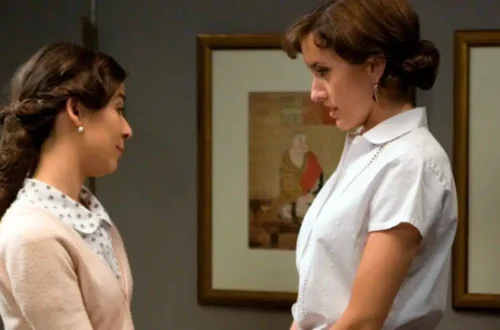
Starting From Now (2014) Analysis: The Realism of Queer Narrative Drawn by Deficient Desire
Just as we rely on each other’s warmth on an isolated island, we sometimes identify our own hollow spaces through others. The reality of countless relationships packaged under the name of “love” may, in fact, be a desperate struggle to fill one’s own deficiencies.
Blooming amidst the raw atmosphere of Australia, Starting From Now follows the brutally realistic trajectory of four women who had to either destroy or save “the other” to find “the self.” This series goes beyond a simple queer romance to dissect the fundamental loneliness of human existence and the resulting power dynamics within relationships.
🌿 Moments When This Web Drama Deeply Resonates
- When you feel a chilling realization that you are consuming each other despite a desperate love.
- When you feel fatigued by your identity being defined solely by your relationships with others.
- At the threshold of a transgression where a destructive truth feels sweeter than a stable daily life.
- The reason to read this article to the end is that it proves how the “selfishness of love”—which we often turn away from—becomes a catalyst for growth.
🎞 Note Before Watching the Web Drama
This work unreservedly exposes psychological pressure and emotional fragments within relationships, showing a level of realistic conflict that can sometimes be uncomfortable. Rather than physical stimulation, it is an authentic relationship-centered narrative focusing on the tension between characters and the emotional density found in conversation.
🎬 Web Drama Information
- Title: Starting From Now (2014–2016)
- Director: Julie Kalceff
- Screenplay: Julie Kalceff
- Country: 🇦🇺 Australia
- Genre: Drama, Queer, Web Series
- Running Time: Approx. 10 minutes per episode (5 Seasons total)
- Platform: YouTube, SBS2, IndieFlix
- Cast: Sarah de Possesse (Steph Fraser), Rosie Lourde (Darcy Peters), Lauren Orrell (Kristen Sheriden), Bianca Bradey (Emily Rochford)
📖 Starting From Now, the Beginning of a Fissure Created by Conflicting Choices [No Spoilers]
The lives of four women thrown into the ordinary daily life of Sydney begin to shake to their core when Steph feels an irresistible attraction to Darcy, the partner of Kristen. As Steph, an alien presence, infiltrates the stable relationship between Kristen and Darcy, internal issues such as individual deficiencies, alcohol dependency, and the desire for control—which had been suppressed—begin to surface.
The arrival of Emily, Steph’s colleague, adds a further layer of complexity, turning the relational axis into a sophisticated quadrangle. These women love and wound each other simultaneously, questioning what kind of life they truly desire amidst a cycle of betrayal and reunion. Their choices, navigating between friendship, love, and moral responsibility, unfold in unexpected directions at every moment.
🔒 The Union of Steph and Darcy: A Harassing Analysis of Destructive Salvation
In this work, the union of Steph and Darcy cannot be dismissed as mere infidelity or betrayal. To Steph, Darcy is a mirror reflecting the true self she had suppressed in a heteronormative society. Conversely, to Darcy, Steph was the only emergency exit through which she could escape her alcohol addiction and Kristen’s suffocating devotion.
Their relationship is built on a sentiment of “shared suffering,” recognizing each other’s wounds, but its foundation is extremely fragile. The arrogance of trying to “save” the other eventually becomes the catalyst that destroys both. The drama suggests that love is not always a medicine that heals the other, but sometimes a poison that must completely dismantle the self before a new beginning is possible.
🔗 Kristen’s Devoted Obsession: An Ending Brought by Relational Asymmetry
Kristen is the most tragic yet multi-dimensional character in this narrative. Her love is closer to a protective control wearing the mask of devotion. The more she tried to embrace Darcy’s instability, the more Darcy suffocated, creating the gap that Steph eventually exploited.
Ultimately, the ending Kristen faces goes beyond resentment over betrayal; it is a painful process of separation that independentizes her identity, which had previously relied on others. The work chillingly proves through Kristen’s collapsed daily life how the act of bypassing or covering up a partner’s problems in the name of love causes a relationship to become necrotic.
🔎 Reinterpreting the Ending — Completion of the Self Through Loss
The ending of Starting From Now rejects the grammar of a conventional happy ending. The repeated partings and reunions throughout the seasons are not about whether they finally found the perfect partner, but a process of finding the answer to the question: “Can I exist as myself, regardless of who I am with?”
In the final moments, what they gain is not the fruit of love, but dignity as independent individuals. Steph ends her wandering between passionate desire (Darcy) and realistic stability (Emily) to face her inner self. Kristen also begins to take full responsibility for her own life by setting down the burden that was Darcy.
What remains in their relationships is not an eternal union, but a sacred fissure that inevitably had to occur for the sake of growth.
The end of a relationship is not the loss of self, but a declaration of independence that withdraws the illusions projected onto another.
❓ Debates on Realistic Representation and the Interpretation of the Queer Narrative Ending
Q: Could the betrayals and immoral choices of the characters cause discomfort for viewers?
This work receives both criticism and praise for its refusal to beautify queer relationships. While many existing media outlets have portrayed LGBTQ+ relationships as either excessively pure or purely tragic, this series unreservedly reveals the inherent “pettiness” of human nature, including selfishness, jealousy, and alcohol addiction.
Critics point out that the characters’ repeated mistakes cause fatigue, but this is actually the result of implementing a “leveling realism”—showing that the lives of queer women are just as chaotic and complex as those of heterosexuals. Rather than applying a moral yardstick, the work sublimates the fluctuations of life created by imperfect humans into an aesthetic. The ambiguity of the ending also serves as a deliberate device, inviting the audience to define relationships in light of their own lives.
✨ Starting From Now, the Courage Needed to Start Again
This work asks us: Are you loving another person, or are you loving your own desire projected onto them? The four women who were lost in the streets of Sydney eventually reached themselves by passing through each other. Love is sometimes destructive, but the drama shows that the building of the true “self” can only be erected upon the ruins of that destruction.
A true relationship is completed not by the strength of the grip holding onto each other, but by the courage to let each other go.
💬 Between Silence and Conversation, What is Your Choice?
If the person you love most fell in love with your best friend, would you cling to that relationship to recover it, or would you protect yourself by completely emptying it out?
📑 Violet Screen’s Curation (Variations of Women’s Narratives)
- Bad Behaviour (2023): A power game and twisted love-hate relationship between girls in the closed space of a boarding school. Recommended if you want a sharper, chillier psychological thriller than Starting From Now.
- The Bisexual (2018): A work that wittily and realistically depicts the process of re-exploring one’s identity after a breakup with a long-term partner. A must-watch if you empathize with the realistic emptiness that follows the collapse of a relationship.
To provide a more stable publishing environment, multilingual content, and better communication with our readers, we have moved our official publication to Substack.
All new film reviews and critical essays will be published on our new platform. This website will be closing down soon, so we would greatly appreciate it if you subscribed to our new space.
TODAY'S QUESTION
Which couple, on screen or in real life, are you rooting for right now?
Your answer isn't saved. Feel free to share it in the comments below.


You May Also Like

Legacies: The Aesthetics of Self-Loving Identity Through Josie and Finch’s Salvation Narrative

We Are Gamily Review: An Interpretation of Real Love Blossoming from the Shell of a Sham Marriage