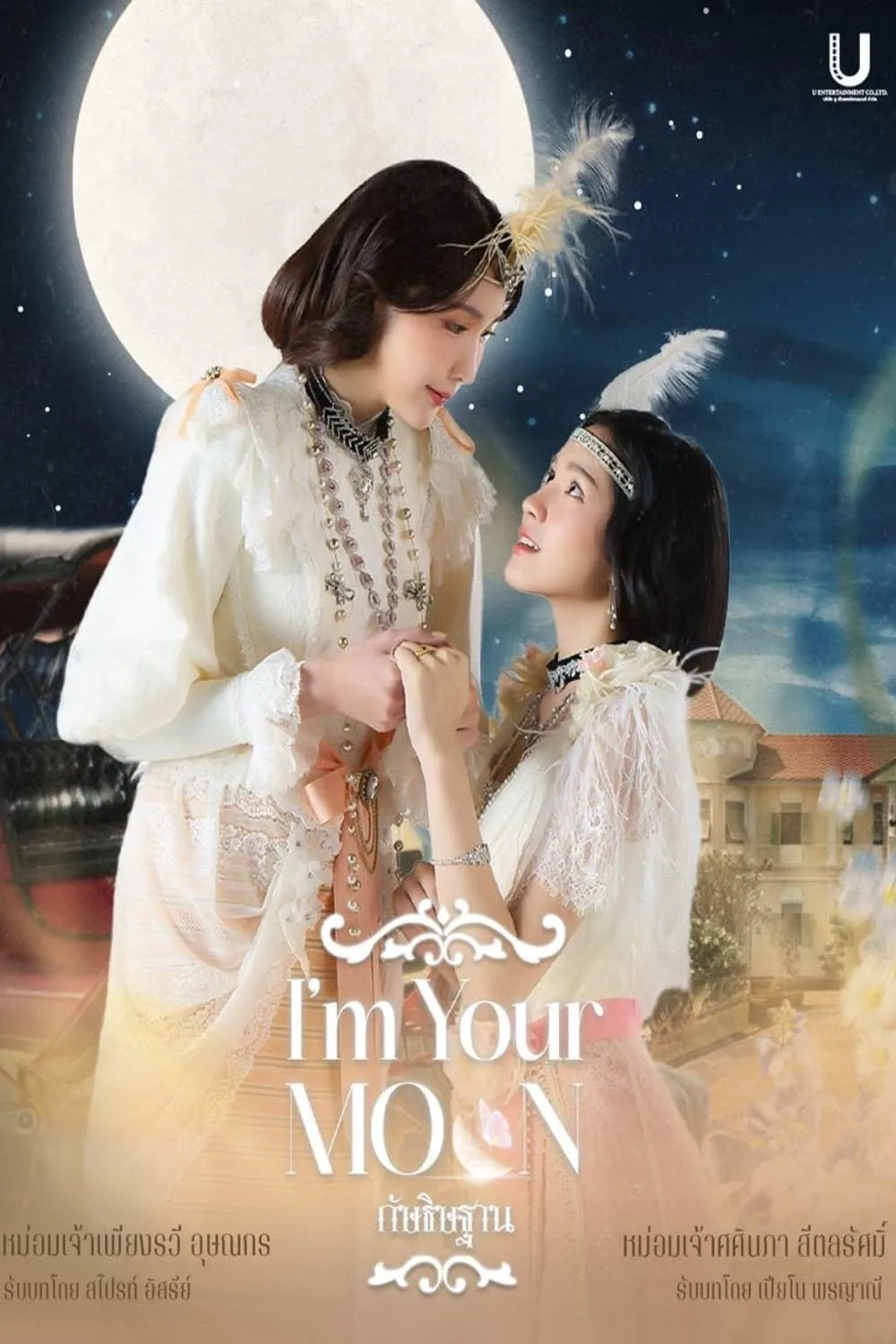
I’m Your Moon (2025): Deep and Multi-Dimensional Analysis of a Female Narrative Transcending Past-Life Tragedy
Souls that recognized each other in an isolated world cross eras to face one another once again. The desires that failed to bloom within the chains of oppression and taboo do not vanish; instead, they manifest as a new form of salvation upon a different axis of time. This work captures the intense gravitational pull between two women that endures across generations, alongside the process of healing their hidden wounds, delivering it with a lyrical yet weighty resonance.
🌿 Moments When This Drama Deeply Permeates
- A moment that reaches those who have ever held their breath, crushed under the weight of tradition and family defined by society.
- A time for those who need the courage to overcome the trauma of loss and reach out to another person once more.
- When you wish to witness the growth of characters determined to make autonomous choices, even in the face of a massive destiny known as past-life memories.
- Thus, going beyond simple romance, one must read to the very end to discern the essence of how past tragedies reshape the structural dynamics of present relationships.
🎞 Notes Prior to Viewing the Drama
This work is a relationship-centered drama that untangles traditional conflict elements—the opposition of social status and family clans—through the affectionate and deep emotional communion of two women. Rather than relying on provocative depictions, it heightens immersion by focusing on the amplitude of the characters’ emotions and their psychological distance.
🎬 Drama Information
- Title: I’m Your Moon (2025) / Original Title: กัษธิษฐาน
- Director: To Sukhaseth Losiri
- Screenwriter: Ming Penchan Wongsomphet
- Country: Thailand
- Genre: Romance, Drama, Fantasy
- Running Time: 10 Episodes
- Platform: CH3, YouTube
- Cast: Sprite Itaree Jarupangomon, Piano Pronyanee Pornpishayawasin
📖 I’m Your Moon, the Inevitable Attraction of Two Women Connecting a Fractured Past Life and the Present [No Spoilers]
In the past of 1913, two princesses of royal blood, Phiangrawi and Sasinapha, nurture their love for each other, transcending the deep-seated resentment of their families and the walls of tradition. However, their tragic escape attempt meets a brutal end as Phiangrawi is murdered due to the intervention of Sasinapha’s mother, and Sasinapha also passes away from a broken heart.
Decades later, in the present of 2021, the two reincarnate and encounter each other again with completely inverted personalities and statuses. Phiangrawi, who was passive in the past, is born as Earl, a decisive and cold-hearted businesswoman, while Sasinapha is born as Prey, a gentle and pure heiress. Beneath the shadow of their still-clashing families, Earl pushes away Prey’s advances due to the trauma of her past life, drawing a new battle line of conflict between the two.
🌙 Psychological Structure Analysis of <I’m Moon Your>: Past Oppression Operating as Present Defense Mechanisms
The fear of death experienced by Phiangrawi in the past manifests in the modern-day Earl as an obsessive desire for control and a rigid defense mechanism. Although Earl attempts to perfectly control her world as a successful businesswoman, she experiences an uncontrollable emotional fracture the moment she faces Prey.
Conversely, Prey retains a sense of past-life indebtedness beneath her gentle demeanor, engaging in an autonomous courtship that persistently approaches Earl despite her cold rejections. This inversion of the power dynamic functions as a narrative device to heal past passive tragedies through present active solidarity, building the relationship between the two women into something far more multi-dimensional.
🔎 Review of the Characters’ Emotional Transition Curve through the Symbolism of the Sun and the Moon
In this work, the two protagonists bear the metaphor of the sun and the moon, entities that can never fully coexist in the same sky. While the past Phiangrawi and Sasinapha were trapped in the absolute orbit of social status, the present Earl and Prey exhibit a movement to break away from that orbit on their own.
Wherever Earl’s cynicism and Prey’s purity collide, the mise-en-scène starkly utilizes the contrast between light and shadow. Into Earl’s world, where she hides in the darkness to avoid being hurt, Prey enters as a warm light; the resulting emotional ripples expand beyond a simple romance into a narrative of solidarity and healing.
🗝 <I’m Moon Your> Ending, Structural Alignment and Interpretation of Two Souls Transcending Family Feuds
The ending of this drama demonstrates a complete emotional communion that severs the chains of past-life tragedies and the accumulated resentments between families over many years. The moment Earl stops her rejections driven by past trauma and accepts Prey’s sincerity, the past-life indebtedness that bound the two is finally resolved.
Instead of losing their social dignity—the so-called honor of the family name—the protagonists gain internal growth and an identity that fully affirms one another. The ending leaves a deep resonance by showing that the present life they face is not a repetition of the past, but a continuation of entirely new choices. Past tragedy degrades into a structural prerequisite for completing present solidarity.
💬 Deep FAQ on the Non-Uniformity of Past-Life Narratives and Modes of Female Representation
Q1. Do the irregular time jumps between the past and present and the plot holes damage the completeness of the narrative?
The fact that the flow of time is not seamless and that rough editing exists can be pointed out as a limitation of the narrative structure. However, this irregularity can rather be interpreted as an aesthetic device that sensorially represents the fractured memories of past lives and the chaotic nature of trauma experienced by the characters. When focusing on the emotional continuity of the two women rather than the probability of events, this shortcoming is offset.
Q2. Does Prey’s submissive characterization in the modern era contradict autonomous female representation?
On the surface, Prey appears to be a gentle and protected heiress, but the one who refuses to yield to Earl’s rejection and takes charge of restoring the relationship is none other than Prey. This should be rightly evaluated as an active representation of a woman as an autonomous agent who steps away from the traditional passive female archetype and first creates a fissure in the massive wall of familial opposition for the sake of her own desire and love.
✨ <I’m Moon Your> The Unyielding Trajectory of Love among Modern Women Erasing Past Tragedies
Through the will of two women who ultimately choose each other even in the face of a cruel destiny like past-life tragedy, this work profoundly investigates the essence of identity and love. The process of overcoming the yoke of resentment imposed by bloodlines and society through autonomous solidarity poses a question about the permanence of relationships to those of us living in the present. True salvation does not stem from accepting a given destiny, but from the resolution to redesign the orbit of destiny oneself.
🌌 Choices of Distance and Embrace in the Face of Wounds
When a partner filled with past-life wounds pushes you away, will you remain silent and maintain your distance to avoid being hurt, or will you nevertheless reach out your hand first to tear down the wall?
🎬 Violet Screen Curation: Other Female Narratives Leaving a Deep Resonance
- I Wanna Be Sup’tar (2026)
- Reason for Recommendation: It depicts the story of ‘Win Pakorn’, a former top star who left his glamorous past behind and suddenly faced public rejection, and ‘Wannueng’, an aspiring actress living passionately with dreams of debuting in the entertainment industry. It is a classic romantic comedy where two people with completely opposite personalities live together by chance, clash over every little thing, and eventually fall in love.
- Mine (마인, 2021)
- Reason for Recommendation: This is a chronicle of two women who break the false peace within the enclosed space of a chaebol family to find what is truly ‘theirs’. The transition curve of their relationship—moving from an initial power struggle toward gradually becoming the sole savior for one another—is highly sophisticated, maximizing the pleasure of psychological analysis amidst a gorgeous mise-en-scène.
To provide a more stable publishing environment, multilingual content, and better communication with our readers, we have moved our official publication to Substack.
All new film reviews and critical essays will be published on our new platform. This website will be closing down soon, so we would greatly appreciate it if you subscribed to our new space.
TODAY'S QUESTION
What genre or mood do you always reach for when you're alone?
Your answer isn't saved. Feel free to share it in the comments below.


You May Also Like
Black Mirror: Hotel Reverie Analysis – Desperate Desires Born of Virtual Isolation

Portrait of a Marriage (1990): Passion Coveted in the Name of Freedom and Fractures in an Open Relationship