Amar en tiempos revueltos: An Era of Control and Deprivation, a Narrative of Liberation Forged by Two Women
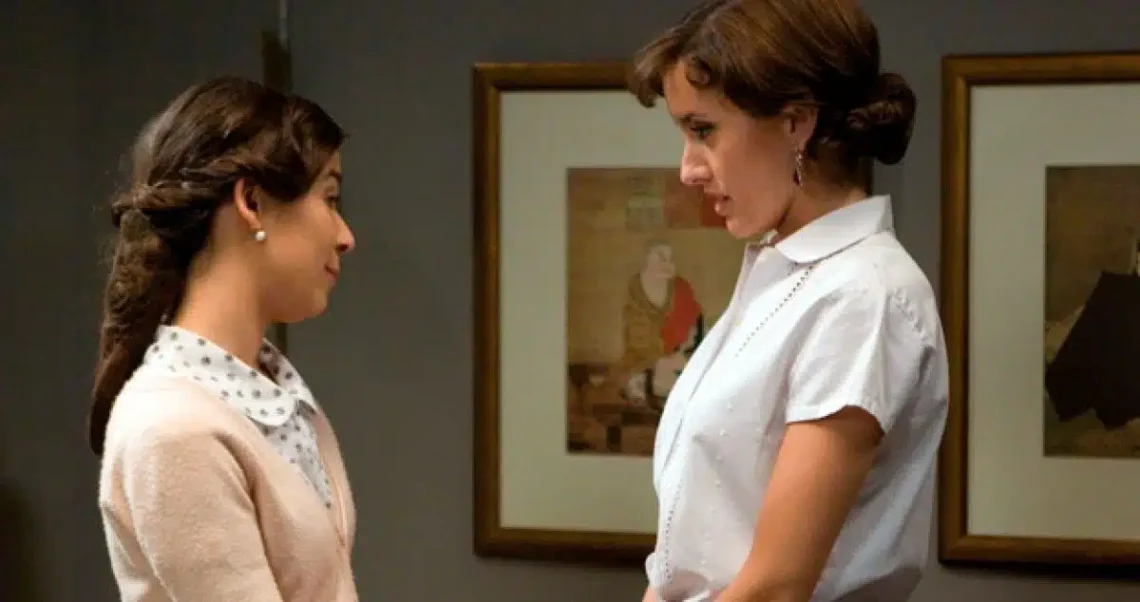
In the early 1950s, during the initial years of Spain’s Francoist dictatorship—an era when isolation and deprivation were woven into daily life—the state-sanctioned framework of the “normal family” functioned as a massive prison for women. Love in Difficult Times (Amar en tiempos revueltos) depicts the fierce and radiant love of Ana and Teresa, two women who rescue each other from the stifling atmosphere of this harsh historical period. Moving beyond a mere romance, their relationship stands as a record of a deeply passionate solidarity that fractures the contemporary violence of patriarchy and class society.
🌿 Moments When This Drama Deeply Permeates the Soul
- On lonely nights in a vast, cold world when you feel that only one specific person truly and fully validates your existence.
- When you wish to catch your breath after losing your way between the correct answers prescribed by society and your own inner truth.
- When you desire to relentlessly trace the nuanced emotional lines and psychological shifts between women that stubbornly blossom despite an oppressive historical backdrop.
- Because at the end of this grueling narrative, one must witness the answer found in a solidarity where two people rescue each other and step out into the world together.
🎞 Note Prior to Viewing the Drama
This work is a densely layered drama that explores the psychological conflicts, the disintegration of relationships, and the subsequent realignment experienced by two women against the grim backdrop of the 1950s Spanish dictatorship. Rather than relying on provocative depictions, the narrative unfolds through the delicate emotional trajectories of the characters and a relationship-centered focus that overcomes contemporary societal limitations.
🎬 Drama Information
- Title: Love in Difficult Times (Amar en tiempos revueltos, 2005~2012) – Review focusing on Seasons 4 and 5
- Director: Joan Noguera, Eduardo Casanova
- Screenplay: Rodolf Sirera, Josep Maria Benet i Jornet
- Country: Spain
- Genre: Period Drama, Romance, Drama
- Running Time: Approx. 50 minutes per episode (Long-form daily drama)
- Platform: Spain RTVE (Official streaming platform)
- Cast: Marina San José (as Ana Rivas), Carlota Olcina (as Teresa García)
📖 The Beginning of Friction and Alignment Between Ana and Teresa in [No Spoilers]
Ana, born as the only daughter of a wealthy department store family, becomes disillusioned by the hypocrisy of the privileged class and takes an undercover job as a salesclerk. Teresa, a member of the working class, lives resiliently and selflessly sacrifices for her family despite severe poverty. The two cross paths within the space of the department store. Transcending class barriers, they rapidly form the deepest of friendships, but their relationship encounters its first fracture when the secret of Ana’s true identity is revealed.
As they work through the ensuing conflict, an unfamiliar emotion exceeding friendship begins to surface, and an abrupt first kiss plunges both women into immense turmoil. Under contemporary social pressures, their attempts to deny these feelings through marriages to men cause their life trajectories to become even more tragically entangled, constructing a complex architecture of conflict.
🔒 The Mise-en-Scène of Oppression and the Spatial Psychology of the Elevator
The elevator within the Rivas department store functions as the most critical space where the characters’ emotions initially erupt, serving as a sanctuary temporarily isolated from social control. The moment the doors close, the external patriarchal order and its watchful gaze are shut out; the narrow, enclosed space creates a psychological chamber that forces them to focus entirely on each other’s breath.
The impulsive first kiss that occurs within this space represents a symbolic event—an eruption of female desire that had been thoroughly repressed under the patriarchal system. Through the physical movement of the opening and closing doors, the director visually maximizes the contrast between the external world, where social masks must be worn, and the internal world, where authentic truth must be faced.
💔 Patriarchal Marriage as a Refuge and the Severe Process of Inner Disintegration
The respective marriages chosen by Ana and Teresa to deny the reality of their emotions functioned as a type of defense mechanism for survival within a heteronormative society. However, the married lives forced upon Ana, an independent and educated woman, and Teresa, a working-class woman, quickly devolve into a continuous, hellish ruin.
The violence, inferiority complexes, and substance abuse of their husbands vividly expose the typical victimization women faced in a male-dominated society. When the refuge of marriage—a compromise intended to keep them apart—instead becomes a prison that destroys them, the two women finally realize with agonizing clarity that salvation can never be found within the patriarchal order.
🤝 Mutual Salvation and the Bond of Solidarity Through the Tragedies of Miscarriage and Death
Teresa’s miscarriage, triggered by Alfonso’s violence, and his subsequent accidental death inflict a profound sense of guilt upon both women, while simultaneously serving as a brutal turning point that breaks the existing cycle of tragedy. In their most painful moments, the promise to rely on each other rather than their husbands and to raise the child together evolves their bond beyond a simple romance into a spiritual partnership.
The economic and social partnership Ana establishes by promoting Teresa to vice president of the department store signifies an autonomous independence rarely permitted to women of that era. The trajectory of these two women, who hold each other’s hands to rise above the heavy deprivation of tragedy, proves how solidarity can become a powerful weapon for survival.
🕊 Ending Interpretation: A Life Simulating Death, a Declaration of Dignity Outside the System
Faced with an absolute crisis involving state punishment and legal blackmail, the choice made by the two women to stage a “fake death” and flee to Argentina serves as the grandest climax of this narrative. This ending represents a complete exit from the existing social order, while simultaneously functioning as an autonomous choice to create a new world in order to preserve their own dignity.
The escape they ultimately execute is a total rejection of and victory over an oppressive system. Through their staged deaths, both women lose their former social statuses and protections, but they achieve a complete bond of absolute mutual possession and inner freedom, arriving at true growth.
🔎 Amar en tiempos revueltos: Questions Regarding Narrative Limitations and the Aesthetics of Representation
Q1. Due to the nature of a daily drama of that era, there is criticism that the narrative becomes repetitive because the period of double lives and denial is excessively prolonged. How can this be interpreted?
The push-and-pull dynamics between the two characters within the structure of a long-form telenovela can admittedly feel drawn out, which stands as a clear structural limitation. However, rather than functioning merely as a dramatic device to fill airtime, this can be interpreted as a realistic psychological plateau. It mirrors just how terrifying and agonizing the process of accepting a lesbian identity was under the harsh Spanish dictatorship of the 1950s. The constant vacillation between certainty and fear structurally reflects the internal censorship that women of that era were forced to navigate.
Q2. Is the ending, where they must choose a “fake death” and flee their homeland, an excessively passive form of escapism?
During the early years of the Franco regime, when surveillance was at its peak, same-sex love was treated not merely as a scandal but as a criminal offense. Within this historical context, a heroic narrative of open defiance against the regime would have lacked realism, verging on fantasy instead. Therefore, the fake death they choose is not passive escapism; rather, it is a highly active and fierce mode of resistance executed to protect their lives and love while bypassing the surveillance apparatus of patriarchal law and institutions. Ultimately, there is no greater victory over structural violence than surviving to achieve happiness.
✨ The Timeless Form of Love Left by
The conclusion of this work continues to present a heavy question to us decades later. Ana and Teresa demonstrate through their lives that the emotion of love does not merely reside within a private, personal sphere, but can sometimes become the most political and human struggle against a massive system and its prejudices. The solidarity of these two women, who recognize and rescue each other despite the rigid discipline and control of patriarchy, declares that true love is, ultimately, a journey toward finding one’s own most dignified freedom through another person.
💬 At the End of the Relationship, What Choice Would You Make?
True salvation begins with the courage to decisively deviate from the orbit that others have established for you.
If a moment arrives where you must leave behind social safety nets and conventional status to pursue an authentic solidarity with a single person, would you remain in a familiar prison that guarantees safety but starves the soul, or would you move toward a life of complete freedom with that person, even if it means losing everything and being socially erased? In which direction does your soul incline?
🔮 Additional Curation Recommendations from Violet Screen
- <Las Pelotaris 1926, 2023>
- Reason for Recommendation: Set in 1920s Spain and Mexico, this series depicts the struggle of three women striving to succeed as the first professional female players in Basque pelota, a sport entirely dominated by men. The intense, bittersweet love between the characters Ida and Ane closely mirrors the patriarchal oppression and class barriers experienced by Ana and Teresa.
- <The Confessions of Frannie Langton, 2022>
- Reason for Recommendation: A four-part British ITV period drama set in 19th-century London, exploring the deep passion and solidarity that transcends class and race between Frannie, a Jamaican maid, and Marguerite, the white upper-class woman she serves. By filtering the dense emotional arc of these two women through the lens of a murder mystery thriller, it offers a distinct form of tension while capturing a somber, passionate atmosphere of oppression similar to Amar en tiempos revueltos.
To provide a more stable publishing environment, multilingual content, and better communication with our readers, we have moved our official publication to Substack.
All new film reviews and critical essays will be published on our new platform. This website will be closing down soon, so we would greatly appreciate it if you subscribed to our new space.
TODAY'S QUESTION
What genre or mood do you always reach for when you're alone?
Your answer isn't saved. Feel free to share it in the comments below.


You May Also Like

Felizes para Sempre? : The Aesthetics of Isolation and Liberation Encountered at the Boundaries of Desire

Skam Belgique (WTFOCK): A Narrative of Indulgence and Self-Respect Found on an Imperfect Orbit