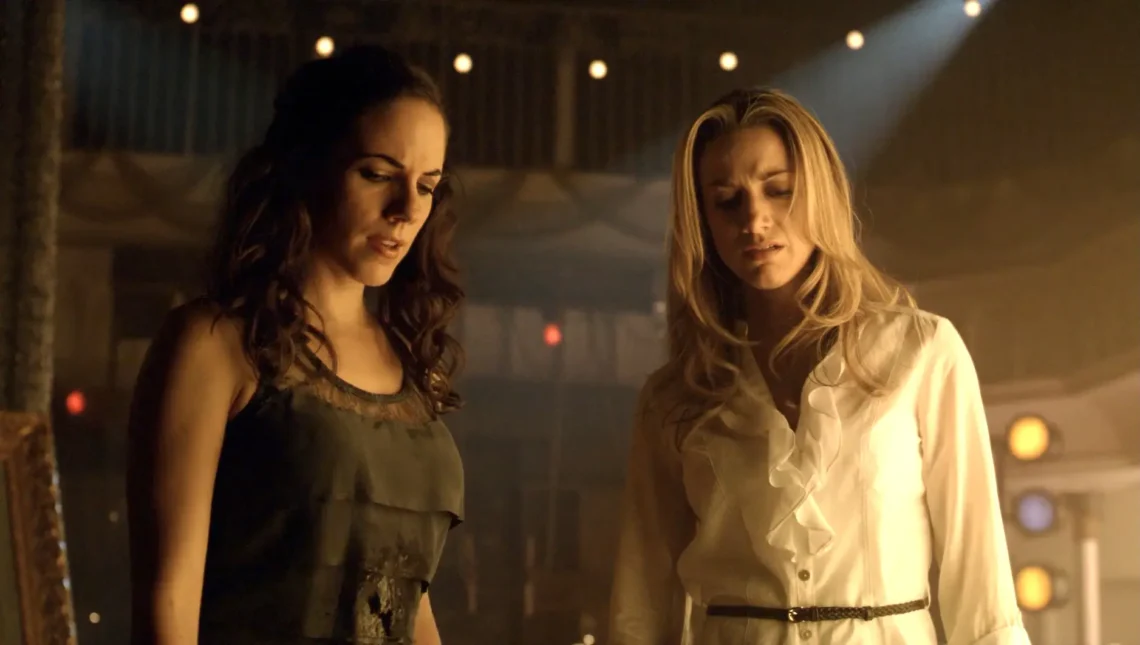
Lost Girl ‘Doccubus’ Ending Explained: The Structural Anatomy of Love Transcending the Impossible Boundary Between Human and Succubus
Isolation arrives the moment one believes themselves to be a monster, and salvation begins with the gaze of the single individual who fully confronts that very monstrosity. We all live bearing our respective deficiencies; like a succubus who cannot exist without harming others, we constantly crave the energy of another within the framework of love, leaving scars in our wake.
The chronicle of Bo and Lauren in the TV series Lost Girl goes beyond mere fantasy romance, serving as a mirror that reflects how two entities with distinct existential limitations can ultimately become one without destroying each other.
🌿 When This Series Particularly Resonates
- When you hesitate and fear entering deep relationships because you cannot fully accept yourself.
- When you wish to witness a desperate, agonizing trust that struggles to protect a loved one even in the face of survival’s brutal reality.
The reason to read until the end is that this piece perfectly dissects the essential aesthetic of how love dismantles the boundaries between human and non-human to reach eternal salvation, tracing the process of sacrifice and triumph as these two women overcome destructive instincts.
🎞 Note Prior to Viewing
Set against a worldview inhabited by supernatural beings, this work consistently stages a sensual and voluptuous tension as it depicts the characters’ instinctive attractions and emotional fluctuations. However, this does not remain mere superficial stimulation; instead, it operates as a pivotal device to visualize the existential conflicts and profound emotional communion of the two protagonists.
🎬 Show Information
- Title: Lost Girl (2010)
- Directors: John Fawcett, Steve DiMarco, et al.
- Screenplay: Michelle Lovretta, et al.
- Country: Canada
- Genre: Dark Fantasy, Drama, Mystery
- Running Time: Seasons 1–5 (74 episodes in total)
- Platforms: Lifetime, Wavve, et al.
- Cast: Anna Silk, Zoie Palmer, Kris Holden-Ried
📖 Lost Girl: A Solidarity of Salvation Blooming on the Boundary Between Human and Fae [No Spoilers]
Wandering without knowing that her identity is that of a succubus who must drain the life force of others to survive, Bo Dennis accidentally steps into the world of the “Fae”—supernatural beings. As she agonizes between instinctive hunger and the guilt of killing, the one who appears before her is Lauren Lewis, a human doctor living bound under the ruler of the Light Fae.
Lauren treats Bo not as a monster, but as a being to be studied and healed, beginning to scientifically research ways to control Bo’s rampaging power. Amidst an instinctive pull, the two finally face each other fully. Yet, Lauren’s institutional secrets, her hidden past lover, and the instinctive toll Bo must pay to survive continuously surge forward, leaving their relationship at a crossroads of rupture and reconciliation.
🧬 Collision of Contrasting Worldviews: Establishing Trust Between Predator Succubus and Observer Human
Bo is an instinctive agent who must absorb the energy of others to survive, while Lauren is a scientific agent who seeks to rationally analyze and regulate this process. Their encounter initially bears an asymmetry of power. Lauren possesses the knowledge capable of saving Bo but remains a physically vulnerable human; Bo commands overwhelming physical abilities but, mentally, constantly risks spiraling out of control without Lauren’s guidance.
Lauren’s declaration—”You’re not a disease. You just don’t know what you are”—offers Bo more than mere comfort; it grants her existential liberation. In their relationship, trust operates as the most delicate emotional theme and serves as the key to overcoming their mutual foreignness.
🥀 The Trajectory of Loss and Sacrifice: Nadia’s Tragedy and the Weight of Exclusivity
As the seasons progress, their relationship is put to the test by ceaseless loss. The secret of bondage that Lauren endured to save her past lover, Nadia, and the tragedy of Nadia ultimately losing control—forcing Bo to execute her with her own hands to save Lauren—leave a deep emotional scar on both women.
🔑 The Ultimate Trust and Value of Exclusivity Reached by Doccubus
Due to the biological traits of a succubus, monogamy represents a threat to Bo’s survival. Yet, in Season 3, Bo promises Lauren for the first time in her life to be her exclusive partner, confessing her love.
This confession is a declaration that she values her relationship with the specific individual, Lauren, above the primal instinct for survival. It is the most decisive juncture where a self-determined choice to look only at each other, despite the instability of the relationship, shines through.
🔎 Reinterpreting the Ending: An Immortal Covenant Dissolving the Boundary Between the Finite and the Infinite
In the final ending of Lost Girl, Lauren completely overcomes her existential dread of being a fragile human who will one day age, die, and disappear, vowing to stand by Bo’s side. The moment Lauren confesses, “Human Lauren Lewis wants to spend the rest of her life with succubus Bo Dennis,” and Bo responds without hesitation, the racial limitations and temporal chasm that blocked their relationship are completely dismantled.
This ending is more than a simple culmination of love. It is the most dignified symbiosis finally achieved upon the boundary, where a human living a finite life and a Fae living an infinite one do not encroach upon each other’s domains. Lauren willingly offers her finite life, which will be completed through death, to Bo, and Bo treasures that finite time within her eternal memory. Through this, the two finally establish a landmark in each other’s universe that will never perish.
Overcoming the differences between two beings is accomplished not through the erasure of nature, but through the existential choice to willingly embrace each other’s limitations.
💬 Debates on the Narrative Structure of Doccubus and Modern Representation of Women
Q1. How should we interpret the criticism that the premise of Bo absorbing others’ energy to survive, combined with Lauren’s devoted attitude, perpetuates a sadomasochistic dynamic?
Bo’s destiny of having to deplete others’ energy to survive due to her nature as a succubus risks appearing, in the early stages, as a relationship demanding one-sided sacrifice. Indeed, the process through which Lauren regulates Bo’s abilities by putting her own safety on the line can easily be viewed as sacrifice-oriented devotion.
However, as the narrative progresses, Lauren does not remain a passive helper. Through scientific inquiry and autonomous decision-making, she emerges as an “active mediator” who holds the key to controlling Bo’s instincts. In other words, this should not be understood as a structure where one side is exploited by the other’s one-sided craving, but as an aesthetic process in which the two values of survival instinct and rational control complement each other to build an equal partnership.
Q2. What is your view on the mixed reception regarding the conflicts Lauren experiences between her past lover Nadia and Bo, as well as Bo’s relationships with other Fae, with some arguing these elements disrupt the core narrative of the two?
The multi-sided relationships with various characters introduced in the middle of the series can cause a degree of fatigue for viewers who expected only emotional purity between the two protagonists. In particular, Nadia’s return or the subtle chemistry Bo shares with Dyson, Tamsin, and others may be perceived as elements that break the consistency of the relationship.
Yet, these waverings and conflicts are precisely the devices that make their “narrative of salvation” more realistic and robust. Rather than a flawless love completed without any friction, the final stability chosen only after passing through numerous losses, temptations, and moral dilemmas delivers a far deeper resonance. Through this process, the audience is invited to evaluate for themselves the true weight of love blooming not from moral perfection, but from human imperfection.
✨ Lost Girl: How to Escape the Bondage of Existence and Become Whole to Each Other
The grandest question permeating all seasons of Lost Girl is: “How does one form a wholesome relationship with another amidst instincts that destroy oneself?” While wearing the guise of fantasy, this work fundamentally deals with the narrative struggle of two women who autonomously claim their dignity and love against societal limitations and inherent deficiencies.
The journey shown by Lauren and Bo proves that if there is a deep trust transcending even physical conditions and the finitude of time, any brutal shackle can ultimately be broken. In the end, true love is the noble resolve to willingly walk into the darkness together, unafraid of the other’s abyss, to become each other’s light.
💌 Before the Limits of Conditions Block You and Me
We often confess our love only when perfect conditions are met. However, starting a love while knowing my own finitude and the partner’s uncontrollable instincts might just be the most powerful solidarity of all.
If your survival conditions and values constantly clash with the essence of the one you love, would you willingly concede your world, or would you insist on guarding your own boundaries to the very end?
🔮 Violet Screen Recommendations: Two Female Narratives of a Different Depth
- The Favourite (2018)
- Reason for Recommendation: A masterpiece that densely portrays the tense psychological warfare and dynamics of desire between two women, taking place on the boundary of supreme power and ruin. It allows you to encounter autonomous and power-dynamic relationships between women in a distinct period-drama tone.
- I Am Not Okay with This (2020)
- Reason for Recommendation: A teen dark fantasy series that tracks the complex and subtle emotions the protagonist, Sydney, harbors toward her best friend, Dina, while agonizing over the manifestation of supernatural powers she does not understand. It modernizes the identity confusion and fear of uncontrollable power that Bo felt in Lost Girl, viewed through a anxious and lonely teenage lens.
To provide a more stable publishing environment, multilingual content, and better communication with our readers, we have moved our official publication to Substack.
All new film reviews and critical essays will be published on our new platform. This website will be closing down soon, so we would greatly appreciate it if you subscribed to our new space.
TODAY'S QUESTION
When did you first feel fully accepted for who you are?
Your answer isn't saved. Feel free to share it in the comments below.


You May Also Like
Fingersmith: An Interpretation of Cold Solidarity and Liberation Born Within a Labyrinth of Twisted Desire
The 100: Clarke and Lexa, an Inevitable Trajectory and Ruinous Salvation Born on the Battlefield of the Apocalypse