The Curse of Styria (2014): Repressed Desire, Seductive Ruin, and an In-Depth Reading of a Gothic Vampire Text
When repressed desire meets an isolated heart, salvation almost always arrives wearing the face of destruction.
There are moments when a hand extended—one that offered seemingly boundless, irresistible salvation—reveals itself to be a fatal sanctuary that collapses the entire world surrounding oneself. When the most seductive and dangerous Other steps into the dark inner space of a young girl who can only register her own existence through self-inflicted wounds, the resulting catastrophe is inherently mesmerizing.
🌿 Moments When This Film Sinks Deeply
- For those who have experienced an intense, fatal attraction that transcends moral standards and social conventions from the very inception of a relationship.
- For those who wish to deeply appreciate the gloomy, beautiful atmosphere unique to classic Gothic literature and the manifestation of repressed female desire.
- For those who want to immerse themselves in a cruel yet beautiful relational dynamic where the boundaries between salvation and destruction, love and obsession, remain profoundly blurred.
- Why you must stay until the end to witness a brutal coming-of-age resolution intertwined with wounded interiority and lesbian eroticism, far beyond a simple horror film.
🎞 Pre-Viewing Notes
This work contains a somber atmosphere dealing with physical self-harm, collective madness, and suicide. However, rather than relying on gruesome physical sadism, it is an emotion-driven psychological Gothic horror that focuses on the psychological and romantic tension as well as the internal turbulence between the two protagonists.
🎬 Film Information
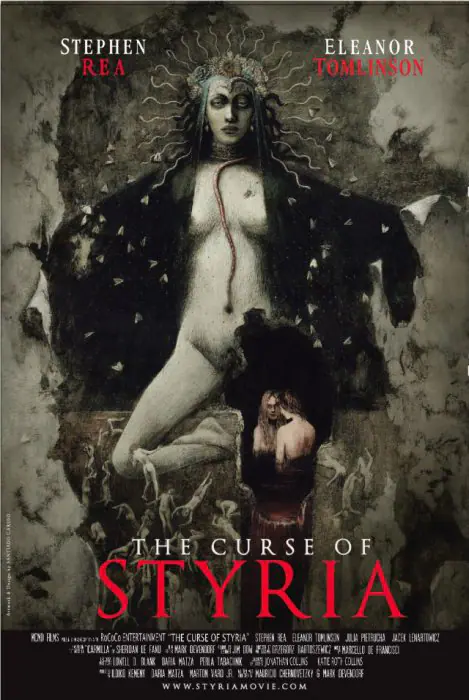
- Title: The Curse of Styria (Original Title: Styria / US Release Title: Angels of Darkness, 2014)
- Director: Maurício Chernovizky, Mark Devendorf
- Screenplay: Maurício Chernovizky, Mark Devendorf
- Original Work: Sheridan Le Fanu’s Gothic novella Carmilla (1872)
- Country: United States, Hungary
- Genre: Fantasy, Horror, Mystery, Drama
- Running Time: 99 minutes
- Platform: VOD Services
- Cast: Eleanor Tomlinson (as Lara), Julia Pietrucha (as Carmilla), Stephen Rea (as Dr. Hill)
📖 The Curse of Styria Synopsis: Dangerous Attraction Originating in an Oppressed Fortress and the Spreading Madness [No Spoilers]
In Eastern Europe in 1989, just before the Iron Curtain was lifted, Lara—a teenage girl trapped in emotional isolation due to scars of self-harm and the trauma of losing her mother—heads to the remote Hungarian village of Styria alongside her father, Dr. Hill, an art historian.
While her father absorbs himself in restoring frescoes inside a neglected, ruined castle, Lara wanders alone. In the forest, she rescues Carmilla, a mysterious girl who escapes an enigmatic car crash. Lara sneaks her into the castle behind her father’s back, initiating an intimate, secret relationship between the two.
Lara falls helplessly under the spell of Carmilla, who understands her solitude without judgment. Yet, simultaneously, a sequence of tragic events erupts as young women in the village succumb to collective madness and mysterious suicides.
As her relationship with Carmilla deepens, Lara experiences liberation while simultaneously becoming enveloped by an immense strangeness. The narrative reaches a critical inflection point as the dark curse hidden within the history of the ruined castle and the true identity of Carmilla gradually come to light.
🖤 Interpretation of the Ending in Styria: Repressed Trauma and the Irresistible Seduction of the Vampire Carmilla
By transplanting Sheridan Le Fanu’s classic novella Carmilla into the somber landscape of late-1980s Hungary, The Curse of Styria elevates a simple vampire narrative into a psychological cruelty play.
To Lara, Carmilla is not merely a supernatural intruder; she is the sole savior and symbol of freedom who pierces through the deep void created by her father’s neglect and her mother’s absence.
The vampiric fascination exerted by Carmilla functions not as a simple physiological hunger for blood, but as an aesthetic conduit that draws out the identity and desire long repressed within Lara’s psyche.
- First Encounter & Approach: Rescue at the accident site and secretive concealment inside the ruined castle (An uncanny union and trust formation between two isolated souls)
- Fascination & Romance: Nocturnal wandering, escalating erotic tension, and psychological dependency (Escape from repressed social norms and emotional liberation)
- Rift & Suspicion: Confronting the collective suicides of village girls and Carmilla’s true identity (Collision with the destructive hazard inherent in the beloved object)
- Climax & Ending: Supernatural turmoil, Carmilla’s disappearance, and residual memories (An indelible fracture of the self and the permanent imprint of growth)
🏰 Closed Space of Styria and the Power Dynamics Implied by Collective Madness
The historical setting of 1989 and the enclosed, decaying space of the declining Communist bloc serve as crucial mise-en-scène that accelerates the psychological breakdown of the characters.
The patriarchal authority system, represented by the government official General Spiegel, attempts to control the history of the castle and the voices of women; however, the madness bursting forth from the young girls can be read as a tragic reaction against that very authority.
The central structural axis of the film’s plot lies in this structural connectivity, where individual psychological trauma contaminates the village as a collective terror.
🔎 Re-Interpretation of Styria’s Ending: The Permanent Fracture Left by Relational Destruction and Traces of Dignity
Even after Carmilla vanishes, Lara’s life cannot return to what it was before, as the film refuses the cliché reassurance of vanquishing evil.
By losing the vampire Carmilla, Lara escapes the brink of utter ruin, yet simultaneously suffers the tragic loss of the only entity who truly and completely understood her.
The most vital point in reviewing this work is the lingering afterimage delivered by the resolution, centered on the irreversible transformation of a character who has awakened to her own agency.
The brutal encounter with Carmilla decisively brought Lara’s childhood deprivations to an end, while permanently carving an unfillable fracture into the architecture of her selfhood.
🕸 In-Depth FAQ on the Adaptation of Carmilla, Female Representation, and Ending Analysis
Q1. Compared to the original novella Carmilla, the ambiguity in its queer narrative and female representation faces some criticism. How should this be viewed?
While this work elevates the original’s homoerotic temptation into a more intuitive, sensory lesbian romance, it can also be critiqued for reverting to the classic cliché where queer yearning is tied to a tragic curse of ‘death’ and ‘madness.’ However, the film does not stop at mere demonization; it frames this dynamic as a tightly bound solidarity between women that could only manifest under isolated conditions, serving as their sole outlet for passion. The cruelty of Carmilla in the film can be read less as individual malice and more as a reaction against the historical curse that has suppressed women, taking the shape of a distorted salvation.
Q2. Why did the film not clearly distinguish whether the supernatural phenomena at the end were Lara’s hallucinations or an actual vampiric curse?
The film intentionally blurs the boundary between supernatural horror and psychological drama to demonstrate that Lara’s internal trauma and the external vampiric curse overlap entirely as one. The explosive force of desire dominating Lara’s mind was deemed far more significant than the physical entity of a vampire. Viewers may interpret it as a supernatural tragedy of cruelty, or appreciate it as an intense psychological hallucination and process of liberation undergone by a wounded soul.
✨ The Curse of Styria: Confronting Internal Agency Through Cruel Taboos
Borrowing the framework of the horror genre, The Curse of Styria is a cruel and beautiful monologue detailing how a damaged soul navigates the intense labyrinth of the Other to locate herself. The work obsessively questions how forbidden love blossoming within a controlled world can destroy a human being while simultaneously granting liberation.
Love is sometimes completed not as a pristine form of salvation, but as a destructive experience that entirely shatters and rebuilds the self.
🖤 The Dangerous Boundary of the Other Confronted at the End of a Relationship
The longing to yield oneself entirely to another and be saved can sometimes become a poison that consumes one’s whole being. Will we choose the quietude of isolating ourselves to avoid being hurt, or will we walk into a dangerous fascination that awakens us, even at the cost of utter ruin?
“If a dangerous savior were to arrive, threatening to upend your entire life, would you reach out to take that hand, or would you guard your safe isolation?”
💜 Violet Screen Recommendations: In-Depth Curation Focused on Female Narratives
- Shiva Baby (2020)
- Reason for Recommendation: Shifting genre and tone, this film offers dense, suffocating psychological tension as a bisexual protagonist navigates the confined space of a shiva house, confronted by her ex-girlfriend and her present identity.
- Fingersmith (2005)
- Reason for Recommendation: Sharing a thematic vein with Sheridan Le Fanu’s Gothic atmosphere, this classic Victorian-era drama depicts intense fascination and twists between two women emerging amid deception and betrayal.
To provide a more stable publishing environment, multilingual content, and better communication with our readers, we have moved our official publication to Substack.
All new film reviews and critical essays will be published on our new platform. This website will be closing down soon, so we would greatly appreciate it if you subscribed to our new space.
TODAY'S QUESTION
What's your favorite line from a WLW movie or show?
Your answer isn't saved. Feel free to share it in the comments below.


You May Also Like
Love Is All You Need? (2016) – A World Where Heterosexuality is a Crime: The Structure of Hatred and Relations Exposed by a Mirror-Image Society
Better Than Chocolate: A Portrait of Liberation and Solidarity in ’90s Queer Cinema