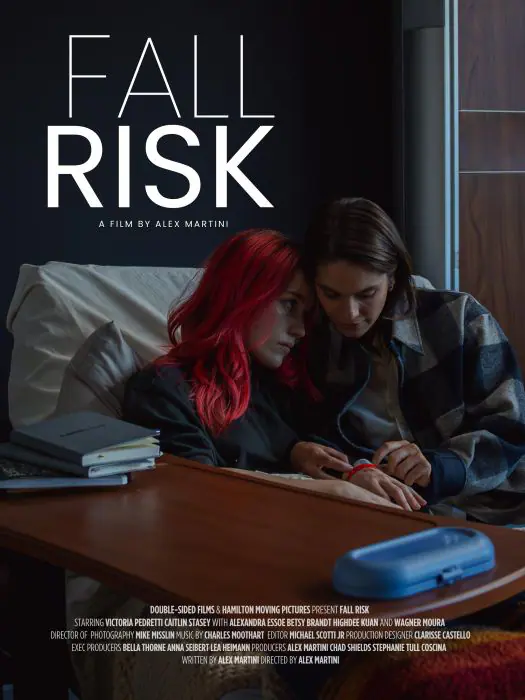
Fall Risk (2024) Analysis: The Aesthetics of Isolation Forged by Bodily Betrayal and Relational Deception
The most fundamental human fear does not originate from an external enemy, but from a collapse within the “interior” that was trusted most. A body that betrays one’s will, and another who deceives one’s love.
The film Fall Risk chillingly and aesthetically depicts a woman facing the irresistible disaster of disease, as she realizes that the sole relationship sustaining her was nothing more than an illusion.
🌿 Moments when this film permeates deeply
- When you have experienced believing that a partner’s hand was the only rope to hold onto in the face of a world-shattering diagnosis.
- When you have instinctively sensed a chilling dissonance hidden behind a gentle voice and devoted demeanor.
- When you wish to witness the paradox of a relationship where one’s vulnerability can become another’s power of control.
- The reason to read this article: To deconstruct the structure of ’emotional gaslighting’ that leaves ulcers deeper than physical illness, and to grasp the true intent of the final monologue uttered by Dylan atop her collapsed self.
🎞 Note before viewing
This work is a psychological thriller dealing with physical helplessness and psychological dominance caused by illness. It should be noted that the film focuses on the emotional suspense arising from relational ruptures rather than visual cruelty.
🎬 Film Information
- Title: Fall Risk (2024)
- Director: Alex Martini
- Screenplay: Alex Martini
- Country: USA
- Genre: Thriller, Psychological, Suspense
- Running Time: 19 minutes
- Platform: YouTube
- Cast: Victoria Pedretti (Dylan), Caitlin Stasey (Emily)
📖 Fall Risk Synopsis: A Body at Risk of Falling and a Plummeting Trust [No Spoilers]
Dylan, suddenly diagnosed with Multiple Sclerosis (MS), becomes a ‘Fall Risk’ patient overnight, unable to move on her own. In the enclosed space of the hospital, her world is maintained solely by the devoted nursing of her partner, Emily.
However, as her body becomes paralyzed, Dylan’s senses grow sharper. Detecting a dissonant fracture within Emily’s excessive kindness, Dylan begins to doubt the reality of the relationship she believed in, spurred by her mother’s cynical warnings and the subtle glances of those around her.
The pathological dependency that arrived at her most vulnerable moment eventually mutates into Emily’s invisible control. Dylan takes a forbidden step to uncover the truth outside the hospital room. The film portrays a brief but intense psychological struggle taking place within a prison named love.
🚨 The Moment Physical Vulnerability Becomes Power: An Interpretation of Emily’s Control
In the film, Dylan’s illness is not a mere setting but signifies a reorganization of the power structure. MS deprives Dylan of her right to physical mobility, and Emily’s ‘protection’ fills that void. Here, protection is a double-edged sword.
The devotion Emily exercises functions as a tool to isolate Dylan from society and induce an asymmetry of information. As Dylan relies entirely on Emily, Emily gains an omnipotent status to recreate Dylan’s world.
This pathological dependency takes on the typical form of psychological dominance, making the victim view the perpetrator as the sole means of survival. The confined space of the hospital room is the rampart of deception built by Emily, and Dylan’s ‘Fall Risk’ becomes Emily’s ‘opportunity for control.’
🔎 Reinterpretation of the Ending: The Dignity of One Awakened from a Wrong Dream
Emily’s true nature revealed at the end of the film—the fact that she has been deceiving Dylan while maintaining her own family—marks the pinnacle of the violence inflicted upon Dylan. It is exposed that to Emily, Dylan was not an object of love, but a ‘weak organism’ temporarily occupied to fill her own deficiencies.
The question Dylan asks the doctor and her final monologue while left alone show a pivotal structural shift in the film. The state where the inner child (love), the teenager (revenge), and the adult (peace) collide is both a fragmentation of the ego and a realization that she has begun to face her inner self, casting off the identity of a ‘patient’ previously defined by others.
The confession, “I suppose I’m here because I had the wrong dream,” is not self-reproach, but a declaration of severance from a past that relied on fantasy. Though her body may still be ill, Dylan’s final cigarette smoke, as she faces the lonely truth after clearing the fog of deception, is a desperate will to survive.
Dylan’s isolation is not the end of a relationship, but the beginning of a subjective recovery, moving away from the illusion of the other to fully confront her own pain.
🧐 Fall Risk Ambiguity and Points of Contention
Q. Is Emily’s wrongdoing simply an individual deviation, or is it due to the power structure of the relationship?
One critical perspective on Fall Risk may be that it flattens the character of Emily into a typical ‘femme fatale’ or ‘perpetrator.’ However, through structural analysis, Emily’s deception should be seen not as a simple character flaw, but as a manifestation of pathological dependency that substitutes the partner’s vulnerability (illness) for her own means of power. Rather than focusing on the perpetrator’s motives, the work warns of the dangers of modern relationships by highlighting how the perpetrator manipulates and privatizes the victim’s environment.
Q. How will Dylan’s life change after the ending?
The film stops at the point where Dylan perceives reality. Now, two tasks remain for Dylan. One is to maintain physical and psychological distance from the deceptive presence of Emily, and the other is to overcome the fundamental distrust of others. The director offers an open conclusion, suggesting through Dylan’s act of picking up a cigarette again that she will no longer be trapped in the frame of the ‘kind and passive patient’ forced upon her by Emily.
✨ Fall Risk: A Grammar of Truth Written with a Betrayed Body
This film explores the extreme horror a human can feel when even the ‘hand that cares for me’ is contaminated amidst the great disaster of illness. However, the director does not preserve Dylan as a mere piteous victim.
The anger and sadness Dylan feels upon facing the truth become the engine that makes her live again. A body can betray and love can deceive, but on all those ruins, the spirit that clearly perceives its own state proves to be the final territory that cannot be invaded.
The true risk of falling comes not from the staggering of the body, but from the silence that denies one’s own intuition by settling into a false tranquility designed by another.
🚬 A Question Left at the End of Loss
When the inner child yearns for love, will you be held in a warm embrace full of deception, or will you choose the solitude of truth that is chilling to the bone?
📽 Violet Screen Recommendations: Complex Solidarity and Tension Between Women
- Holy Spider (2022): A chilling thriller about the social cobwebs threatening women’s survival and those struggling within them.
- Certain Women (2016): A masterpiece that captures the subtle alienation and emptiness of relationships felt by women in isolated spaces through static mise-en-scène.
To provide a more stable publishing environment, multilingual content, and better communication with our readers, we have moved our official publication to Substack.
All new film reviews and critical essays will be published on our new platform. This website will be closing down soon, so we would greatly appreciate it if you subscribed to our new space.
TODAY'S QUESTION
Which ending has stayed with you the longest?
Your answer isn't saved. Feel free to share it in the comments below.


You May Also Like
Indetectables Season 1 Yo también Review: The Profound Bond and Interpretation Between Women Hidden Behind the Narrative of Illness

Control Ending Analysis & Review: Desire Caught Between Reunion and Parting