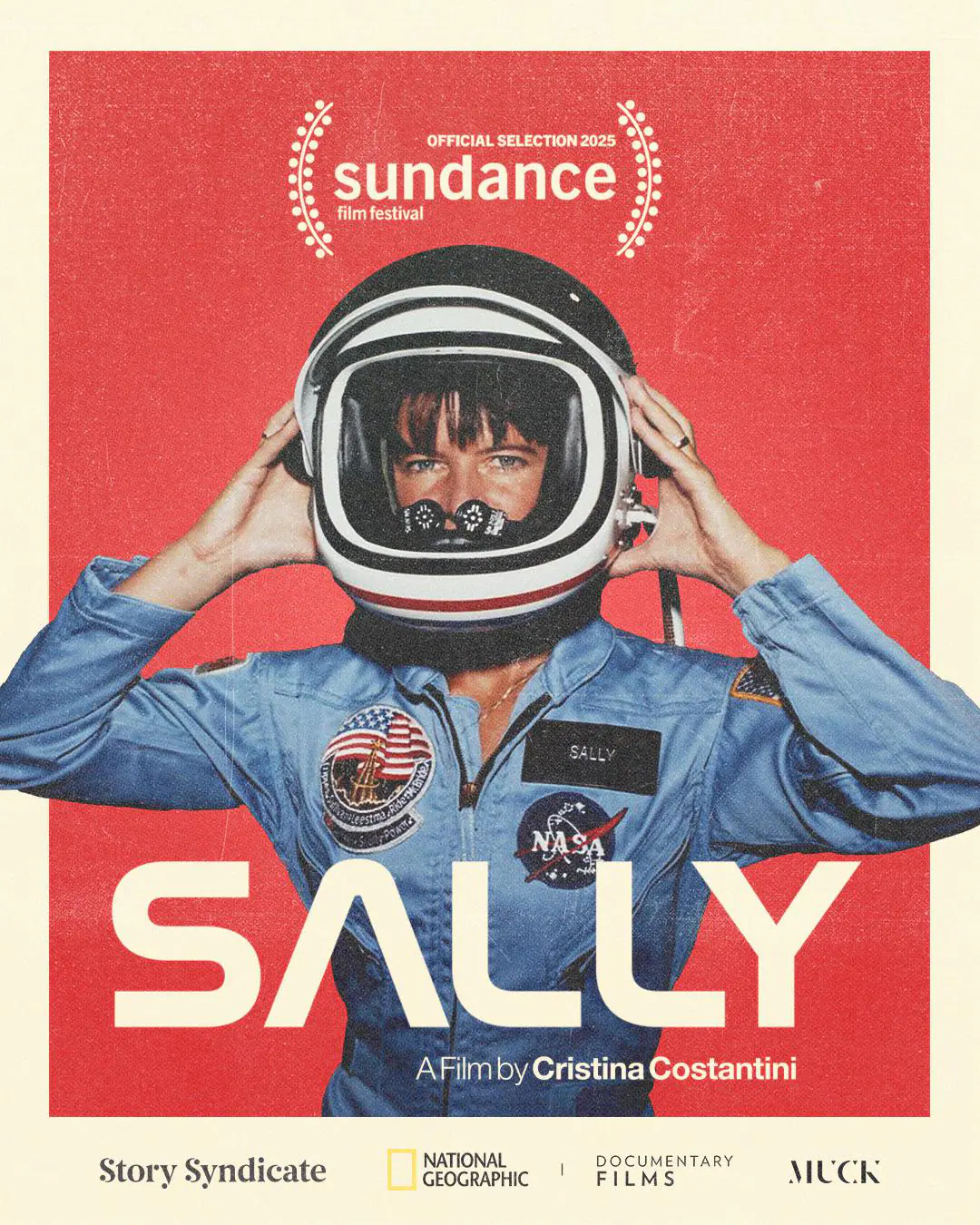
Sally (2025): The Stage of Space and the Orbit of Silence, Sally Ride’s Hidden 27 Years
Confronting the life of a person who had to erase their deepest self to soar to the highest heights evokes a sense of mournful awe. We often fixate solely on a pioneer’s achievements, yet remain indifferent to the private price paid to sustain those very accomplishments.
Between the lines of recorded history exist sentences that one dare not read aloud. Behind the scenes of the Challenger launch—one of the most radiant moments in human history—the film Sally unearths the love and solitude of a woman who had to hold her breath for a lifetime. This work is not merely a paean to the first American woman in space; it is a humanistic exploration tracing the essence of a relationship that remained inviolate despite the silence imposed by the era.
🌿 Moments When This Film Resonates Deeply
- For those who have ever struggled to protect their “true self” hidden behind seemingly perfect social success.
- For those who believe in the power of human connection and warmth shared even within cold, monolithic systems.
- For quiet nights when you become curious not about someone’s accolades, but the “way” they loved.
- This review is dedicated to you, who wish to understand the weight of solitude endured to sustain the splendor of achievement.
🎞 Note Before Viewing
This work is a private chronicle of Sally Ride, who had to conceal her identity within the extremely conservative system of NASA. It is a traditional documentary that prioritizes emotional restraint and the density of relationships over physical explicitness.
🎬 Film Information
- Title: Sally (2025)
- Director: Cristina Costantini
- Screenplay: Cristina Costantini, Tom Maroney
- Country: USA
- Genre: Documentary, Biography, Romance
- Running Time: 103 minutes
- Platform: National Geographic, Disney+
- Cast: Sally Ride (Archival), Tam O’Shaughnessy, Billie Jean King, Kathryn D. Sullivan
📖 Sally: A Record of the Heaviest Love Flowering in Zero Gravity [No Spoilers]
In 1983, Sally Ride took flight beyond the Earth as America’s first female astronaut. While the eyes of the world were fixed upon her and the media hailed her as an “icon of women’s liberation,” Sally remained utterly isolated behind the camera, engaging in rigorous self-censorship. The film demonstrates how Ride proved her professional expertise amidst NASA’s strict patriarchal order and homophobic atmosphere, while simultaneously piecing together the long-shrouded fragments of truth through the voice of Tam O’Shaughnessy, her partner of 27 years.
The film constructs a multi-dimensional portrait of a woman through confessions allowed only after her passing, questioning why she, who enjoyed absolute freedom in the weightlessness of space, had to orbit such a heavy axis of silence back on Earth.
🚀 Gravity and Silence: A Structural Analysis of the “Perfect Shell” Built by Sally Ride
Sally Ride was more than just an exceptional scientist; she was a strategist who understood the demands of her time and knew how to mold herself accordingly. The film focuses on the “emotional poker face” she adopted to survive within NASA. To avoid falling behind her male counterparts, she went beyond erasing her femininity, encasing her entire private life in a shroud of opaque dark matter.
This split-self attitude is starkly contrasted through the cross-cutting of spectacular launch footage and intimate interviews with Tam O’Shaughnessy. The Sally remembered by the public is a cold, competent hero, but the Sally remembered by Tam was a lover who harbored both fear and affection. Rather than attempting to bridge the gap between these two selves, the director coolly analyzes how that very gap was the fundamental structure supporting Sally Ride as a person. For Sally, silence was not submission; it was her most powerful defense mechanism to protect both her professional integrity and her love.
🔭 Solidarity of Unseen Beings: The Transparent Relationship Witnessed by Tam O’Shaughnessy
The true protagonist of the film Sally might arguably be Tam O’Shaughnessy. For 27 years, she sustained a sincere love behind the false labels of “friend” or “business partner.” Through Tam’s eyes, the film illuminates both the sublimity and the cruelty of a “unrecorded love.”
A profound pain is transmitted to the audience through Tam’s solitude—the way she could not share the joy of Sally’s achievements in public, even as Sally was hailed as a hero during the Challenger investigation, but had to whisper only behind closed doors at home. The relationship between the two could only remain whole in a closed space where the “gravity” of social recognition did not reach. To express this through mise-en-scène, the director visualizes the hierarchy of space by placing Sally’s public archival footage in wide-angle grandeur while capturing their private letters and photographs in tight, intimate close-ups.
🔎 Reinterpretation of the Ending — An Orbit of Truth and Social Liberation Completed by Death
The conclusion of this documentary converges on the single sentence released with Sally Ride’s obituary in 2012: the fact that “she is survived by her partner of 27 years, Tam O’Shaughnessy.” This ending is more than a list of facts; it is interpreted as the final manifestation of self-determination, breaking down the wall of silence Sally could never collapse in life through the finality of death.
By revealing Tam’s existence only after her passing, Sally declared that all her achievements actually blossomed atop a deep bond and love with another woman. This is the moment their relationship transitioned from a “secret” into “history,” and it served as the greatest legacy Sally could leave her lover without compromising the dignity she maintained throughout her life. Following the conclusion, the audience realizes anew how narrow the Earth was that Sally gazed upon from space, and how marvelous the strength of these two women was in enduring that narrowness to protect their love.
The life of Sally Ride was a great voyage that launched the most brilliant truths from within the darkest orbit of silence.
💬 Sally: Records, Memories, and the Interpretation of Women’s Narratives
Q1. Why did Sally Ride not come out during her lifetime? How does the work defend this?
The work defines Sally’s silence not as personal cowardice, but as a result of the systemic violence of the era. NASA in the 1980s was the pinnacle of conservatism; the moment she was revealed to be a member of the LGBTQ+ community, her entire career was at risk of immediate termination. Rather than criticizing her, the film examines the structural limitations she faced and acknowledges that the “first” title she secured by choosing silence opened doors for countless female scientists who followed.
Q2. Does the heavy weighting of Tam O’Shaughnessy’s interviews undermine objectivity?
On the contrary, the aesthetic achievement of this work lies in placing Tam’s subjective testimony at the forefront. While public records of Sally are abundant, losing the testimony of Tam—the only witness to her inner life—would be equivalent to losing half of Sally Ride as a human being. Since this film aims for the “restoration of lost memory” rather than mere objective information delivery, Tam’s voice becomes the core device for securing the work’s authenticity.
✨ Sally, The Legacy of a Silence Deeper Than the Vastness of Space
The film Sally does not stop at summoning a figure from the past; it asks what is hidden behind the mask of the “perfect individual” demanded by our society today. The beauty of the Earth that Sally Ride saw while in orbit may have been a projection of a desperate longing for the freedom she could not enjoy on the ground. Love is sometimes a weapon to fight the world, but for Sally and Tam, love was the final fortress for enduring it. The tragedy of an era where one had to hide their identity to succeed is now a matter of record, but the 27 years these two women shared insists to those of us living today that the density of a relationship is more important than its public duration.
True pioneering is not the conquest of unknown space, but the very attitude of never abandoning the self to protect one’s truth.
🌌 The Fortress of Silence: On the Dignity of Erasing Oneself to Protect Love
If faced with the risk of losing something precious by revealing the truth, would you, like Sally, build a fortress of silence, or would you risk everything to tear it down?
What is the boundary of “invisible sacrifice” that you are willing to endure for the one you love?
📽 Violet Screen Recommendations: Other Perspectives on the Essence of Relationships
- Eileen (2023): Set against the oppressive backdrop of the 1960s, this film explores the destructive yet mesmerizing influence two women have on each other. If Sally is the protection of silence, Eileen is a thriller depicting the explosion of silence.
- The Color Purple (2023): A masterpiece that uses grand musical grammar to show how solidarity among women can redeem a person and help them find their true self despite long-standing hardship and oppression.
To provide a more stable publishing environment, multilingual content, and better communication with our readers, we have moved our official publication to Substack.
All new film reviews and critical essays will be published on our new platform. This website will be closing down soon, so we would greatly appreciate it if you subscribed to our new space.
TODAY'S QUESTION
What's your favorite line from a WLW movie or show?
Your answer isn't saved. Feel free to share it in the comments below.


You May Also Like
40 Love (2014): An Interpretation of Fateful ‘Love’ Engineered by Chance on the Tennis Court
Indetectables Season 1 Yo también Review: The Profound Bond and Interpretation Between Women Hidden Behind the Narrative of Illness