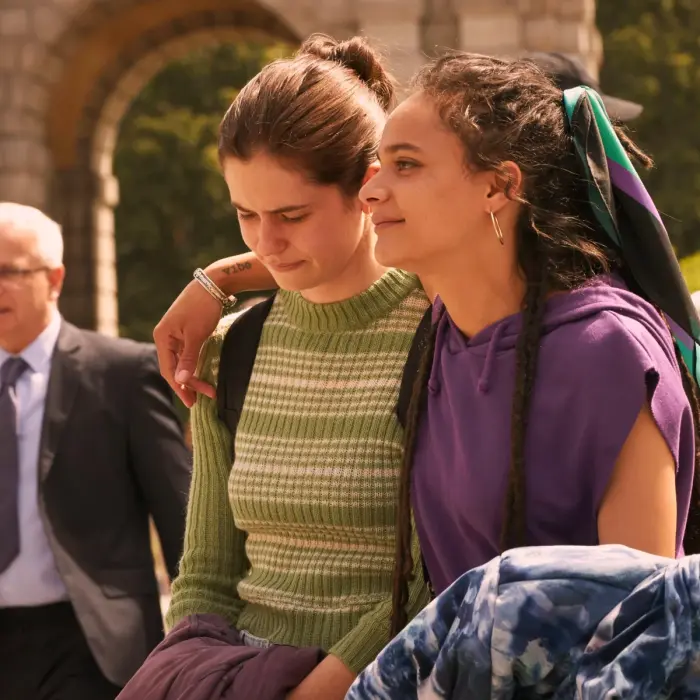
Conversations with Friends: The Aesthetics of the ‘Fissure’ Born from the Collision of Isolated Interiors and the Worlds of Others
Love is often less a desire to possess someone entirely and more a desperate struggle to have one’s own deficiencies validated through the gaze of another. While we long to connect with others, we simultaneously build thick walls of silence, fearing that our most vulnerable parts might be discovered.
The characters in Sally Rooney’s universe crave “Conversations,” yet paradoxically, the most crucial truths always linger within the unspoken voids. This work gazes into those voids, painting a lonely portrait of modern individuals wandering lost within the labyrinth of the ‘Other.’
🌿 Moments When This Drama Deeply Permeates
- For those who have felt a sudden, profound sense of isolation even while in the company of others.
- For those who believe that clumsy silence and ambiguous glances speak more than refined language.
- For those who wish to immerse themselves in the irresistible flow of emotion rather than the moral justification of love.
- For those who want to learn how to simply remain within a relationship rather than defining it.
- The reason you should read to the end is that this narrative is not a mere tale of infidelity or romance, but a poignant record of a woman’s growth as she aligns her ‘physical pain’ with her ‘existential reality.’
🎞 Note Before Watching
This work deals with dense psychological tension and physical intimacy between characters. However, it expresses these not through sensationalist direction, but through a sensory mise-en-scène connected to the characters’ inner pain. It is a delicate psychological drama about those wandering the ethical boundaries of relationships.
🎬 Drama Information
- Title: Conversations with Friends (2022)
- Director: Lenny Abrahamson, Leanne Welham
- Screenplay: Alice Birch
- Original Work: Novel of the same name by Sally Rooney
- Country: 🇬🇧 United Kingdom / 🇮🇪 Ireland
- Genre: Drama, Romance, Psychological Drama
- Running Time: 12 episodes total (approx. 30 mins per episode)
- Platform: Hulu, BBC Three (Watcha in South Korea, etc.)
- Cast: Alison Oliver (Frances), Sasha Lane (Bobbi), Jemima Kirke (Melissa), Joe Alwyn (Nick)
📖 Conversations with Friends: The Trajectory of Precarious Relationships Formed by the Intersection of Four Voices [No Spoilers]
Frances, a college student and poet living in Dublin, and Bobbi, her former lover and best friend, exist in a symbiotic relationship, sharing artistic inspiration. One day, they become acquainted with Melissa, a sophisticated writer, and their encounter with her husband Nick, an actor, begins to create fissures in their once-solid daily lives.
While the confident Bobbi is captivated by Melissa’s intellectual world, the introverted and observant Frances feels a strange sense of kinship and attraction toward Nick, who harbors a listless sorrow. Moving beyond the social frameworks of “couple” and “friend,” they form a secret relationship that tests the definitions of relationships and moral values each had previously believed in.
The drama tenaciously tracks the intellectual conversations among the four and the hidden jealousy, inferiority, and identity confusion beneath them. In particular, the physical pain Frances suffers and her secret bond with Nick become pivotal events that force her to dismantle and rebuild the boundaries of her ‘self.’
🧩 Silence as a Defense Mechanism for ‘Isolation’ and the Interpretation of Relationships
In Conversations with Friends, Frances acts as a lens through which to observe the world. She protects herself by hiding behind Bobbi’s flamboyant eloquence, but through her meeting with Nick, she experiences the collapse of those walls. The key to interpretation here is that Frances chooses Nick not out of simple affection, but because she discovers a shared ‘passivity’ and ‘melancholy.’
Their communication occurs primarily through text messages, brief calls, and long silences. This serves as the only sanctuary for two souls lost between the established order of the older generation (Melissa) and the self-assuredness of youth (Bobbi). Through their relationship, Sally Rooney demonstrates the power of the ‘unverbalized bond’—a point a review must capture.
Ultimately, this narrative explores how the act of loving someone forces one to face their own rock bottom, and how one can truly connect with others from that depth. The pain of endometriosis Frances endures is a process where internal psychological suffering manifests physically, serving as a device to visualize the disconnection and deficiency she feels in her relationships.
🔗 Subverting Power Structures: Tightrope Walking Between Intellectual Posturing and Emotional Vulnerability
In the progression toward the ending of this work, the subtle shift in power between characters is noteworthy. Initially, the older generation or the ‘successful couple’—Melissa and Nick—appear to hold the upper hand. However, as the story unfolds, it is revealed that their relationship also stands upon precarious fissures.
The relationship between Bobbi and Frances also transcends simple friendship. Bobbi is Frances’s intellectual muse and, simultaneously, a figure of authority who defines her. Frances’s act of hiding her relationship with Nick is her first attempt to escape Bobbi’s influence and establish a domain entirely her own.
Director Lenny Abrahamson captures even the minute tremors of muscles through extreme close-ups, emphasizing the emptiness that follows the splendor of dialogue. This direction allows viewers to feel that the relationships are being reorganized not by social contracts, but by purely personal ’emotional necessity.’
🔎 Reinterpreting the Ending — A Declaration of ‘Incomplete Union’ Amidst Eternal Wandering
The scene at the end of the drama where Frances and Nick reconnect via phone does not signify a simple reunion. It is not a complete healing or a resolution of moral flaws, but a ‘provisional choice’ made while fully accepting one’s own vulnerability. They have hurt each other and destroyed surrounding relationships, yet they turn toward each other once again.
This ending suggests that their relationship is a form that cannot be socially defined. They choose to remain as ‘witnesses’ who understand each other’s loneliness best, rather than as ‘lovers’ or ‘adulterers.’ Frances begins to find her own voice, stepping out of Bobbi’s shadow, while Nick leaves behind a comfortable but lifeless existence with Melissa to choose the unstable light that is Frances.
Ultimately, the point they reach is not stability, but a continuous trembling. Yet, that very trembling becomes the sole evidence of being alive. Through the wounds gained in this relationship, the protagonist Frances finally attains the dignity of having her body and mind fully connected.
Their reconnection is not the completion or settling of a relationship, but a declaration of survival—a commitment to eternally share each other’s deficiencies.
💬 Ambiguous Morality and Ending Interpretation in Conversations with Friends
Q: Can the relationship between Frances and Nick be dismissed as mere infidelity? What are your thoughts on the criticism that the work glamorizes adultery?
A: The primary criticism regarding the ‘glamorization of adultery’ is certainly valid. From a moral perspective, their actions leave deep scars on those around them. However, the structural intent of this work is not to pass moral judgment. Instead, the author asks whether ‘standardized frameworks of relationships (marriage, exclusive romance)’ can truly contain the complex interiors of human beings. The bond between Nick and Frances is portrayed more as emotional salvation than sexual desire, and it should be interpreted as a desperate solidarity between individuals who cannot be integrated into the existing order.
Q: Is Frances’s choice to accept Nick’s call at the end a regression rather than growth?
A: Many readers and viewers are divided on this point. In a narrative about finding an independent self, cutting Nick off might seem like the standard path. However, the ‘realism’ this work aims for is closer to a messy connection than a clean break. For Frances to stop hiding her desire and say, “Come and get me,” is the first moment she reveals her ‘true urge’ without filter, rather than following a ‘proper growth’ dictated by the gaze of others. Whether this is regression or a new way of affirming herself remains an open question for the audience’s own values.
✨ Conversations with Friends: Silence as the Most Intense Dialogue
This work asserts that of the countless “Conversations” we offer to others, only a fraction is truly conveyed. The essence of a relationship lies not in eloquent sentences, but in the chilly void that follows those sentences and the glances that project each other’s pain.
As the obsession with ‘healthy relationships’ grows in modern society, these incomplete and precarious characters created by Sally Rooney paradoxically offer us a sense of liberation. Love is not an exam where one must find the right answer, but a process of constantly writing down wrong answers and becoming familiar with each other’s handwriting.
True connection begins not in each other’s perfection, but the moment we recognize each other’s broken cracks.
💬 What color is your ‘void’?
At a silent dining table, do you avoid the other person’s eyes, or do you struggle to find the unspoken words within that stillness?
- A: Silence is disconnection. I must fill the speech somehow to erase the awkwardness.
- B: Silence is the deepest communication. I want to endure that weight shared without words.
Please share your choice and the subtle emotions you felt while watching this drama in the comments.
📽 Violet Screen Recommendation: Other Gazes into the Depths of Female Narrative
- Lost Girls and Love Hotels (2020)
- Reason for Recommendation: It deals with the psychology of a woman pushing her own pain to the limit in the unfamiliar space of Tokyo. It is a work that depicts the self-destructive impulses and the expansion of physical senses felt by Frances in Conversations with Friends in a darker and more aesthetic manner.
- The Worst Person in the World (2021)
- Reason for Recommendation: It covers the fragments of relationships experienced by a woman in her late 20s wandering to find her identity. A masterpiece that melts the self-portrait of a ‘smart but wandering’ youth—reminiscent of Sally Rooney—into the seasonality of Norway, offering beautiful insights into growth and loss within relationships.
To provide a more stable publishing environment, multilingual content, and better communication with our readers, we have moved our official publication to Substack.
All new film reviews and critical essays will be published on our new platform. This website will be closing down soon, so we would greatly appreciate it if you subscribed to our new space.
TODAY'S QUESTION
Which ending has stayed with you the longest?
Your answer isn't saved. Feel free to share it in the comments below.


You May Also Like

Only You The Series: A Reunion Breaking Eight Years of Silence, A Radiant Trajectory Forged by Longing in the Name of Protection

Hometown Romance Review: The Essence of a Spectacle Romantic Comedy Where the Urban and the Rural Converge