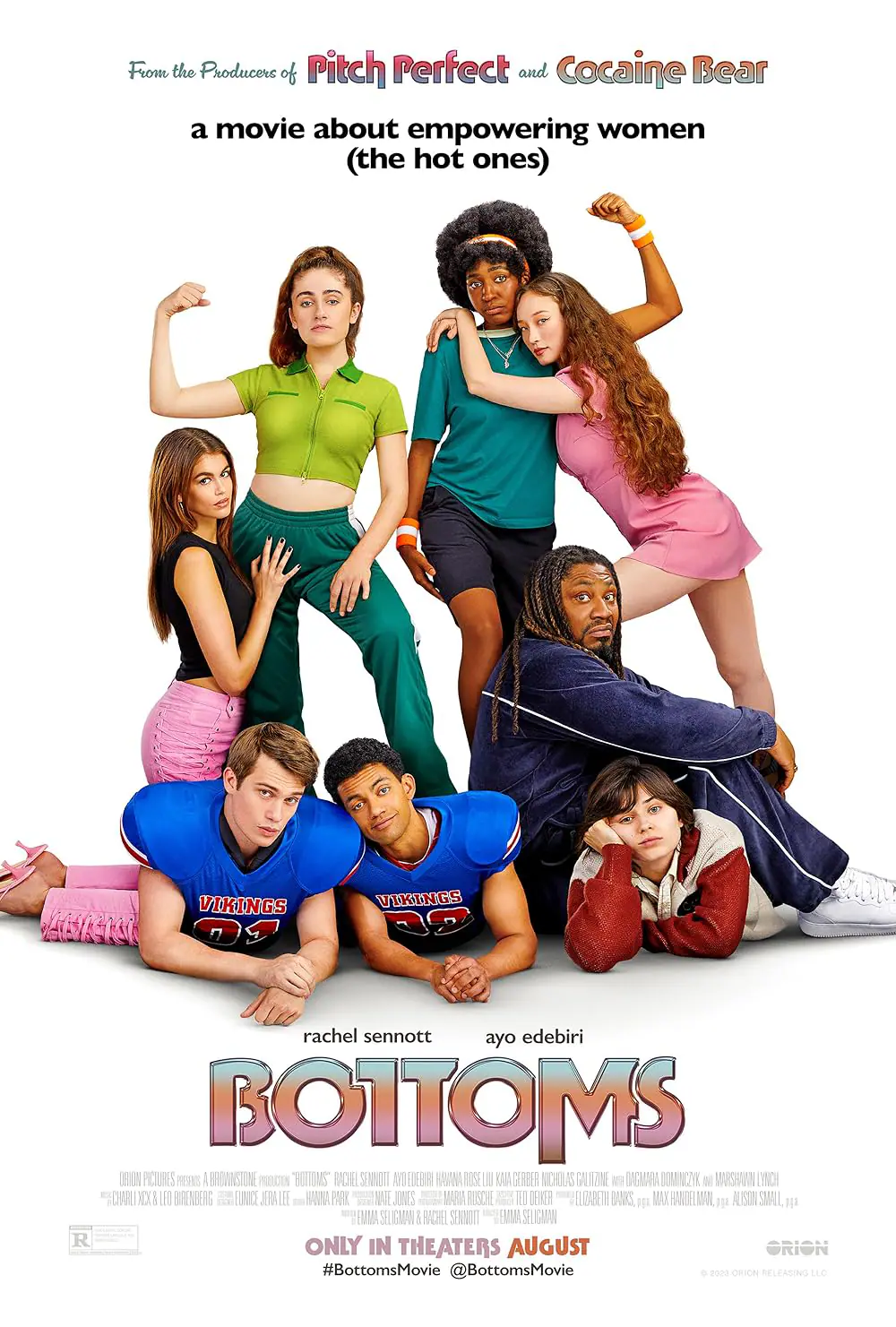
Bottoms (2023): Subversive Solidarity and the Anatomy of “Loser” Desires in B-Movie Comedy
The methods chosen by the isolated to save themselves are sometimes as absurd as they are destructive. Shattering the framework of “femininity” defined by society is perhaps not achieved through elegant solidarity, but through raw desire and reckless, bottomless audacity.
This work liberates the suppressed energy within us through the dissonance created when imperfect—or rather, fundamentally flawed—characters collide. I recommend this audacious narrative to those who find a primal roar more necessary than refined criticism.
🌿 Moments When This Film Deeply Permeates
- For those who wish to feel the catharsis of marginalization being sublimated into “comedy” rather than “anger.”
- For those who want to experience the subversive pleasure of twisting the conventions of the typical high school romance.
- For those who want to witness the process of growth as selfishness and sincerity, hidden under the guise of friendship, clash.
- Why you should read to the end: Because you will discover a sharp satire of patriarchal power structures hidden behind mere toilet humor, and the new horizons that “female-centered narratives” can reach.
🎞 Note Before Viewing
While this work includes coarse language and somewhat absurd, violent depictions involving high school students, these are devices for satire and genre-specific fun. It should be noted that this is a black comedy focused on the dynamics of relationships and psychological liberation rather than purely provocative settings.
🎬 Film Information
- Title: Bottoms (2023)
- Director: Emma Seligman
- Screenplay: Emma Seligman, Rachel Sennott
- Country: USA
- Genre: Comedy, High School
- Running Time: 92 minutes
- Platform: Coupang Play, Naver Series On, etc.
- Cast: Rachel Sennott, Ayo Edebiri, Ruby Cruz, Havana Rose Liu, Marshawn Lynch
📖 Bottoms: An Absurd Narrative Context for a Loser Rebellion [No Spoilers]
PJ and Josie, self-proclaimed “social untouchables” at Rockbridge Falls High School, are an unusual pair of lesbian best friends dreaming of romance with their cheerleader crushes before graduation. However, their reality remains at the very bottom of the school’s power hierarchy, stigmatized as “ugly, untalented gays.”
One day, when a rumor spreads due to a minor misunderstanding that they attacked the school’s idolized quarterback, PJ turns this crisis into an opportunity. Under the pretext of protecting female students, they go so far as to found a “Female Self-Defense Club (Fight Club).”
While the group initially began with the ulterior motive of getting closer to popular girls, the suppressed students begin to grow enthusiastic about this violent yet liberating space. As PJ becomes intoxicated by a thirst for power and Josie struggles with guilt, the confrontation with the school’s absolute authority—the football team—gradually spirals out of control. Just before their kingdom built on lies collapses, will they be able to find the true meaning of solidarity?
🥊 A Subversive Interpretation of Bottoms Overturning the Power Pyramid
The most striking aspect of this film is that it grants female characters the “right to be ugly.” While female relationships handled in media have largely focused on delicate emotional exchange or moral solidarity, this work unreservedly reveals purely selfish and goal-oriented desires.
PJ and Josie are by no means virtuous or righteous protagonists. They utilize their friends and resort to constant lying to satisfy their own sexual desires. By not hiding these moral flaws, director Emma Seligman elevates the female characters into multi-dimensional human beings. The raw energy generated when women occupy the position of the “stupid but lovable loser”—a role commonly seen in male-centered high school genres—shakes the existing gender role stereotypes from the very bottom.
🩸 A New Narrative and Mise-en-scène of Female Solidarity Written in Blood and Bruises
The violence occurring within the “Self-Defense Club” is not merely a device for provocation. The act of punching one another in the face and drawing blood is akin to a purification ritual that physically destroys the masks of “modesty” and “beauty” imposed by society.
The mess of the characters’ appearances, contrasted with the vibrant, primary-colored mise-en-scène, visualizes the message of liberation: that it is okay to be imperfect. In particular, the process by which symbols of toxic patriarchy—represented by the football team—are comically satirized scathingly exposes how hollow the foundations of such authority truly are. Their violence can be interpreted not as a means to suppress others, but as a struggle to break through the transparent walls that imprisoned them.
🔎 Reinterpretation of the Ending — A Paradoxical Unity Brought by Total Ruin
The film’s ending presents a pinnacle of catharsis that transcends logical probability. At a point where all lies are exposed and relationships are fragmented, the protagonists choose a direct confrontation instead of flight. The collective brawl they engage in at the football stadium is not a mere victory, but a declaration of identity that carves their existence into the world.
In the end, the two protagonists do not become heroes. They are still lacking in some ways and remain outside social standards. However, what matters is the “scar” they have come to share. The fissure that appears after the truth is revealed is transformed into a sturdy sense of bonding that can only be held by those who have witnessed each other’s rock bottom. This film suggests that failure and exposure are not the end, but the starting point where one can finally take off the mask and face the other.
The ending of this film is the reconstruction of a relationship through destruction, and the victory of a deformed order born out of chaos.
❓ FAQ Regarding the Ending and Narrative Structure of <Bottoms>
Q1. Regarding the criticism that the depiction of violence in the work is overly exaggerated and uncomfortable.
The violence in this work belongs to the realm of surreal satire, not realism. The school atmosphere itself, where the football team is deified, is a microcosm of an abnormal society, and the method of resisting it is also set to an extreme. This exaggeration should be understood as a formal genre convention that allows the audience to view the absurdities of reality objectively.
Q2. Does the selfish behavior of the protagonist PJ undermine the value of female-centered narratives?
Quite the opposite. Demanding “flawless virtue” or “victimhood” from female characters can itself be another form of oppression. PJ, who is faithful to her desires and repeats mistakes, demonstrates the final stage that female narratives should reach: a “return to the status of an ordinary human.” Her selfishness is the engine that drives the narrative and a core element in constructing a multi-dimensional persona.
✨ Bottoms: A Roar of Liberation Finally Reached by Our Messy Selves
For a long time, we have only seen “correct women” on screen. But this film says: it is okay to swear, to hit, and to be selfish sometimes. True solidarity does not arise from praising each other’s perfection, but from the process of enduring each other’s patheticness.
What brings down the sturdy walls of patriarchy is not a grand revolution, but the unceasing commotion of the marginalized writhing at the bottom. This film proves that the essence of a relationship lies in “acceptance” rather than “understanding,” and that the process is bound to be noisy.
True liberation is finally completed when one escapes the gaze of others and affirms even their ugliest self.
💬 Distance in Relationships: Do You Have the Courage to Speak the Truth?
Perfect friendship does not exist. There is only the determination to willingly share each other’s flaws.
Are you hiding your “bottom” to be loved, or are you looking for someone to share that bottom with?
💜 Violet Screen Curation: Other Stories of Women
- Shiva Baby (2020)
- Reason for Recommendation: A previous work by director Emma Seligman and Rachel Sennott of Bottoms. It is a masterpiece that unpacks the anxiety and desire of a young woman within a suffocating space through the lens of a suspense comedy.
- Booksmart (2019)
- Reason for Recommendation: A riotous comedy about two model students who dream of a final act of rebellion before high school graduation. While warmer in tone than Bottoms, its sensitivity in handling female friendship and growth is cut from the same cloth.
To provide a more stable publishing environment, multilingual content, and better communication with our readers, we have moved our official publication to Substack.
All new film reviews and critical essays will be published on our new platform. This website will be closing down soon, so we would greatly appreciate it if you subscribed to our new space.
TODAY'S QUESTION
What's your favorite line from a WLW movie or show?
Your answer isn't saved. Feel free to share it in the comments below.


You May Also Like

Take Me Home Ending Interpretation: The Imagination of Alternative Families and Sad Solidarity Born of Institutional Limits

Besties (Les Meilleures, 2021) Review: Identity and First Love Blossoming in a Tent Within a Forbidden Zone