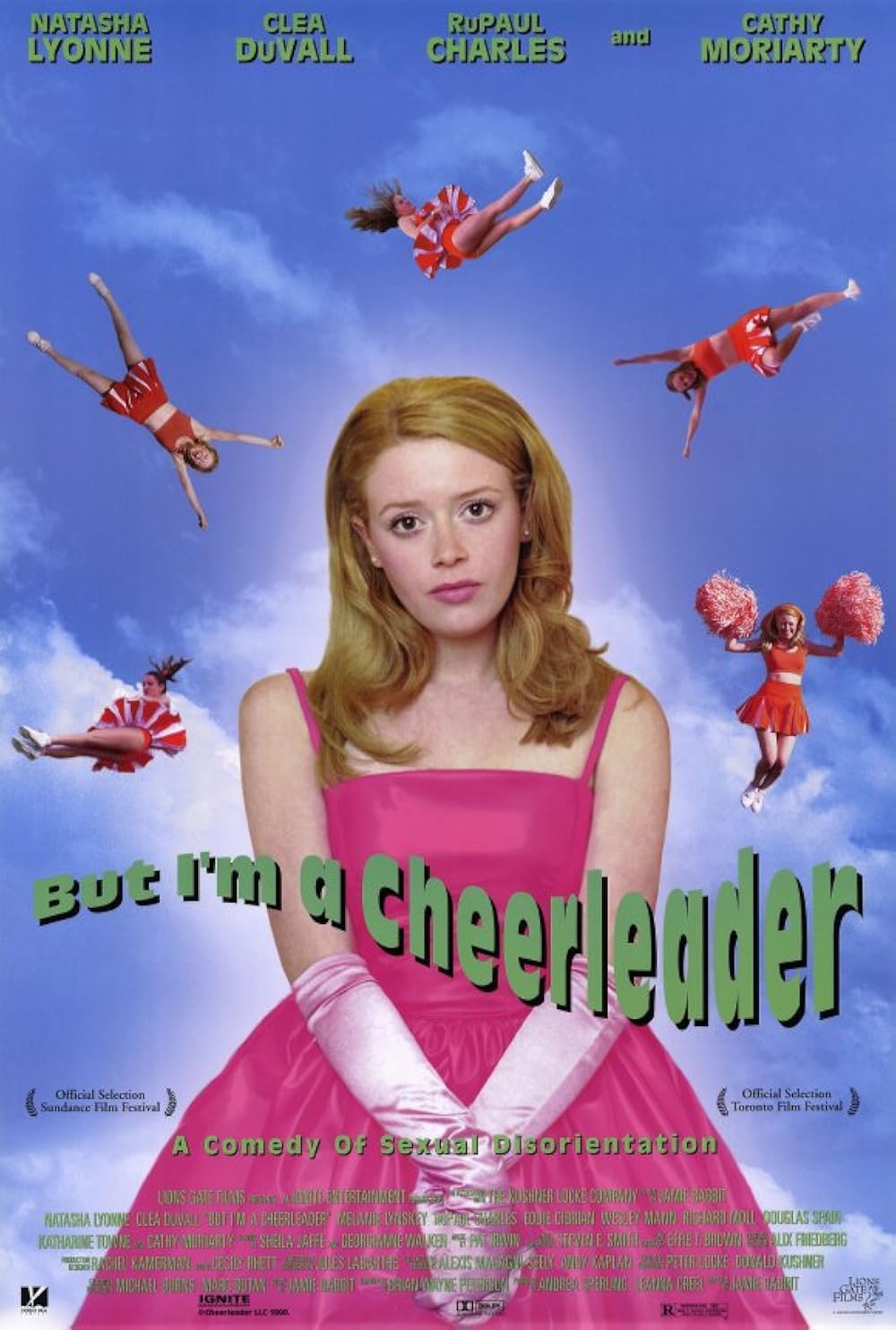
But I’m a Cheerleader: The Liberation and Love of Queer Identity Subverting a Pastel-Toned Controlled Society
There are those who live their lives losing their true faces within a perfect framework defined by the world. For those who have been erasing themselves, believing the eyes of others and social norms to be the correct answers, sometimes the most artificial and violent spaces paradoxically become places of awakening where they confront their true selves.
This film lightheartedly yet sharply depicts the journey of breaking through a faux paradise that imprisons our lives and finding one’s own essence through autonomous love and solidarity born at the peak of oppression.
🌿 Moments When This Film Resonates Particularly Deeply
- For those who want to escape the shackles of false normalcy demanded by society and family, and prove the value of true self-acceptance.
- For those who wish to deeply read into a sensory and playful queer romance film that cracks open artificial gender norms.
- For those who want to witness the growth of the relationship and genuine emotional connection between Megan and Graham, blooming amidst the violence of a counterfeit cure.
- Because one must read to the very end the sharp, humanistic critique and aesthetics of liberation hidden within a pink satire that subverts a standardized world.
🎞 Notes Prior to Viewing
This work addresses the heavy subject matter of a gay conversion therapy camp through a kitsch and bright-toned comedy, meaning the level of expression is neither provocative nor sadistic. It is an emotion- and relationship-centered queer narrative in which two women are drawn to each other and find their identities amidst artificial gender norms.
🎬 Film Information
- Title: But I’m a Cheerleader (1999)
- Director: Jamie Babbit
- Screenplay: Brian Wayne Peterson
- Country: United States
- Genre: Comedy, Romance, Drama
- Running Time: 85 minutes
- Platform: Naver Series On, Wavve, Watcha
- Cast: Natasha Lyonne, Clea DuVall, Cathy Moriarty, RuPaul
📖 《But I’m a Cheerleader》, The Dawn of Genuine Attraction Blooming inside an Oppressive Corrective Camp [No Spoilers]
Megan, an ordinary high school student and cheerleader, lives believing she is a perfectly heterosexual person, no different from anyone else. However, due to her vegetarian tendencies, preference for rock music, and her gaze directed at her fellow cheerleaders, her family and those around her begin to suspect she is a homosexual. Ultimately, Megan is forcibly sent to ‘True Directions,’ a gay conversion therapy camp.
Strictly segregated into pink and blue, Megan experiences confusion within the space as she is forced into artificial gender roles and behavioral patterns. In an environment where control and surveillance are routine, Megan meets Graham, a fellow camper who is cynical yet does not hide her identity.
As the counterfeit corrective program demanded by the camp persists, the subtle emotional spark between Megan and Graham grows even stronger. At the moment when heteronormative oppression reaches its peak, the relationship between the two moves beyond simple friendship into a phase of decisive conflict and change that awakens each other’s true essence.
🎨 A Plastic Prison of Pink and Blue, The Artificiality of Heteronormativity Visualized by 《But I’m a Cheerleader》
The Falsity of Gender Roles Exposed by Artificial Colors
The ‘True Directions’ camp in the film is filled with an extreme contrast of pink and blue. Through this plastic-like set design, Director Jamie Babbit visually demonstrates that patriarchy and heteronormativity are not natural instincts, but rather thoroughly designed and instilled artificial ideologies.
Cracks Developing Within a Controlled Space
The psychologies of Megan, who learns enforced femininity, and Graham, who rejects it, collide violently within this contrasting space. Every time the pure emotions of the two intersect, this perfectly controlled prison of color suffers deep cracks in its artificial outer walls, maximizing the narrative tension.
💖 The Dialectic of Rejection and Acceptance: An Analysis of Megan and Graham’s Relational Structure
From False Normalcy to Autonomous Awakening
Megan’s journey is a process of acceptance, unlearning the false normalcy defined by others and embracing her true desires. If Megan in the early scenes was a character striving to conform to the system, her emotional connection with Graham acts as a powerful catalyst that forces her to listen to her inner voice.
Two Divergent Gazes Confronting Oppression
Graham is a character who has already discerned the hypocrisy of the system and armed herself with cynicism; she disarms her defense mechanisms upon colliding with Megan’s purity. The relational structure of the two women is a combination of differing methods for coping with oppression, and their solidarity expands beyond simple romance into a narrative of salvation that affirms each other’s very existence.
🔔 A Reinterpretation of 《But I’m a Cheerleader》’s Ending: A Declaration of Liberation Subverting the Stage of Oppression and Complete Oneness
A Cheerleading Ending Subverting the Conventional Camp
In the film’s finale, Megan crashes the camp’s graduation ceremony to perform a cheerleading routine solely for Graham. This ending achieves a highly potent structural subversion, as it reappropriates the act of cheerleading—once a symbol of instilled femininity—into an autonomous tool to declare her identity and seduce her female lover.
Cracks in the System and the Acquisition of a Whole Self
The moment Graham takes Megan’s hand and escapes the camp, their relationship achieves a ‘complete companionship’ free from societal oppression. Even if they have lost the support of family and a safe sanctuary, the future of the two, having acquired their own dignity and identity, confirms a life of autonomy no longer mortgaged to a false paradise. Megan’s cheerleading is a flawless declaration of agency, substituting a tool of oppression with the language of liberation.
💬 Regarding the Satirical Grammar and Queer Narrative Interpretation of 《But I’m a Cheerleader》
Q. Opinions are divided on the approach of unpacking conversion therapy—a heavy subject matter—through comedy and a Camp aesthetic. What is the structural interpretation of this?
Some audience members raise critiques that the violent subject of conversion therapy, which left historical trauma on countless queer individuals, is consumed in an overly lighthearted and cartoonish manner. Considering the realistic weight of the subject matter, this is a fully valid criticism.
However, the aesthetic context of this film lies not in realistically reproducing violence, but rather in mocking the ‘hypocrisy and unscientific nature’ of the heteronormative framework that underpins that violence. Through exaggerated colors and satire bordering on slapstick, the director exposes how bizarre and absurd a theatrical performance the conversion therapy system itself is. By reinterpreting tragedy through the grammar of comedy, the film’s directorial style strips the system of its authority, suggesting to the audience an alternative form of queer resistance that subverts oppression with laughter, thereby leaving room for an open judgment.
✨ 《But I’m a Cheerleader》, A Solidarity of Dignity Won by Smashing a Faux Paradise
Despite being a work from the end of the 20th century, this film still poses sharp questions to modern society, which continues to measure individuals by enforcing a specific normalcy. It exposes how fragile and artificial the social standards dividing the normal from the abnormal truly are, demonstrating that genuine salvation comes not from the stability provided by institutions, but from the courage to face oneself completely.
The love between Megan and Graham goes beyond a mere rebellion against heteronormativity; it is a hymn of liberation directed at everyone who rejects the manuals prescribed by the world and seeks to form solidarity at their own pace. True self-acceptance begins at the exact moment one escapes the paradise engineered by others and affirms one’s own identity.
🔮 Which Choice Will You Make?
Will you live conforming to the safe rules and false theatrical plays set by society to avoid being hurt within relationships, or will you walk out toward a genuine love and solidarity that will prove your whole essence, even if it may be rough and uncertain?
🔮 Violet Screen Curation: Female Narratives Reaching Each Other Beyond Oppression
The Miseducation of Cameron Post (2018)
- Reason for Recommendation: Sharing the exact same setting of a gay conversion therapy camp as 《But I’m a Cheerleader》, this film portrays the solidarity and survival of queer youths in a far more calm and realistic tone. Instead of a light, kitschy satire, it serves as an excellent variation for those who wish to deeply follow a heavy emotional resonance and the internal growth of the characters.
The Gymnast (2006)
- Reason for Recommendation: A dense queer coming-of-age drama depicting the process of a former gymnast, who had lived trapped within an oppressive marriage and societal expectations, finding her true self through sharing physical and emotional connections with another female partner while preparing an autonomous aerial silk performance.
To provide a more stable publishing environment, multilingual content, and better communication with our readers, we have moved our official publication to Substack.
All new film reviews and critical essays will be published on our new platform. This website will be closing down soon, so we would greatly appreciate it if you subscribed to our new space.
TODAY'S QUESTION
Which film feels like your 'first love' story?
Your answer isn't saved. Feel free to share it in the comments below.


You May Also Like

Concussion (2013): Desires Awakened by Trauma, a Sensory Interpretation Piercing the Cracks of Stagnant Relationships

Snapshots (2018) Review: Love Shaken by 50-Year-Old Secret Photos and the Solidarity of Three Women