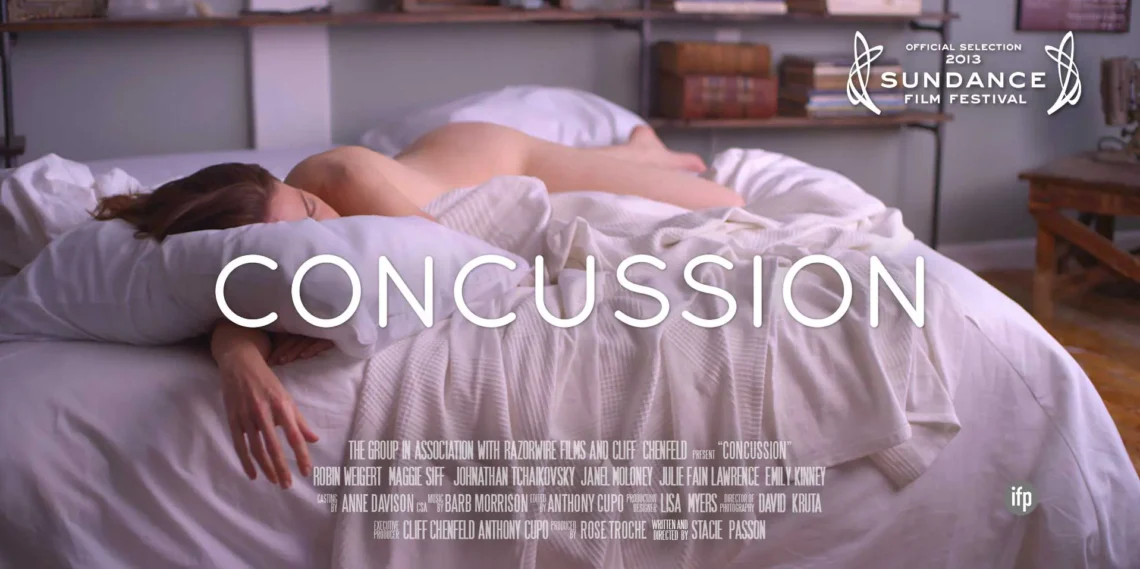
Concussion (2013): Desires Awakened by Trauma, a Sensory Interpretation Piercing the Cracks of Stagnant Relationships
There comes a sudden moment when a life that appears perfect feels inexplicably foreign. The tidy living room, the peaceful laughter of children, and a socially successful partner. Yet, when the very air of that comfort becomes suffocating, do we call it ‘stability’ or ‘isolation’?
The film Concussion elegantly and chillingly depicts the process of a woman, alienated from herself, reclaiming the sovereignty of her senses through the accidental physical impact of a concussion.
This story is not an indulgence in forbidden desire, but rather an existential record of a human being fighting a fierce battle to prove the existence of the ‘self.’
🌿 Moments when this film resonates deeply:
- An afternoon where you live a seemingly perfect daily life but feel an unexplainable emptiness within.
- When you realize a cosmic distance between you and your partner despite lying in the same bed.
- When you feel your social roles (mother, wife, professional) have swallowed your essence.
The reason to read until the end is that the film’s conclusion is not a simple regression, but a proposal of a new mode of survival accessible only to those who have acquired the ‘language of desire.’
🎞 Note before viewing
While this work includes physical contact and sexual discourse between women, these elements are utilized as devices to reveal character psychology and the power structures of relationships rather than for provocative consumption. It is an adult drama focused on the density of emotion and the essence of connection rather than graphic sensationalism.
🎬 Film Information (2013)
- Title: Concussion
- Director: Stacie Passon
- Screenplay: Stacie Passon
- Country: USA
- Genre: Drama
- Running Time: 96 minutes
- Platforms: Amazon Prime Video, Mubi
- Cast: Robin Weigert (Abby), Maggie Siff (Sam), Julie Fain Lawrence (Kate), Johnathan Tchaikovsky (Justin)
📖 Concussion Synopsis — A woman reclaiming the language of desire [No Spoilers]
Abby, a 42-year-old living a stable life in the New Jersey suburbs, works in apartment renovation and lives with her wife Kate, a divorce attorney, and their two children. One afternoon, a baseball thrown by her son strikes Abby in the head. While recovering from a diagnosed mild concussion, she begins to ask herself for the first time: “Is this really all there is to my life?”
Feeling emotionally and physically alienated in her relationship with her wife, Abby makes a series of impulsive choices, eventually beginning work as an escort for female clients only in a private Manhattan apartment under the pseudonym ‘Eleanor.’ Through the network provided by an employee, Justin, Abby meets various female clients and gradually restores her suppressed desires and self-confidence.
However, this double life begins to collide with her domestic world. Particularly as her relationship with Sam, a neighbor from her spin class, deepens beyond a simple encounter, Abby stands at a crossroads of choice.
🧠 Concussion In-Depth Analysis — The prison named ‘Daily Life,’ and what the ending leaves behind
💥 Concussion is not an event, but a metaphor — Interpreting Abby’s awakening
Director Stacie Passon utilizes the concussion—both the title and the core incident—not as a mere accident, but as an aesthetic device that creates a crack in the persona. Before the blow to the head, Abby was strictly a ‘functioning human being.’ She was a background presence repairing houses, tending to the children’s meals, and supporting her wife’s career.
The cognitive confusion following the concussion punctures the solid fortress of ‘bourgeois morality’ and ‘domestic peace’ that she had maintained all her life. While aligning with the traditions of Luis Buñuel’s classics, this film opens a differentiated horizon of interpretation by shifting the subject of the gaze to a woman. The audience does not witness Abby being purchased by others; rather, they witness her restoring her vanished contours using the desires of others as a mirror.
💔 The ‘Invisible Divorce’ of a lesbian couple — Relationship structure analysis
The most clever aspect of this film is the removal of external conflicts (hate, discrimination) commonly consumed in queer narratives. In their place remains ‘relational entropy.’ Abby and Kate love each other, but that love has become inertial.
Specifically, Kate’s line, “I don’t want anyone,” sharply captures the emotional exhaustion and the asymmetry of power occurring within the relationship. Abby’s choice of the extreme deviation of escort services is not motivated by mere sexual pleasure.
It is closer to a desperate struggle to confirm her own existence by becoming ‘the object of fervent desire’ for someone else. The film precisely dissects how a stable relationship can castrate individual desire and the manner in which that castrated desire makes its return.
🏙️ Suburbs vs. Manhattan — Psychological contrast spoken through space
The spaces within the work visualize Abby’s dual self. The New Jersey mansion appears sunny and warm, but in reality, it is a ‘space of noise’ punctuated by endless childcare and domestic labor. Conversely, the small Manhattan apartment she secures is cold and minimalist, yet it is a ‘sanctuary of silence’ controlled solely by her will.
The setting of Abby as a renovation contractor who dismantles and reassembles household items is also symbolic. While she repairs the homes of others, she cannot fix her own collapsing interiority; it is only after occupying the new space in Manhattan that she truly begins the ‘remodeling’ of herself. The shift in space is a shift in self, symbolizing the split between the public persona and private desires experienced by modern women.
🔎 Reinterpreting the Concussion Ending — Where she returned is not the starting point
Many viewers feel a sense of futility seeing the ending where Abby ultimately chooses her family and returns to her daily life. However, this return is neither defeat nor surrender. In the final spin class scene, her expression is markedly different from the vacant state at the beginning of the film.
She has returned in a state of precise awareness of what she craves. The faces of the many women she met through her escort work were, in the end, fragments of Abby herself. Through her relationships with others, she found the ‘words to describe herself.’ The dinner table with Kate following the conclusion will not be as peaceful as before. However, unlike the past characterized by consistent silence, she has now become a being capable of bringing forth uncomfortable truths.
Abby’s return is not a resignation, but a subjective choice of someone who has reclaimed the language of desire re-entering reality.
❓ Controversies surrounding the Concussion ending and interpretation — How honest is this film?
Q1. Isn’t Abby’s choice ultimately a return to the patriarchal system?
Some critics point out that her eventual return to the roles of ‘mother’ and ‘wife’ is a narrative limitation. However, the aesthetics of this work lie in ‘brutal realism’ rather than a fantasy escape. In reality, we cannot abandon all foundations just because we have identified our desires. The film acknowledges those limits but leaves the judgment to the audience by implying that the inner self of the returned Abby can never be the same as before.
Q2. Does the subject of escort services commodify female sexuality?
This work does not use the subject matter to glamorize or condemn sex work. Rather, it exposes the irony of modern society where ‘honest desire’ can only be confronted within a clear contractual relationship of buyer and seller. Through the contradiction where desires unspoken even to the closest partner erupt within a contractual relationship with a stranger, it questions the fiction of the ‘normal relationships’ we maintain.
✨ Concussion — Questions this film poses in an age of lost desire
Concussion illuminates the vast void of our lives through the brief shock of a head injury. We all live a double life to some extent. The gap between the self required by society and the true self swirling within exists in everyone.
The film asks: Is your daily life truly alright? Is that tranquility perhaps the result of sacrificing your desires as an offering? This film does not urge us toward deviance, but quietly whispers to check if at least the spark within has not been extinguished.
Desire is not a poison that destroys relationships, but the final bulwark that preserves the self within a relationship.
💬 The courage to start again at the end of a relationship
Between the desire to be completely understood by someone and the secret you wish to hide from everyone, what choice would you make?
Would you stay within a safe silence and slowly wither away, or would you utter truthful language even at the risk of catastrophe?
🔮 Violet Screen Curation
- The Duke of Burgundy (2014): Another masterpiece that explores desire, roleplay, and the power structures of relationships through aesthetic mise-en-scène.
- Disobedience (2017): A drama that captures a heavy narrative regarding forbidden desire, faith, and choice through detailed emotional lines.
To provide a more stable publishing environment, multilingual content, and better communication with our readers, we have moved our official publication to Substack.
All new film reviews and critical essays will be published on our new platform. This website will be closing down soon, so we would greatly appreciate it if you subscribed to our new space.
TODAY'S QUESTION
What's the most memorable new release you watched this year?
Your answer isn't saved. Feel free to share it in the comments below.


You May Also Like

Eileen, a Noir of Suppressed Desire and the Illusory Fissure Named Rebecca (Eileen, 2023)

Ashamed (2011): The Aesthetics of Desire and Emotion Deconstructed at the Boundaries of Female Narrative