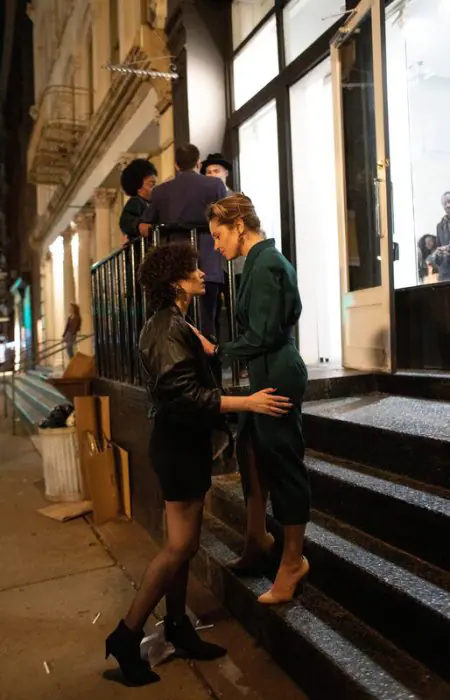
Abby Parker in The Deuce: Reclaiming Agency from the Streets of Desire
Comfortable tranquility sometimes suffocates the soul. Is it courage or aimless wandering to reject a guaranteed future within the walls of privilege and confront the visceral desires of the lowest places head-on?
HBO’s series The Deuce chronicles the birth of the prostitution and porn industries in 1970s New York City’s Times Square, but at its center is a woman who breathed the air of the era to write her own narrative: Abby Parker. Her choice was not mere deviance, but a desperate struggle for self-determination.
🌿 Moments When This Drama Deeply Resonates
- When you feel a powerful impulse to deviate from the “model orbit” prescribed by the world.
- The moment you realize that relationships in the name of love are, in fact, arenas for invisible power struggles.
- When you face frustration witnessing how powerless your convictions are before massive capital and systems.
- The reason to read to the end: Abby Parker’s 14-year trajectory offers the most intellectual answer to the “right to exist as oneself” that we have lost.
🎞 Note Before Watching
As this work is set in the New York sex industry of the 1970s and 80s, nudity and sexual depictions are frequent. However, these are not devices for mere stimulation; they serve as essential mise-en-scène reflecting how capitalism commodifies the human body and as a mirror illuminating the essence of relationships.
🎬 Drama Information
- Title: The Deuce (2017–2019)
- Directors: Michelle MacLaren, James Franco, and others
- Writers: David Simon, George Pelecanos
- Country: USA
- Genre: Drama, Period Piece
- Runtime: Seasons 1–3 (25 episodes total)
- Platform: HBO Max (Wavve, Watcha, etc. in South Korea)
- Cast: Margarita Levieva (Abby Parker), Maggie Gyllenhaal (Candy), Paloma Guzman (Pilar)
📖 The Start of Abby Parker’s ‘Filthy Heaven’ [No Spoilers]
Abby Parker, a 20-year-old NYU English major raised in a wealthy Connecticut home, suddenly drops out of school. Disillusioned by the hypocrisy of the elite, she seeps into the raw underbelly of Times Square, known as “The Deuce.” Her life changes rapidly after meeting bartender Vincent Martino.
Abby grows into the manager of the “Hi-Hat,” the bar Vincent operates, and strives to establish her own order amidst the chaos where pimps, sex workers, and gangsters intermingle. She does not remain a mere bystander. She transforms into an activist practicing feminist solidarity, advocating for the rights of sex workers and standing up to the violence of pimps. What she faced after leaving her wealthy past for self-chosen isolation was a peculiar vitality blooming in the most hideous of places.
🌆 Interpretation of the Rejection of Privilege and Abby Parker’s ‘Chosen Isolation’
The most critical point in Abby Parker’s narrative is her class position. Unlike other women in Times Square, she is a person who has a “place to go back to.” However, she destroys that safe harbor herself.
In Season 1, the act of rejecting her father’s check and bringing Vincent to a family gathering as a form of “shock therapy” is her own declaration of war against the established order. To her, “The Deuce” was not a place of escape, but a truthful battlefield free of hypocrisy. While recognizing her own privilege, she utilizes it as a weapon to help women on the streets, forming a unique positional energy. This is a process of intellectual growth that expands beyond self-salvation into solidarity with others.
⛓ The Open Relationship with Vincent: The Illusion of Limitless Love and Its Conclusion
The relationship between Vincent and Abby is the core axis that runs through the entire series. The two seem to respect each other’s freedom through the format of an “open relationship,” but beneath it lies a constant psychological fracture.
While Vincent is a character who lives off the sex industry by parasitizing mafia capital, Abby is an activist seeking to dismantle the exploitative structures of that very industry. Their love is like a house of cards built upon structural contradictions. The more Abby tries to make Vincent’s bar a sanctuary, the thicker the scent of street blood Vincent brings back with him. The conclusion of this relationship is an inevitable parting.
Abby did not allow love to erode her convictions; she eventually chooses to lay down the power of the “Hi-Hat” gifted by Vincent and returns to her studies. This is a declaration proving that dignity takes precedence over love.
🎨 Meeting Pilar: Intellectual Liberation and Queer Narrative Interpretation
The relationship with the graffiti artist Pilar, who appears in Season 3, is the turning point where the orientation of Abby Parker’s relationships completely shifts. If her relationship with Vincent belonged to the realm of “survival and compromise,” her meeting with Pilar approaches as the substance of “intellectual and political liberation.”
The space shared with Pilar was a pure field of struggle where ideals and art were discussed. Abby fills her intellectual deficiencies through Pilar’s gaze, which is filled with conviction. However, this relationship could not last forever either. As the passion of indulging in each other’s skin began to fade, Abby realized something.
Pilar, too, was a milestone she had to pass. The end of this relationship was not a failure but growth. Choosing neither to be someone’s “girlfriend” nor a “comrade,” she chooses solitude once again to exist solely as herself.
🔎 Reinterpreting the Ending: Questions Abby Poses to Us After the Conclusion
The appearance of an elderly Abby Parker as a lawyer returning to Times Square is the ultimate highlight of The Deuce. She is no longer the confused girl of the 1970s. As she looks upon the current Times Square, now occupied by flashy neon signs and massive capital, remorse and pride cross in her eyes.
What she gained was “her own language,” and what she lost was the “purity of street romance.” However, she knows better than anyone that such romance was built upon someone else’s sacrifice. Her appearance in the finale proves that her experience at the bottom was not mere wandering, but the fertilizer for social justice.
Abby Parker’s life is a perfect narrative conclusion, demonstrating the fact that only those who have saved themselves can advocate for others.
❓ [The Deuce] On Abby Parker’s Choices and Limitations
Q1. Is the criticism that Abby’s activities were ultimately nothing more than the ‘moral play of a wealthy white woman’ justified?
This critical perspective exists within the work itself. In reality, Abby was someone free from the fundamental economic poverty experienced by the women on the streets. However, the drama breaks through this criticism head-on by showing the process in which Abby clearly recognizes her limitations and, instead of remaining in a merely patronizing attitude, moves toward a legal and structural battle (her return as a lawyer).
Q2. What significance does the queer relationship with Pilar hold in the narrative?
The meeting with Pilar symbolizes a complete escape from the male-centric worldview represented by Vincent. As a comrade and lover who provides Abby with intellectual and political stimulation, Pilar helps Abby explore the various desires she had suppressed. This relationship becomes a decisive turning point that allows Abby to focus on her inner voice rather than the gaze of others.
✨ [The Deuce] The Only Way for an Individual to Overcome the Era is to Record and Remember
Abby Parker recorded the faces of The Deuce through her camera lens and lived through that scene herself. Her narrative shows how the will to preserve human dignity manifests even in spaces where capitalism operates most brutally.
We are all living our own “The Deuce.” To those of us struggling between desire and compromise, Abby Parker says: True liberation begins not in the comfort given by others, but in the painful freedom I choose for myself.
The character of Abby Parker is a great witness who refused to be a cog in the system and maintained authorial agency over her own narrative until the end.
🌌 “Maybe you haven’t met the one yet, or maybe you already missed them.”
Abby found her way on the grand map of justice to save the world, yet she failed to read the small coordinate of her lover’s loneliness right beside her. Pilar’s declaration of parting proves how noble the convictions Abby upheld were, and simultaneously, how chilling the price of “warmth” she paid to uphold those convictions was. The solitude of a woman who craved “the world she had to prove” more than love asks us:
If you had to sacrifice the “minor promises” kept by your side for the “great cause” of changing the world, would you willingly accept that lonely growth?
🎬 Violet Screen’s Recommended Curation
- Betty (2020) / HBO
- Reason for Recommendation: It deals with the solidarity of women set against the New York skateboarding scene. If The Deuce dealt with the raw survival of the 70s, Betty sensuously and hiply depicts the way women occupy space and support each other in a modern city.
- Vida (2018) / Starz
- Reason for Recommendation: It portrays two sisters who return home after their mother’s death and discover their mother’s hidden queer identity and their own roots. The conflicts within class, gender, and community resemble the agony Abby experienced, providing a deep sense of immersion.
To provide a more stable publishing environment, multilingual content, and better communication with our readers, we have moved our official publication to Substack.
All new film reviews and critical essays will be published on our new platform. This website will be closing down soon, so we would greatly appreciate it if you subscribed to our new space.
TODAY'S QUESTION
What's your favorite line from a WLW movie or show?
Your answer isn't saved. Feel free to share it in the comments below.


You May Also Like

Sin huellas: The Reunion of a Romani Cleaner and a Detective, a Narrative of Solidarity Beyond Hatred

Matlock (2024): Sarah and Kira, a Harmless Narrative of Love Piercing the Cracks of Perfectionism