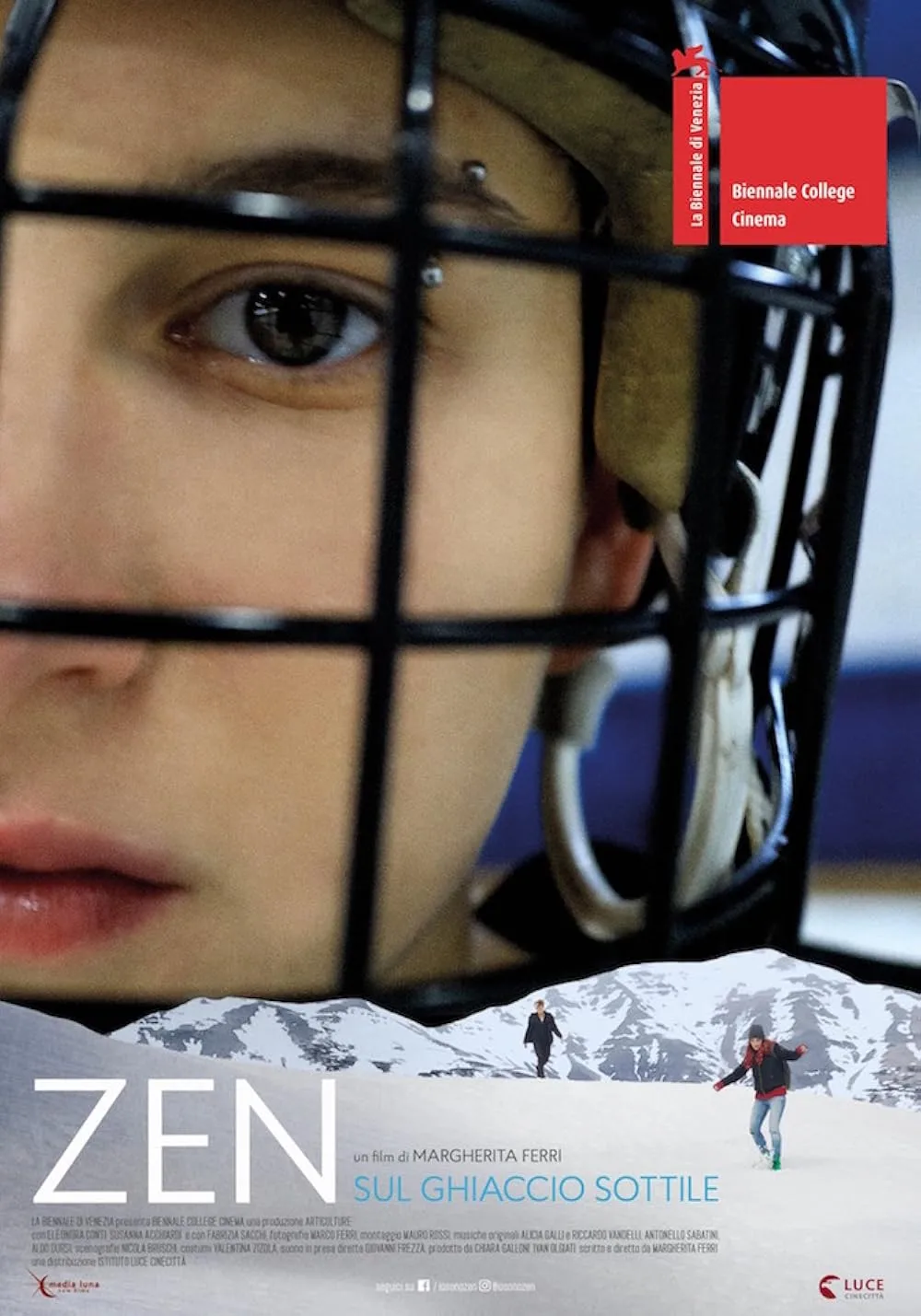
[Zen in the Ice Rift] A Queer Coming-of-Age Interpretation of Two Girls Blooming Atop a Perilous Glacier
In the midst of a cold, snow-capped mountain range where solitude feels physicalized, every one of us walks upon our own “thin ice.” Confronting one’s true face before the rigid walls of gender and roles dictated by others always accompanies a frightening, chilling isolation.
Zen sul ghiaccio sottile (original title) is a poetic record that holds its breath to capture the sound of that ice cracking. Moving beyond the mere growing pains of passing through a period of youth, this film tenaciously tracks how two beings, recognizing each other’s deficiencies within an oppressive community, leave an indelible mark on one another’s flesh.
🌿 Moments When This Film Deeply Permeates
- For those who have felt suffocated within the rigid boundaries of compulsory heteronormativity and gender roles imposed by society.
- For those who wish to read another’s loneliness hidden behind a rough defensive barrier, using nothing but glances and the surrounding atmosphere.
- For those who trust the liberation offered by sensory, somatic narratives like physical intimacy, dance, and tattoos over spoken language.
- The reason you must read until the end: The film decisively rejects the clichés of a typical queer romance happy ending or the complete solidification of identity, allowing us to confront the raw, fluid essence of youth’s most unstable emotions.
🎞 Note Before Viewing
This work addresses the identity confusion of adolescents and homophobic, sexist bullying within a closed community. The sensory and physical intimacy between the characters is depicted with high density. It is a profound art film that focuses on the intimate emotional lines and shifting relational dynamics between two isolated girls rather than sensational provocation.
🎬 Film Information
- Title: Zen in the Ice Rift (Zen sul ghiaccio sottile, 2018)
- Director: Margherita Ferri
- Screenplay: Margherita Ferri
- Country: Italy
- Genre: Drama, LGBTQ+
- Running Time: 87 minutes
- Platform: Local independent film platforms and major VOD services
- Cast: Eleonora Conti, Susanna Achchiardi
📖 Zen in the Ice Rift, The Secret Escape and Fracture of Two Girls Beginning in a Frozen World [No Spoilers]
In a closed ski resort town in the Italian Apennines, Maia (commonly known as Zen), a rough 16-year-old tomboy, lives as the sole female player on the local ice hockey team. Suffused with harsh homophobic bullying from her teammates due to her masculine appearance and demeanor, Zen willfully chooses a rougher, more isolated existence to defend herself. Conversely, Vanessa is the girlfriend of the team’s popular captain, an attractive figure envied by everyone in town.
Vanessa demands the keys to a mountain cabin from Zen for a secret rendezvous with her boyfriend, creating a point of contact between the two. However, as Vanessa recoils from compulsory sexual relations and detaches herself, the remote cabin transforms into an isolated sanctuary for just the two girls.
In a space hidden from the world’s gaze, the two begin to explore their inner identities and desires through physical and sensory communication that transcends spoken language, but the conservative atmosphere of the town and the pressure of its norms gradually threaten their relationship.
❄️ The Thin Ice (Ice Rift) Symbolizing the Fluid Identities and Limitations of Zen and Vanessa
The aerial shot of the fracturing glacier that opens the film serves as the psychological landscape confronted by the protagonist, Zen, and a grand symbol governing the entire film. Zen exists as the sole foreign object on the hard, cold ice of a male-dominated hockey team. The verbal and physical violence inflicted by her teammates lacerates her gender identity, yet Zen paradoxically arms herself with an asexual or defensive posture, turning as rigid as solid ice.
Vanessa, on the other hand, appears to perfectly execute the role of the “attractive woman” demanded by this conservative rural village, but her interiority resembles thin ice that could crack at any moment. The mountain cabin where the two meet functions as a form of heterotopia where the power structures and sexual expectations of the existing community are entirely erased.
Here, the two girls suspend verbal definitions, experiencing sensory liberation as they draw on each other’s bodies and give each other tattoos. Director Margherita Ferri refuses to petrify youth’s sexuality into a fixed noun, instead leaving it in a fluid state that continuously flows and shifts form, thereby expanding the aesthetic horizon of queer narrative.
🔎 Reinterpreting the End — A Declaration of Dignity and Growth Left by a Ballet on Ice
The film’s ending resolutely refuses the clear awakening of identity or the dramatic union expected by audiences. After their first kiss concludes not with sweetness but with tension and awkwardness, Vanessa ultimately chooses to return to her original place, unable to withstand social norms and community pressure. Zen is left alone in a deeper social isolation than before.
Yet, the lingering resonance of this ending is not a simple loss or the rupture of a relationship. In the space where Vanessa’s presence left a fracture in Zen’s life, Zen finally constructs a territory of her own, entirely liberated from the gaze of others.
The final scene, where Zen stands alone on a deserted ice rink, sheds her heavy hockey gear, and performs a balletic sequence, marks the pinnacle of sensory liberation in the film. A girl who once skated across the ice with crude hockey blades now dances, revealing the flexible contours of her body—a gesture of dignity that shatters the frames of “tomboy” or “monster” prescribed by the world.
Having looked directly into her own interiority through her relationship with Vanessa, Zen attains an internal growth that affirms her own existence, even if she has lost love. Zen’s final dance is a declaration of autonomy, stating her intention to exist solely as herself beyond the binary gender limitations imposed by others.
💬 A Discussion on the Representation of Women and Ending Interpretation in Zen in the Ice Rift
Q1. Isn’t Vanessa’s defection and return a typical instance of queerbaiting or a disposable narrative?
Some viewers criticize the film because Vanessa returns to the heterosexual system after using Zen as a tool to explore her own identity. However, rather than an aesthetic limitation of the work, this is a directorial device designed to structurally expose the reality of the pressure exerted by a closed community.
Instead of depicting Vanessa as a coward, the film structurally demonstrates that she, too, is a victim imprisoned by normalcy. Vanessa’s return does not signify the failure of their solidarity; rather, it paradoxically proves how sensory and fierce their brief moment of escape truly was.
Q2. How should we interpret the criticism regarding the ambiguity of Zen’s identity, as it is never explicitly defined as either transgender or lesbian?
This work adopts a method that avoids hastily labeling a character’s identity. What Zen experiences is a mutable adolescent state where gender dysphoria and same-sex attraction are intricately intertwined. By leaving it unnamed, the film instead invites the audience to ponder the fluidity existing at the boundaries of gender and sexual orientation, demonstrating a diversity in female representation that holds significant critical value even from a contemporary perspective.
✨ Zen in the Ice Rift, Learning to Become Your Own Foothold in the Center of a Frozen World
Through the image of Zen standing alone on the ice, tightly lacing her skates even after the brief warmth shared with Vanessa has vanished, the film illustrates structural growth that transcends mere loss. Redemption obtained by relying on another is a mirage; the work argues that breaking through the oppressive norms demanded by a patriarchal society is ultimately an individual’s solitary struggle to assemble a fragmented self.
What blooms in the space where love and solidarity have failed is a sublime dignity toward oneself that remains uncorrupted, even in the face of the world’s betrayal.
🏒 On this cold ice, have you ever halted your steps for fear that the ice of public gaze might shatter?
Everyone experiences moments where they bury their internal cries in silence to conform to the standards of the world. Will you choose a life of existing as yourself despite absolute isolation, or will you erase yourself to settle as a member of a safe community? What choice would you make upon this thin ice?
👥 Other Perspectives from Violet Screen, Echoing the Density of Loneliness
- Lovesong (2016) — Directed by So Yong Kim
- Reason for Recommendation: Addresses the ambiguous, highly dense emotional fractures between two longtime female friends (Riley Keough and Jena Malone). It is a masterwork that captures an indescribable identity and fluid relationships through a static camera and microscopic emotional curves.
- Tomboy (2011) — Directed by Céline Sciamma
- Reason for Recommendation: A work that explores the identity confusion and societal gaze experienced by Zen, but through the clear, chilly lens of an earlier childhood. The childhood identity situated at the boundaries of gender and the sensory descriptions provide a profound resonance.
To provide a more stable publishing environment, multilingual content, and better communication with our readers, we have moved our official publication to Substack.
All new film reviews and critical essays will be published on our new platform. This website will be closing down soon, so we would greatly appreciate it if you subscribed to our new space.
TODAY'S QUESTION
Which ending has stayed with you the longest?
Your answer isn't saved. Feel free to share it in the comments below.


You May Also Like

Drifting Flowers (2008): Three Streams of Queer Narratives, Our Wandering Youth Burdened with Sorrow

Clouds of Sils Maria Analysis: A Solidarity of Isolation Between Women and the Ghosts of Time