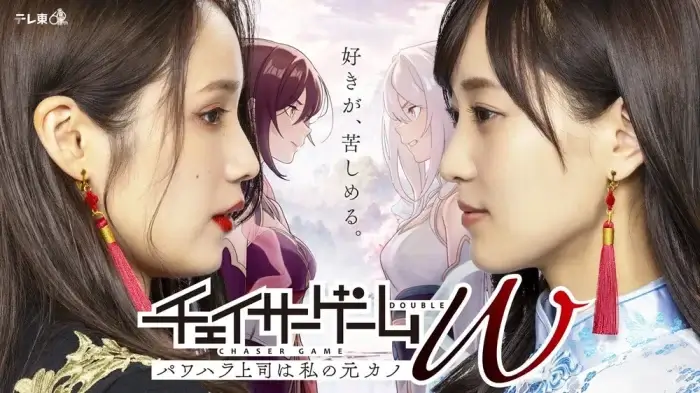
Chaser Game W: Power Harassment Boss Is My Ex-Girlfriend—An Interpretation of Deliverance and Solidarity Born from the Love-Hate Dynamics of Power Harassment
Every breakup leaves a trace, but an abrupt severance without an understood cause digs a massive pitfall in the heart. Love that ends in silence is bound to grow, as time passes, not into longing, but into a deformed shape of hatred and lack.
Chaser Game W: Power Harassment Boss Is My Ex-Girlfriend is a work that chases the fierce emotional trajectory of two women who, within that frozen time, tried to destroy each other but ultimately became each other’s deliverance. Moving beyond a simple office romance, this drama sharply captures the essence of a relationship that is finally completed only by confronting past wounds head-on and being broken.
🌿 Moments When This Drama Deeply Permeates
- When the true emotion buried beneath fierce resentment inevitably leaks through cold gazes
- When witnessing the struggle to never let go of each other’s hands despite social scrutiny and realistic constraints
- Therefore, the reason to read until the end is that it unpacks, through a humanistic lens, the structural mechanism by which destructive vindictiveness is sublimated into perfect solidarity and love, as well as the true meaning of the ending that pierces through the seasons.
🎞 Note Before Watching the Drama
Although this work adopts the form of a revenge drama utilizing the provocative subject matter of workplace power harassment, its essence is a relationship-centered narrative focusing on the deep emotional communion and growth of the two characters. While the amplitude of emotion is depicted somewhat violently, this functions as a device to maximize the characters’ internal lack.
🎬 Drama Information
- Title: Chaser Game W: Power Harassment Boss Is My Ex-Girlfriend (チェイサーゲームW パワハラ上司は私の元カノ, 2024)
- Director: Ota Yu, Yamaguchi Yuya
- Screenplay: Asada Atsushi, Ota Yu
- Original Work: Original narrative based on the worldview of the manga Chaser Game
- Country: Japan
- Genre: Office, Romance, Drama
- Running Time: Season 1 (8 episodes total) / Season 2 (8 episodes total)
- Platform: TV TOKYO / OTT Streaming
- Cast: Sugai Yuika, Nakamura Yurika, Kurotani Tomoka
📖 Chaser Game W Synopsis: A Love-Hate Business Brought by the Storm of Reunion [No Spoilers]
Itsuki Harumoto, who is in her fifth year at DD Company and has been selected as the leader of the massive Korean-Chinese joint venture game project Monster World, finds her joy of promotion short-lived as she is caught in a massive whirlpool of fate upon reuniting with her ex-girlfriend, Lin Dongyu, who appears as the executive in charge from the Chinese partner company. Because Itsuki had initiated their breakup through one-sided silence during their university days, Dongyu, harboring deep wounds and a desire for revenge, reigns over Itsuki as her superior and begins practicing power harassment by forcing excessive workloads upon her.
Having focused solely on work while hiding her sexual identity, Itsuki silently endures the pain amidst Dongyu’s cruel badgering. However, due to sabotage surrounding the project and the intervention of another corporate power faction, the conflict gradually races toward a catastrophe. The precarious business, mixed with lingering attachment and hatred for one another, begins to unearth their hidden pasts and present secrets one by one.
🎯 Subversion of Power Structures and Emotional Asymmetry
The dynamic dominating the first half of Chaser Game W lies in the asymmetry of power that arises as the hierarchical relationship of workplace rank and the past romantic relationship become strangely twisted. Dongyu superficially attempts to control Itsuki from a position of power, but the earrings she breaks or her excessive work orders are, paradoxically, a defense mechanism proving that she herself is still dominated by the existence of Itsuki.
Itsuki’s act of silently accepting her unreasonable demands is also not mere submission, but an emotional expression of indebtedness and atonement for the wounds she inflicted in the past. The drama transforms the public space of the office into a stage where the private emotions of the two clash and compromise fiercely, delicately tracing the psychological ripples that occur when the wounded seize power.
🔗 External Cracks Bringing Internal Solidarity
As the seasons progress, the relationship between the two expands from a private revenge drama into a communal solidarity confronting a massive organizational crisis and social pressure. The existence of an internal spy trying to collapse the project and the appearance of Asami, another figure of authority, paradoxically serve as an opportunity for Itsuki and Dongyu to confirm each other’s sincerity.
Particularly, as external oppression strengthens, the two are reborn as complementary existences that fill each other’s deficiencies. The process in which Itsuki silently shoulders together the realistic chains of Dongyu—the existence of a runaway husband and a daughter, and the extreme opposition of her mother—demonstrates that this drama does not remain a simple romantic queer narrative, but is a drama of growth where one human being attempts to take full responsibility for another.
🔎 Reinterpretation of the Ending: The Aesthetics of an Autonomous Declaration Left by a Happy Ending
The public coming-out at the Monster World press conference in the final episode of Season 2 is the aesthetic pinnacle reached by this drama. Moving beyond the meaning of a romantic happy ending where two people simply overcome social constraints and unite, this conclusion is an autonomous declaration of liberation thrown at the patriarchal family system and the closed corporate culture that oppressed them. Dongyu relinquished the vested interests of her mother’s control and social comfort, and Itsuki gained the courage to stand proudly before the world, discarding her past habit of running away.
The complete binding they chose is closer to an active struggle of walking together into a world still full of prejudice, rather than into a perfectly refined world. Their ending is a victory of dignity achieved by those who refused to remain silent within oppressive structures. This ending makes one imagine the numerous realistic walls the two will face even after the camera turns off, leaving a lingering impression of a solid solidarity that will never collapse because they have each other.
❓ Interpretations of Female Representation and Narrative Preferences
Q. How do you view the criticism that the ‘power harassment’ setting depicted in the work detracts from the aesthetics of the romance?
From a modern perspective, the sadistic work orders and emotional badgering that Dongyu inflicts on Itsuki in the early stages are certainly uncomfortable points that can divide preferences. However, if one strips away the critical gaze and examines it structurally, this is closer to an extreme mise-en-scène to express the depth of the psychological trauma Dongyu suffered.
Instead of justifying this power harassment, the drama rapidly dismantles this abnormal power relationship through Itsuki’s atonement and Dongyu’s emotional explosion. Consequently, this provocative setting functions as a device that makes the process of the two re-establishing themselves as equal individuals stand out more dramatically.
Q. Do the new characters in Season 2 and the sabotage from families not hinder immersion in the narrative?
The appearance of Park Yul-mo or the full-scale intervention of Dongyu’s mother may look like typical clichéd melodrama. However, these are indispensable trials that drag the relationship of the two, which had remained within private romantic feelings, into a ‘social context.’
In queer narratives, family opposition and societal scrutiny are massive, unavoidable walls, and how these are broken through determines the depth of the narrative. Chaser Game W utilized these potentially mundane obstructive elements as excellent stepping stones to test the bond between the two and ultimately lead to the autonomous declaration at the press conference.
✨ Chaser Game W, a Sanctuary of Deliverance Built by Gathering Fragments Named Wounds
This drama is a work that cleverly untangles how love can destroy a human being, and at the same time, how it can deliver them, right on the boundary between an office thriller and a melodrama. Moving beyond a simple love story of sexual minorities, the narrative of Itsuki and Dongyu poses a universal question about how brave one can become to reconcile with the past self that once hurt someone and to protect the precious values of the present.
True love does not guarantee a life without wounds, but is the process of approving the only alternative person with whom those wounds can be shared.
💬 When Was the Moment of Reunion That Shook Your Heart?
Faced with emotions difficult to handle, we sometimes run away like Itsuki, or raise sharp thorns like Dongyu. When confronting past wounds, are you the type to run away, or the type to collide? Please share your perspective in the comments as to which emotion among their fierce love-hate dynamics resonated with you more deeply.
💜 Solidarity Narratives Where Violet Screen’s Gaze Lingered
- Film Moonlit Winter (윤희에게, 2019)
- Reason for Recommendation: It depicts the process of past lovers, who have now become middle-aged women, reaching out to each other across decades of time and social oppression. Instead of violent and provocative conflicts, it is a narrative of healing that calmly liberates lifelong hidden emotions within the mise-en-scène of a quiet snowy field.
- Drama The L Word: Generation Q (2019–2023)
- Reason for Recommendation: If Chaser Game W chose a secretive concealment, this work is a narrative of major-scale energy where women of various generations proudly prove their careers, love, and diverse relational dynamics at the center of the world. The realities of power dynamics within the office and the queer community can be encountered through a more expanded gaze.
To provide a more stable publishing environment, multilingual content, and better communication with our readers, we have moved our official publication to Substack.
All new film reviews and critical essays will be published on our new platform. This website will be closing down soon, so we would greatly appreciate it if you subscribed to our new space.
TODAY'S QUESTION
Which character has comforted you lately?
Your answer isn't saved. Feel free to share it in the comments below.


You May Also Like
Analysis of Sol and Ji-wan in Nevertheless: A Record of Desire Beyond the Safety Zone of Friendship

Denied Love: The Only Defeat in the Name of Love—An Interpretation of Its Fatal Ending