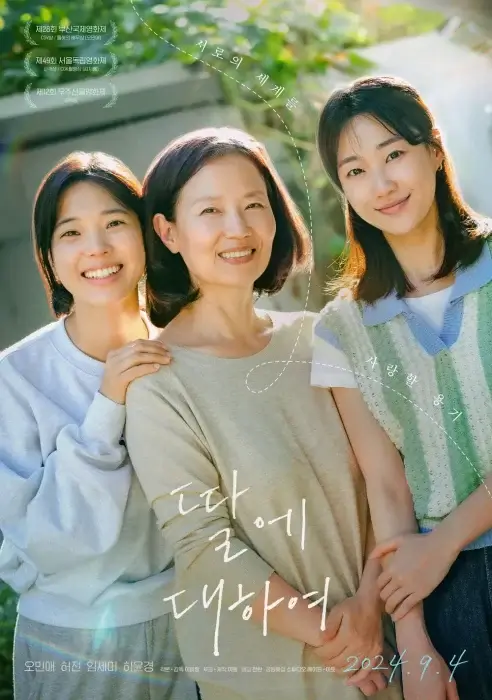
Concerning My Daughter Review: The Sublimity of an Abnormal Solidarity Forged by Isolated Lives
To believe one can fully understand another may be an arrogant illusion. We merely contemplate others through a window from within the rooms of our own respective deficiencies. Yet, the act of opening that door and setting a table to fill someone’s hunger—the praxis situated between agonizing desire and pain—is what makes us human.
The film Concerning My Daughter is a work that depicts this seemingly impossible journey of understanding in a manner that is both chillingly cold and fervently warm.
🌿 Moments When This Film Deeply Permeates
- A cold afternoon when you realize the trajectory of the “normal life” you believed in can become a form of violence to another.
- When a contradictory heart swells—wanting to deny the identity of a loved one while simultaneously worrying if they have eaten.
- When you wish to witness the miracle of elderly isolation and youthful anxiety meeting at the single intersection of “care.”
- The reason to read until the end: This text is not a mere indictment; it offers a structural answer as to why we must never give up on one another.
🎞 Note Before Viewing
This work deals with the internal conflict of a parent with an LGBTQ+ child and the isolation of old age. Rather than provocative depictions, it is a sophisticated drama focusing on the silences and gazes between characters and the precise ebbs and flows of emotion.
🎬 Movie Information
- Title: Concerning My Daughter (2024)
- Director: Lee Mi-rang
- Screenplay: Lee Mi-rang
- Original Work: Kim Hye-jin’s novel of the same name, Concerning My Daughter
- Country: South Korea
- Genre: Drama, Family
- Running Time: 106 minutes
- Platform: Naver SeriesOn, IPTV, etc.
- Cast: Oh Min-ae (Mom), Lim Se-mi (Green), Ha Yoon-kyung (Rain), Heo Jin (Yi-hee)
📖 <Concerning My Daughter> Synopsis: Until a Mother and Daughter on Parallel Lines Meet at the Intersection of “The Other” [No Spoilers]
“Mom,” who has built a life alone working as a caregiver, takes in her daughter “Green,” who is facing financial difficulties, along with Green’s partner, “Rain.” To Mom, who wished all her life for her daughter to live “ordinarily like others,” the existence of her daughter appearing with a same-sex partner is a massive fissure that shakes her bedrock values.
At work, Mom projects her own bleak future while caring for “Yi-hee,” an elderly woman with dementia who is aging without any kin. Meanwhile, the daughter struggles to protect her current dignity by protesting on the streets for a colleague who was unfairly dismissed. Between the daughter’s incomprehensible choices and the elderly isolation she wishes to ignore, Mom’s anguish deepens.
Through the uncomfortable cohabitation of these women, the film weightily captures the burden of “taking responsibility for someone” beyond the bonds of blood and the solidarity of those residing in social blind spots. Can they remain within one fence without destroying each other’s worlds?
🏚️ Isolated Old Age and Denied Youth: The Power Dynamics of Relationships Highlighted in <Concerning My Daughter>
The way “Mom” rejects her daughter’s identity in the film is rooted not in simple hatred, but in fear. To her, “normalcy” was the only armor that could protect her from a harsh world. Ironically, however, that armor becomes an oppression that stifles her daughter.
The character “Yi-hee,” whom Mom cares for, is both the daughter’s future and Mom’s own mirror. Yi-hee, abandoned once her “utility” expired despite her past social achievements, overlaps with the daughter’s future as she fights as a social minority. Here, the film inverts the power dynamics of care. When the object to be protected (Yi-hee), the protecting subject (Mom), and the denied subject (the daughter) gather in one space, care transforms from an act of charity into a collective struggle for survival.
🥣 The Aesthetics of the Dining Table: An Action-Oriented Interpretation Replacing Failed Language
In this film, communication occurs through actions rather than words (Language). Mom spits out harsh words toward her daughter’s partner, “Rain,” but feels a strange sense of defeat and relief when she faces the meal Rain has prepared.
The repetitive domestic labor of preparing, feeding, and cleaning up food serves as the most powerful tool of psychological transference in this film. The gap in values, which can never be narrowed through language, is temporarily sutured through a warm bowl of soup. This is the core of the mise-en-scène intended by the director; the steaming food, contrasted with the cold colors of the wallpaper, acts as a silent cheer of “Stay alive” that the characters cannot bring themselves to utter.
🔎 Reinterpreting the Ending: Choosing Dignity by “Being Beside” Rather Than Perfect Understanding
Many might have expected a clear reconciliation in the ending of Concerning My Daughter. However, the film never opts for cheap forgiveness. Mom still cannot fully affirm her daughter’s life, and the daughter also faces the reality that she cannot change her mother’s worldview.
Nevertheless, the scene at the end where Yi-hee is brought home and the four women—strangers to one another—stay under one roof declares that coexistence with “the other” is a realm of “patience” and “responsibility” rather than “understanding.” By not turning away from another’s pain, Mom finally recovers her own dignity. Instead of fearing that her daughter’s future might be as lonely as Yi-hee’s, she demonstrates a practical change by taking the hand of the person beside her right now.
Coexistence is not about dragging the other into my world, but about standing at the boundary to ensure the other’s world does not collapse.
❓ Concerning <Concerning My Daughter>’s Ending and Narrative Ambiguity
Q1. Isn’t Mom’s act of bringing Yi-hee home a realistically irresponsible choice?
Considering economic and physical limitations, this is certainly a precarious decision. From a critical perspective, it could be called “self-satisfying pity.” However, in a cinematic context, this choice is a gesture of resistance—a declaration that an individual will recover a life abandoned by the system. The act of guarding the end of the elderly woman she cared for is, in effect, a proxy execution of a desperate prayer that someone will guard her daughter’s end when the world turns away.
Q2. The daughter Green’s method of struggle feels somewhat flat or selfish.
Green does not bend her convictions and at times seems to take her mother’s sacrifice for granted. This is a device to maximize the disconnect in communication between generations. Green’s stubbornness is the survival method of a minority who has collided with the massive wall of the “normal family.” By not depicting Green as a merely pitiable victim, the film maintains the tension of the mother-daughter relationship until the end, making it difficult for the audience to take a side.
✨ <Concerning My Daughter>: The Most Rugged Yet Sublime Meal Crossing an Era of Hatred
This film projects the most painful corners of our society—the alienation of the elderly and hatred toward LGBTQ+ individuals—through the lens of “family.” Yet, the conclusion is not despair. It suggests that even if they are beings like parallel lines who can never understand each other, as long as there is the will to fill each other’s hunger, that in itself can become a new form of family and solidarity.
Solidarity is the courage to discover one’s own future within the pain of another and to willingly share and shoulder that fear.
💬 What is your truth contained within the silence?
When you love someone but absolutely cannot accept their way of life, can you willingly set a table for them? Or will you close the door because you cannot understand?
💜 Violet Screen Curation: The Depth of Other Female Narratives
- Lucky, Apartment (2025): Depicts the subtle discrimination and solidarity experienced by a lesbian couple as they enter the conservative space of an apartment complex. It is an intriguing psychological thriller showing how “space” defines human relationships.
- The World to Come (2020): Set in the 19th-century American frontier, this is a poetic yet fierce melodrama depicting the process of two women awakening their language and senses through each other’s existence amidst isolated lives.
To provide a more stable publishing environment, multilingual content, and better communication with our readers, we have moved our official publication to Substack.
All new film reviews and critical essays will be published on our new platform. This website will be closing down soon, so we would greatly appreciate it if you subscribed to our new space.
TODAY'S QUESTION
When did you first feel fully accepted for who you are?
Your answer isn't saved. Feel free to share it in the comments below.


You May Also Like

Late Bloomers (1996) Queer Film Review: Mid-life Awakening and the Solidarity of Late-Blooming Desire
Snapshots (2018) Review: Love Shaken by 50-Year-Old Secret Photos and the Solidarity of Three Women