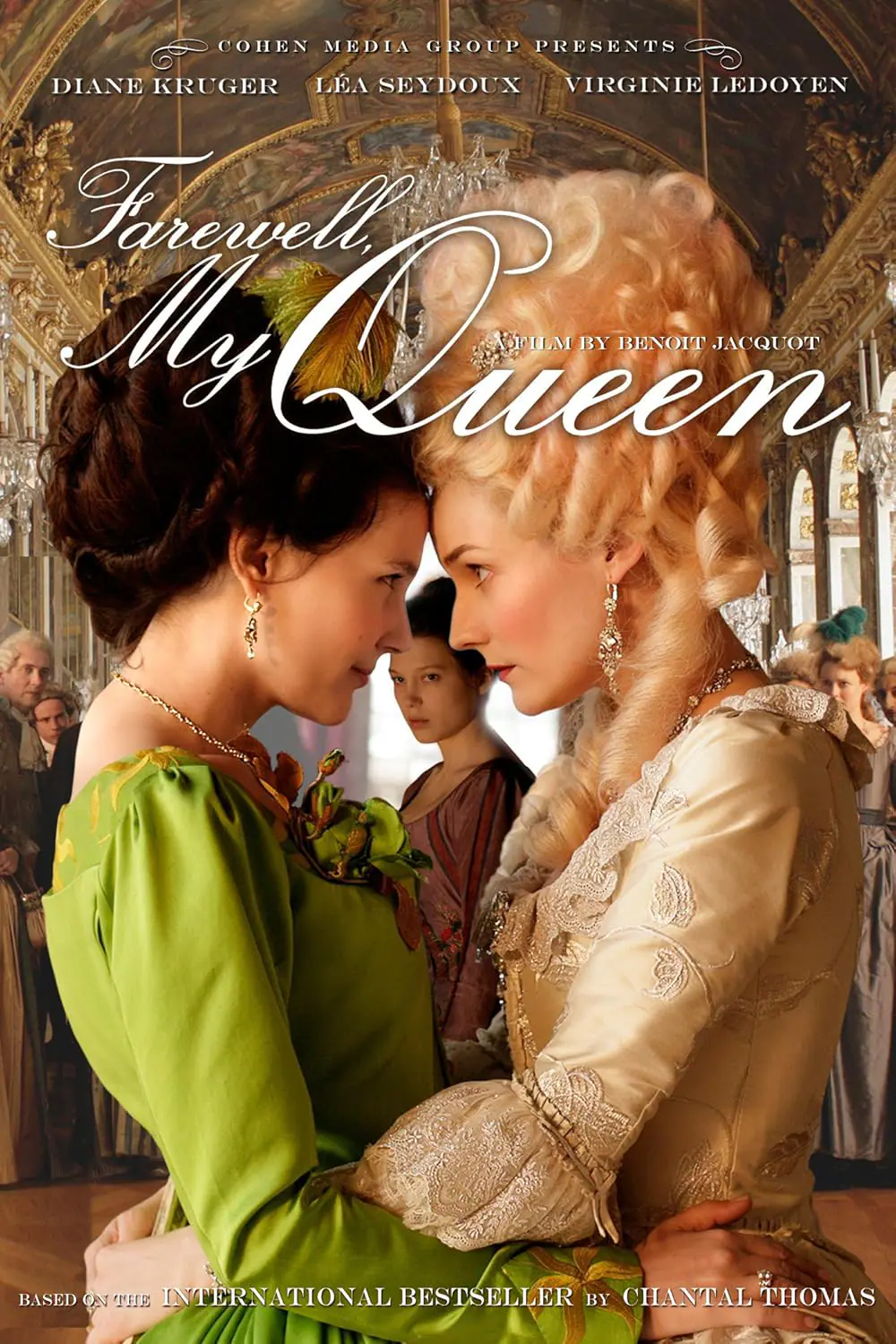
Farewell, My Queen Analysis: A Chronicle of Ruin Collapsing as Class Indulges in Obsession
The sound of a world collapsing begins with a whisper lower than the thunder of artillery. When blind longing for another meets the sharp blade of power, the relationship transforms from a narrative of noble sacrifice into one of cruel exploitation.
Instead of turning the grand pages of history, the film Farewell, My Queen gazes at the dust trapped between the textures of the paper and the wet eyes of a servant girl. This is not a chronicle of a glamorous queen’s downfall, but a chilling report on how power—wielded in the name of love—deconstructs an individual’s dignity.
🌿 Moments When This Film Deeply Permeates
- When the chilling realization dawns that the sincerity you offered is being used as a tool for another’s desire.
- When you wish to face the truth of moldy hallways and the scent of sweat behind the facade of a magnificent palace.
- When you want to see how violently deceptive the word “favor” can be within a power structure.
- To encounter the aesthetics of a finale that completely shatters the illusion of “loyalty” and “solidarity” we once believed in, through the eyes of a servant unrecorded by history.
🎞 Note Before Watching
Rather than physical exposure or direct depictions of violence, this work focuses on psychological pressure and the emotional extortion between classes. It is a psychological drama where the tension derived from emotional asymmetry is higher than any physical intensity.
🎬 Film Information
- Title: Farewell, My Queen (Les Adieux à la Reine, 2012)
- Director: Benoît Jacquot
- Screenplay: Benoît Jacquot, Gilles Taurand
- Original Work: Novel of the same name by Chantal Thomas
- Country: 🇫🇷 France
- Genre: Historical Drama, Drama
- Running Time: 105 minutes
- Platform: Watcha, TVING, etc.
- Cast: Léa Seydoux, Diane Kruger, Virginie Ledoyen
📖 Farewell, My Queen Plot: Divergent Longings Born in the Heart of Versailles [No Spoilers]
July 1789, Versailles sits on the precipice of the French Revolution, just before the flames engulf the Bastille. Beside Queen Marie Antoinette stands Sidonie Laborde, a loyal servant whose duty is to read to her. For Sidonie, the Queen is more than a sovereign; she is an object of worship and the only being who awakens all her senses.
However, as rumors of revolution begin to leak through the palace’s fortified walls, the once peaceful paradise instantly transforms into a crucible of fear. While aristocrats scramble to pack their bags and the Queen exhibits signs of extreme anxiety, her gaze is fixed on only one person: the Duchess Gabrielle de Polastron.
Between Sidonie, who longs for the Queen’s gaze, the Queen, who is obsessed with Polastron, and Polastron, who seeks to flee for survival—the asymmetrical desires of these three women begin to race toward the most brutal choice within the secret corridors of Versailles, just as the grand wave of history is about to strike.
🥀 Sidonie’s Isolated Desire and Interpretation Trapped in the Mirror of Class
While Versailles is often depicted as a space of luxury, in this film, it is represented by the damp, dark passages used by servants. The feelings Sidonie Laborde harbors for the Queen are closer to “emotional subordination” than simple loyalty. She fluctuates between joy and despair at a single gesture or the scent of the Queen’s perfume, sequestering her identity within the Queen’s shadow.
Director Benoît Jacquot unravels this through the power structure of the gaze. Sidonie looks at the Queen, the Queen looks at Polastron, and Polastron looks only at her own safety in the mirror. Within this linear flow of gazes, Sidonie remains eternally an “invisible presence.” Her love is blocked by the solid wall of class and never circulates; it functions merely as a consumable used to soothe her superior’s anxiety.
🕸 <Farewell, My Queen> Ending Interpretation: An Elaborate Murder in the Name of Love
The command Marie Antoinette gives to Sidonie at the film’s conclusion is the most brutal peak of this work. To save Polastron—the one she loves—the Queen throws Sidonie—the one who loves her—out as “bait” by having her dress in Polastron’s clothes. Sidonie must set out on a path toward death, acting as a double for the woman she so bitterly envied.
This ending proves that the relationship between the two was “predation,” not “solidarity.” When Sidonie enters the carriage wearing Polastron’s ornate gown, she finally enters the Queen’s world as she had dreamed, but it is a fake identity secured only by the collateral of death. Sidonie sacrifices her life, deceived by the Queen’s tender embrace and the whisper, “If you love me.”
In this ending, Sidonie’s ego is completely extinguished as it descends into a tool for performing the desires of another. Though she may have survived, her life as Sidonie ended inside that carriage. This is the most chilling metaphor for how the sincerity of the lower class is stripped away for the survival of the powerful in a class-based society.
🔎 Afterimages of an Empty Palace and a Servant’s Sorrowful Review
The overarching sentiment of the work is “emptiness.” Even in the urgent moments of the revolution, the camera captures the cowardly backs of those inside the palace instead of the shouts of the people. The weakness shown by Marie Antoinette shines even more hideously when contrasted with Sidonie’s steadfast devotion.
The film asks the audience: “Whose stomach is the devotion you offer filling?” The expression Sidonie wears in the final scene is close to “nothingness”—neither triumph nor sorrow. She has realized that the god she loved was, in fact, a selfish human being who did not hesitate to offer her up as a sacrifice. What remains at the end of this harrowing story are the screams of the nameless, preserved behind the glamorous facade of history.
❔ Questions Regarding the Class Cruelty and Ending of <Farewell, My Queen>
Q1. Was the final tenderness Marie Antoinette showed toward Sidonie sincere? Many viewers hope for a sliver of humanity in the scene where the Queen embraces Sidonie. However, viewed structurally, that tenderness is closer to “emotional bribery” intended to drive Sidonie toward her death. The Queen was fully aware of Sidonie’s affection and exploited it to assign her the most dangerous task. From a critical perspective, this is the most sophisticated form of an upper-class individual exploiting the emotions of a subordinate.
Q2. Why did Sidonie follow the Queen’s orders to the end instead of fleeing? To Sidonie, the Queen was not just an employer but her entire world. In the isolated space of Versailles, the only self-actualization permitted to a servant is “being recognized.” Her obedience is less a matter of foolishness and more the result of “gaslighting under the guise of loyalty” indoctrinated by a class society. Do you, the reader, see Sidonie’s choice as love, or as a tragic compulsion created by her environment?
✨ <Farewell, My Queen>: More Tragic Than a Collapsing Kingdom is a Collapsed Heart
This film precisely dissects the catastrophe born from the “asymmetry of relationships” atop a massive historical turning point. While the kingdom falls under the guillotine, Sidonie’s world collapses first at a single cold command from the Queen.
Ultimately, the film warns that even noble values like love and loyalty can become tools of power in the soil of class. True solidarity only exists when individuals face each other from equal positions; devotion in an asymmetrical relationship inevitably results in exploitation.
🎙 Echoes Between Possession and Existence
How did you feel watching Sidonie’s life, where she exists only as another’s double after giving away her everything?
Are you ready to discard your own name for someone else, or are you currently surviving by borrowing someone else’s name?
📽 Violet Screen Curation: Variations on Twisted Relationships and Female Narratives
- The Favourite (2018): A fierce power struggle between two women vowing for the Queen’s favor. It offers a look at female relationships that are much more audacious and power-oriented than those in Farewell, My Queen.
- The Handmaiden (2016): An aesthetic masterpiece showing how a relationship that began with exploitation between a handmaid and a lady is subverted and evolves into solidarity. The journey of the handmaid Sook-hee, who walks the opposite path of Sidonie, provides a sense of catharsis.
To provide a more stable publishing environment, multilingual content, and better communication with our readers, we have moved our official publication to Substack.
All new film reviews and critical essays will be published on our new platform. This website will be closing down soon, so we would greatly appreciate it if you subscribed to our new space.
TODAY'S QUESTION
Which ending has stayed with you the longest?
Your answer isn't saved. Feel free to share it in the comments below.


You May Also Like
Breaking the Girls: A Chilling Alliance Where Twisted Desire and Vivid Revenge Intersect

Valoa valoa valoa: Coming-of-Age Film Analysis: The Mirage of Love and the Aesthetics of Guilt