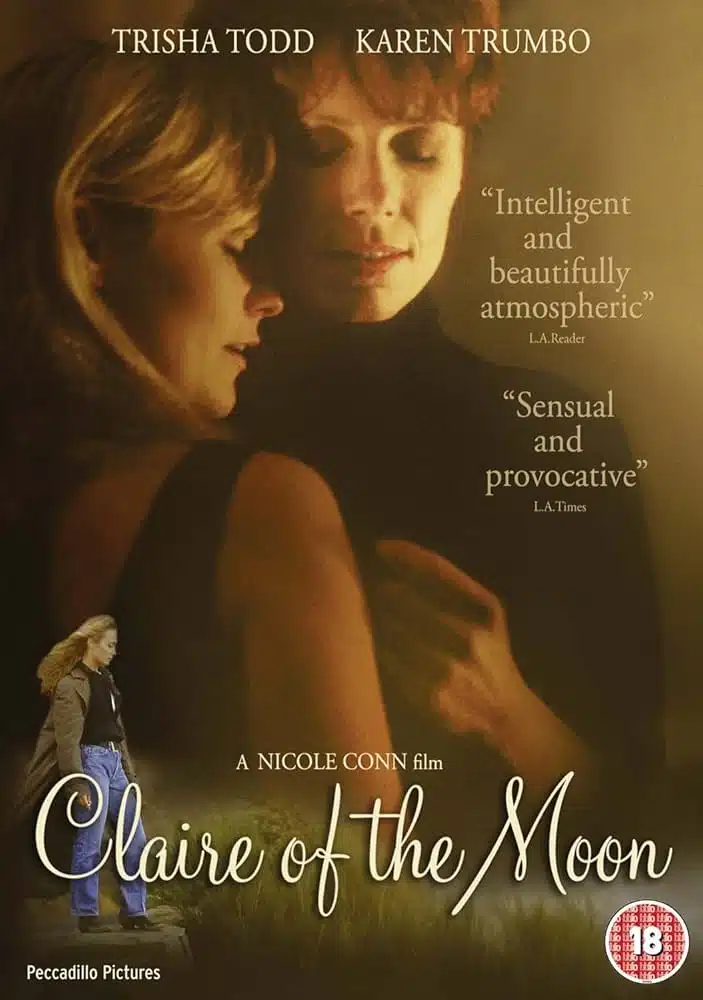
Claire of the Moon Review: A Record of Liberation Forged by Fissures in Identity and Desire
Love sometimes approaches as an invasion, tearing down the ramparts of the self we believed to be impenetrable. It is only when we step out of familiar comforts and stand before an alien truth that we truly feel alive.
This film goes beyond a mere encounter between two women; it depicts the process of facing one’s deepest deficiencies through the mirror of another. This narrative of escape, exploration, and eventual acceptance continues to resonate with valid echoes even 30 years later.
🌿 Moments When This Film Deeply Permeates
- On days when you intuitively feel the grammar of your life must change, yet find yourself clinging to the inertia of the past.
- When a thrill more intense than physical attraction arrives through intellectual conversation with another.
- At the moment when a longing within, which even I could not define, is given a name by the gaze of another.
- I dedicate this piece to you, who wish to end the long years of self-deception and finally take a breath of truth.
🎞️ Notes Before Viewing
This work explores the emotional communion and sexual tension between women, including sensual depictions in the latter half that symbolize emotional catharsis. Rather than being consumed by provocativeness, it takes the form of an authentic queer drama focused on shifting relationships and psychological pressure.
🎬 Film Information
- Title: Claire of the Moon (1992)
- Director: Nicole Conn
- Screenplay: Nicole Conn
- Country: USA
- Genre: Romance, Drama
- Running Time: 102 minutes
- Platform: DVD, select international streaming services
- Cast: Trisha Todd (as Claire Jabrowski), Karen Trumbo (as Dr. Noel Benedict)
📖 Claire of the Moon: Confusion and Development of Identity Initiated in an Unfamiliar Space [No Spoilers]
Following a breakup with her partner, popular novelist Claire Jabrowski leaves for the “Arcadia Women’s Writers Retreat” on the Oregon coast to resolve a severe slump and emotional void. In this isolated space where only female writers gather, Claire encounters her roommate, Noel Benedict.
Noel, a psychiatrist and author of sexual research, stands at the polar opposite of Claire. To the free-spirited and impulsive Claire, the principled and rational Noel is a source of constant friction and discomfort. However, the moment Noel confidently reveals her identity, fissures begin to form within Claire’s interior.
Claire identifies as strictly heterosexual and struggles to prove this through relationships with men. Yet, the intellectual debates and delicate emotional exchanges she shares with Noel gradually shake the world Claire has built. The tense confrontation between the two in an isolated beach house eventually transforms into an irresistible attraction, unfolding in unexpected directions.
🌓 Between Rational Control and Emotional Liberation: Interpreting the Relationships Presented in Claire of the Moon
🌊 The Beach as a Symbol of Boundaries and Interior Collapse
The Oregon coast, the film’s primary setting, functions as a metaphorical space representing the characters’ psychological states beyond mere aesthetic scenery. The ceaselessly surging waves represent Claire’s suppressed desires, while the rugged coastline symbolizes the boundaries of the self she strives to maintain.
The scene where Claire runs along the beach and emotionally collapses is the essence of this film. This is not simple sorrow, but the growing pains occurring in the process of deconstructing an existing worldview. The presence of Noel becomes a wave that breaches those boundaries, penetrating deep into Claire’s inner self.
🧠 The Aesthetics of Queer Narrative: Intellectual Exchange Transferred to Physical Desire
Director Nicole Conn places an extensive amount of dialogue before the physical union of the two protagonists. Their fierce debates on sex, art, and philosophy are akin to a process of nakedly exploring each other’s souls.
In particular, Noel’s rational attitude serves as a mirror for Claire. While criticizing Noel, Claire realizes that she actually craved the certainty and sincerity Noel possesses. Their relationship goes beyond simple curiosity; it is closer to an inevitable gravitational pull generated in the process of intellectually filling each other’s voids.
🔎 Reinterpretation of the Ending — Eternal Union Brought by Total Acceptance
At the end of the film, the moment the two acknowledge and face their feelings for each other signifies more than just the start of a romance. Claire sheds the mask of the “heterosexual author” prescribed by society and is reborn as a subject who affirms her own desires completely.
This conclusion suggests that their relationship is not a temporary deviation, but a new order established by destroying the old structures that sustained their respective lives. To Claire, Noel is not an object to be conquered or a tool to quench the thirst of curiosity, but an ontological companion who finally makes her whole.
The choice Claire makes at the ending is not a denial of her past self, but a declaration of liberation in discovering her true self.
❓ Curiosity Regarding the Interpretation and Narrative Archetypes of Claire of the Moon
Q. Is Claire’s confusion while maintaining relationships with men a form of wandering or deception?
Some viewers view Claire’s act of meeting a man, Brian, while being attracted to Noel with a critical eye. However, this is closer to a defense mechanism than deception. When one’s identity is shaken, humans attempt to prove themselves in the most familiar ways. It is reasonable to interpret Claire’s infidelity as a desperate struggle to confirm to herself the fact that “I am still heterosexual.” Within the aesthetic context of the work, this process serves as a structural device that makes the acceptance at the ending even more dramatic.
Q. Why did Noel reject Claire’s first proposition?
Noel was wary of Claire approaching her out of mere ‘curiosity’ or ‘impulsive urge.’ As a psychiatrist, she discerned that Claire’s interior was not yet ready. Had a relationship been established at that point, it would have ended as a consumptive indulgence rather than a truthful connection. Noel’s rejection becomes the decisive catalyst for Claire to look deeper into her own emotions, elevating their relationship from a simple romance to a narrative of mutual respect.
✨ Claire of the Moon: The Name of Truth Bloomed at the End of Broken Boundaries
This film demonstrates that identity is not a fixed entity, but a process of constant reconstruction through the person one loves. The fact that it dealt with relationships between women intellectually and in-depth, even within the temporal limitations of the 1990s, proves why this work has ascended to the status of a classic.
Moving beyond the simple question of ‘whom one loves,’ this narrative delivers a heavy message to us today regarding the question: ‘How honest am I with myself?’ Love is, after all, another name for the courage to break out of the shell that imprisoned me and willingly walk into another person’s world.
True identity is perfected not by social definitions, but by the truthful tremors felt at the moment of facing another.
💬 Toward which side is your door open?
If a powerful attraction to another person shakes all the values you have believed in, are you ready to accept that confusion with your whole body? Or do you still wish to hide behind familiar comforts?
Please share the memory of the most unfamiliar and intense encounter that knocked upon your inner self.
🎞 Violet Screen Curation: Recommendations Capturing Delicate Relational Textures
- Blue Is the Warmest Color (2013)
- Reason for Recommendation: A masterpiece that portrays the confusion of identity, the fever of love, and the subsequent growth in the most intense and visually beautiful manner. It is an essential choice if you wish to revisit Claire’s wandering with a modern sensibility.
- Blue Jean (2022)
- Reason for Recommendation: An excellent work dealing with the restrained struggle of ‘Jean,’ a teacher who had to hide her identity amidst the oppression of sexual minorities under the Thatcher administration in 80s Britain. While Claire of the Moon focuses on inner discovery, this film contemplates the maintenance of the self under social pressure.
To provide a more stable publishing environment, multilingual content, and better communication with our readers, we have moved our official publication to Substack.
All new film reviews and critical essays will be published on our new platform. This website will be closing down soon, so we would greatly appreciate it if you subscribed to our new space.
TODAY'S QUESTION
Which ending has stayed with you the longest?
Your answer isn't saved. Feel free to share it in the comments below.


You May Also Like

Flat Girls Review: Female Narratives Blocked by Class Barriers, the Collapse of First Love, and Interpretation of the Hidden Ending
Film Review: The Perfection — A Cruel Solidarity Bound by Perfection, and Its Subversive Interpretation