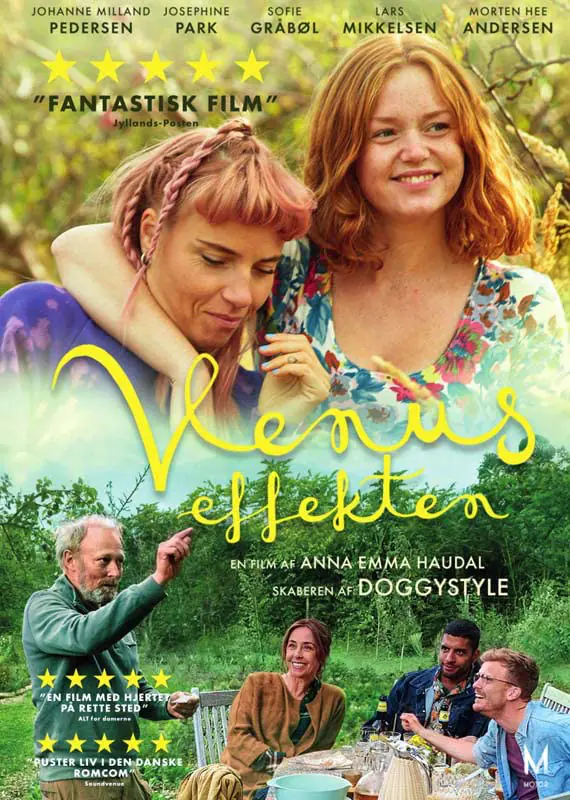
Film The Venus Effect Review: An Interpretation of Existential Awakening and Solidarity Beyond the Boundaries of Queer Identity
Our lives often lose their way in the middle of the plains we believed to be the safest. To those who live with their desires erased inside the peaceful fence of familiarity, the existence of another person is not a mere intruder, but a massive tectonic shift that awakens a dormant internal state.
The film The Venus Effect captures the precise moment a crack forms in that peaceful daily life, relentlessly exploring the psychology of characters who finally expand the universe of the self through another person.
🌿 The Moments This Film Deeply Permeates
- When one suddenly confronts an inexplicable emptiness in the middle of a familiar and secure relationship
- When one’s identity cannot be fully bound within existing definitions or categories, causing them to wander like a stranger
- When the solid world under the name of parents or family collapses, forcing one to finally stand alone as an adult
- Why You Should Read to the End: Because moving beyond simple romance, through the ending and interpretation of this film—which embraces the dissolution and creation of relationships as the order of seasons—one can gain the dignified courage to face the true ‘self.’
🎞 Note Before Watching the Film
This work is an emotion-driven narrative centered on the deep emotional connection and sexual attraction between two female characters. Scenes of physical contact or intimate communion between the lovers eschew overly provocative or sensational depictions, and are instead directed through an artistic mise-en-scène that visualizes the characters’ internal awakening and sense of liberation.
🎬 Film Information
- Title: The Venus Effect (Venuseffekten) (2021)
- Director / Screenplay: Anna Emma Haudal
- Country: 🇩🇰 Denmark
- Genre: Drama / Romance / Coming-of-age
- Running Time: 105 minutes
- Platform: Naver Series On, Wavve, WATCHA
- Cast: Johanne Milland Pedersen – as Liv, Josephine Park – as Andrea
📖 The Venus Effect, a Storm-like Attraction and Growth Arriving at a Peaceful Farm [No Spoilers]
Living in a peaceful Danish suburb and helping her parents run a large-scale horticultural farm, Liv, who is in her early 20s, enjoys a stable life that appears flawless to others. A future with her sweet boyfriend, Sebastian, is mapped out, and her family is open-minded and harmonious. However, Liv’s inner self is close to a suspended state that has never once boiled over passionately.
One day, an accidental encounter with Andrea, an artist who abruptly visits the farm after her car breaks down on her way to an ex-girlfriend’s event, becomes a turning point that shakes Liv’s solid world. Feeling a powerful sexual attraction and emotional liberation through Andrea’s free-spirited and unstoppable energy, Liv awakens to an identity she had never known her entire life and bids farewell to Sebastian.
However, within the urban queer community of Andrea, who has long established her identity with confidence, Liv instead feels an alienating sense of being an outsider, plunging her into internal conflict. To make matters worse, the moment Liv resolves to come out, the marriage of her parents, which had seemed perfect, begins to collapse, and Liv falls into a swamp of heavy guilt and identity confusion, believing all these crises are due to her own choices.
🌱 Deep Analysis: Transgressing Queer Narrative and Existential Liberation
🌸 The Collision of Earth and City: The Power Structure and Psychological Distance Between Liv and Andrea
The film The Venus Effect visualizes internal power structures through the contrast of the spaces where the characters plant their feet. The horticultural farm where Liv has taken root is a traditional earth symbolizing compliance, repetition, and the order of a family community. Conversely, the streets of Copenhagen represented by Andrea signify liberation, the avant-garde, and an already established queer culture.
In the early stages of their relationship, Andrea, who achieved certainty regarding her identity first, appears to hold the emotional initiative. Liv endeavors to assimilate into Andrea’s sophisticated world, but Andrea’s freedom, which refuses to be trapped in prescribed frames, conversely acts as another form of oppression and anxiety for Liv. The excellent critical value of this film lies in how it persuasively demonstrates that their psychological distance does not stem merely from a difference in disposition, but from a difference in speed in the process of reclaiming sovereignty over their own lives.
🍂 The Question of Being “Gay Enough”: Skepticism Toward Categorized Identity
“I just don’t think I’m gay enough to be gay.”
This confession, confided by Liv to her older brother Jonas, is the sharpest insight this work possesses. Modern society often demands a specific lifestyle or typicality even within the category of sexual minorities.
The sense of alienation Liv felt amidst the uninhibited language of an already firmly formed queer community reveals the paradox of liberation: that an individual’s uniqueness can be erased not only in an oppressive, heteronormative society but also within an alternative community. Through Liv’s clumsy wandering, the director asserts that identity is not a certificate approved by others, but an inherent state that one embodies for oneself.
[Liv’s Stages of Identity Recognition]
Stable Heterosexual Order (Horticultural Farm) ──> Intense Attraction and Awakening (Andrea) ──> Alienation Within the Queer Community (Confusion of Boundaries) ──> Subjective Acceptance Beyond Categories
❄️ Family Dissolution and the Order of Nature: The Parallel Awakening of Mother and Daughter
While many queer films confront a protagonist’s coming out and family conflict head-on, this film expands into a macro female narrative by placing the divorce declaration of the mother, Gitte, on a parallel track with Liv’s trajectory. Although Liv suffers from guilt that her mother’s divorce is due to her own identity, Gitte’s departure was the manifestation of a subjective desire to restore her ‘own narrative,’ which had been lost while dedicating her entire life to others.
The seasonal changes of the horticultural farm, starting from the full bloom of spring, passing through the bleakness of winter, and cycling back, imply that human relationships are also not fixed specimens. The parents’ divorce and the sale of the farm are not a catastrophe, but an inevitable dismantling to find each individual’s dignity.
🔍 Reinterpretation of the Ending: Leaving the Firm Earth to Leap Toward One Another in Complete Empathy
The ending of this film does not remain merely on the level of a romantic happy ending where estranged lovers reunite. Witnessing the lives of her parents who leave to find their own paths after winter passes, Liv finally gains independence from the massive illusion called family. Instead of blindly escaping into another person’s space—the Copenhagen suggested by Andrea—Liv’s footsteps as she completely sorts through her mind in her hometown before seeking Andrea out are evidence of subjective growth.
The final moment the two face each other is a journey of complete empathy, validating each other’s deficiencies, clumsiness, and differences that can never perfectly align, exactly as they are. Andrea’s immature wanderlust and Liv’s clumsy fear are purified within the order of the seasons. Their reunion is not a regression to the past, but a dignified declaration of solidarity by two subjects intending to create a completely new form of community.
🔎 Reflection on Narrative Structure and the Representation of Women
Q. How should we interpret the critique that Liv’s clumsy handling of situations and emotional wandering in the film feel somewhat frustrating?
A. Liv’s process of wrapping up her relationship with her ex-boyfriend Sebastian, or her behavior of blaming her parents’ divorce on herself, can cause psychological fatigue for the audience. However, this is a point that arises precisely because the work captures realistic growing pains as they are, without idealizing the character. Having grown up in an environment where conflict was entirely absent her whole life, Liv is bound to be defensive and immature in a crisis. The work does not bypass these points of criticism; rather, by confronting that immaturity head-on, it highlights the value of the character’s subjective growth even more.
Q. Is the criticism valid that the character of Andrea is trapped in the typical cliché of the ‘free-spirited artist’ common in conventional queer cinema?
A. Andrea moving into the apartment right above her ex-girlfriend or exhibiting impulsive tendencies may appear on the surface to wear the mantle of a typically free-spirited character. However, the film does not hide that Andrea is also a fragile human being who groans under the pain of heartbreak and exaggerates her actions to mask her own instability. Andrea is represented not as an absolute other who salvages Liv, but as a mutually complementary figure who obtains the courage to halt her unstable wandering and settle down through the mirror that is Liv. Therefore, rather than viewing this as a simple repetition of a cliché, it is appropriate to understand it as an egalitarian narrative structure where characters mature together within a relationship. Readers will also find deeper aesthetic pleasure when viewing the characters’ choices not through a fixed moral yardstick, but as part of a trajectory of growth.
✨ The Venus Effect: Every Collapse in Life Is a Prelude to Welcoming One’s Own Season
The film The Venus Effect proves that the act of loving another person can ultimately become an existential mirror to face oneself honestly. The identity confusion, family dissolution, and movement of spaces experienced by the characters are not mere losses, but the inevitable winter landscape that must be passed through to live a life of one’s own choosing. When we listen to the voice of desire echoing from within instead of settling into the safety of a relationship, we can finally greet the true liberation of identity. Human beings can arrive at the most unfamiliar territory—which is oneself—only after passing through a perfect stranger.
💬 When was the moment of rupture that awakened your universe?
We often turn away from the true voice within, fearing that our peaceful daily lives might collapse. What was the ‘unexpected encounter’ or ‘moment of rupture’ that completely shook your life, and thereby allowed you to finally grow into a subjective adult? If you have an experience of choosing your own season without being trapped by the gaze of others, please share it in the comments below.
🔮 Violet Screen Curation: Recommendations for Female Narratives with a Different Undertone
- A signpost of clumsy, colliding youth amidst a brilliant pop sound: Girls Like Girls (2026)
- Reason for Recommendation: This is a recent 2026 work based on the novel of the same name by pop artist Hayley Kiyoko. While Venuseffekten explores the fluidity of identity against the backdrop of suburban nature, this work centers on a sophisticated, sensuous visual style and energetic music to handle the boundary between passionate love and friendship experienced by young women in their late teens. It delicately captures the non-trivial growing pains of youth, offering a generic variation.
- The awakening of identity and the mystery of irresistible instinct: Thelma (2017)
- Reason for Recommendation: This is a Nordic thriller romance that begins when Thelma, a college student raised in a strict religious environment, feels an intense sexual attraction and love toward her classmate Anja. Unlike the warm growing pains of Venuseffekten, this co-production film, in which Denmark participated, depicts the process of suppressed desire manifesting as a supernatural phenomenon through a mysterious and chilling atmosphere, unraveling the awakening of identity in a completely different visual grammar.
To provide a more stable publishing environment, multilingual content, and better communication with our readers, we have moved our official publication to Substack.
All new film reviews and critical essays will be published on our new platform. This website will be closing down soon, so we would greatly appreciate it if you subscribed to our new space.
TODAY'S QUESTION
Which ending has stayed with you the longest?
Your answer isn't saved. Feel free to share it in the comments below.


You May Also Like

La Luciérnaga Film Analysis: Salvation in the Name of Desire Found at the Edge of Loss

[Glück (Bliss)] Solidarity Born of Deprivation in a Workspace of Desire: The Paradox of a Radiant ‘Happiness’