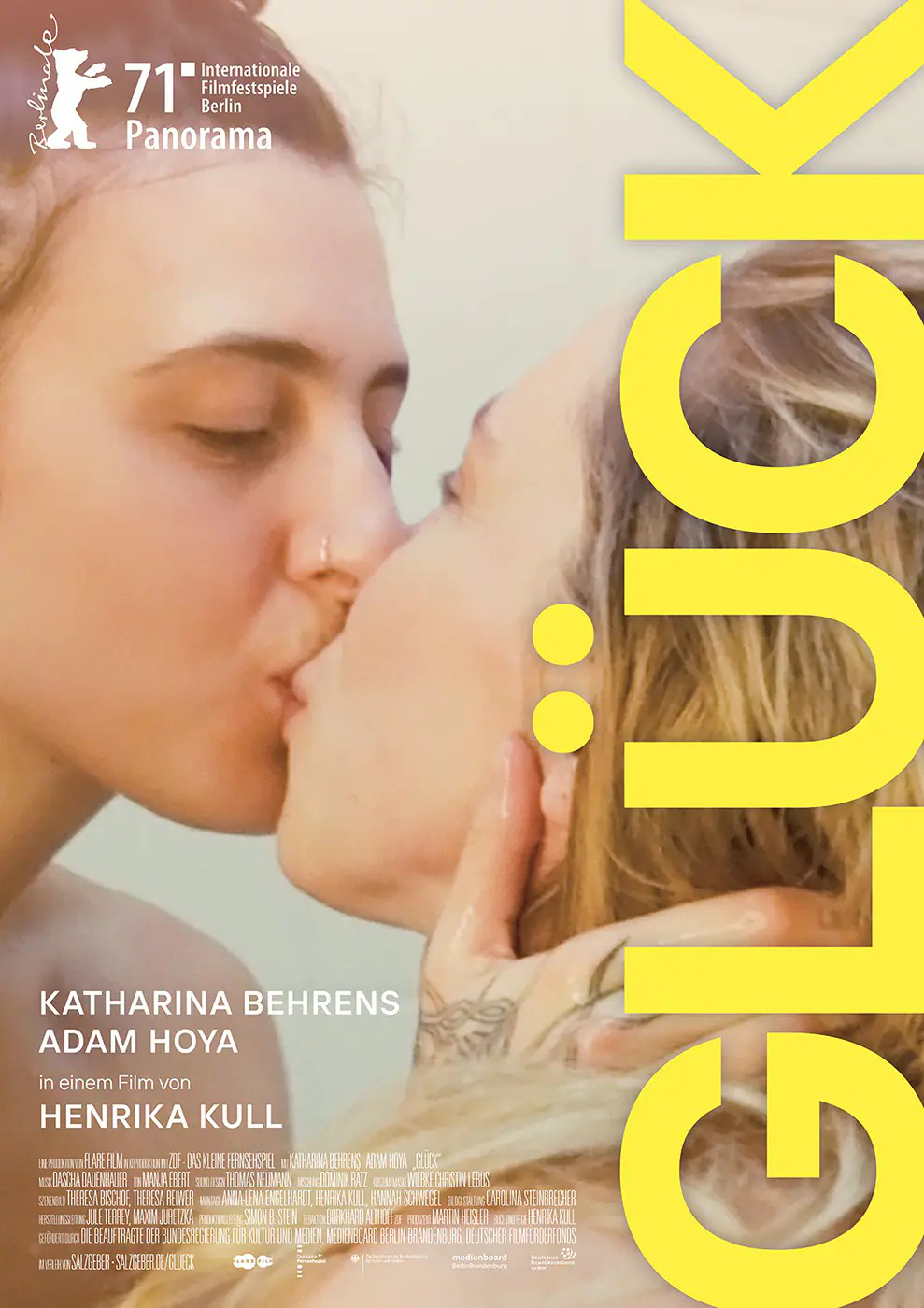
[Glück (Bliss)] Solidarity Born of Deprivation in a Workspace of Desire: The Paradox of a Radiant ‘Happiness’
While the world often attempts to confine love within the realm of purity, certain forms of love only prove their authenticity at the site of the most secular and harsh survival. When two women, who live with their own desires castrated while catering to the desires of others, meet, the gaze they share becomes a form of salvation that transcends simple curiosity.
Glück calmly observes that love is not a matter of moral perfection, but the courage to willingly peer into each other’s deepest abysses.
🌿 Moments when this film deeply resonates:
- When you feel trapped in the gaze of others, repeating a mechanical daily routine while losing your sense of self.
- When you are isolating yourself from relationships to avoid being hurt, building a wall under the name of “independence.”
- On nights when you long for the warmth of a single person with whom you can share even the lowest, most fundamental truths.
- Why you should read until the end: You will discover a humanistic answer regarding the “true connection” we all crave, hidden behind the provocative subject matter of sex work.
🎞 Note before viewing
Set against the backdrop of the daily lives of sex workers, this work includes depictions of physical exposure and professional acts. However, these function not as a means of provocation, but as essential devices to reveal the characters’ lives and emotional isolation. It is a sophisticated psychological drama that focuses on the essence of relationships and the psychological tension flowing between them rather than mere physical contact.
🎬 Film Information
- Title: Glück (Bliss, 2021)
- Director: Henrika Kull
- Screenplay: Henrika Kull
- Country: Germany
- Genre: Drama, Romance
- Running Time: 90 min
- Platform: MUBI
- Cast: Katharina Behrens, Adam Hoya
📖 Glück, the Collision and Gravity of Two Worlds Encountered in a Berlin Brothel [No Spoilers]
In Berlin’s legal brothel “Queens,” 42-year-old Sascha (Katharina Behrens) lives as a veteran sex worker. She skillfully greets clients and gets along well with her colleagues, yet she feels an inexplicable emptiness amidst a distant relationship with her son and a repetitive daily life. Then one day, Maria (Adam Hoya), a 25-year-old newcomer from Italy, appears.
With tattoos covering her body, a free-spirited attitude, and an artistic sensibility for writing poetry in her spare time, Maria instantly disrupts the rigid grammar of the daily life Sascha has maintained. Sascha is intensely drawn to Maria’s “difference,” and Maria likewise reads the solitude hidden behind Sascha’s charisma. The two quickly develop into lovers, experiencing “happiness” (Glück) for the first time in their lives, but their respective wounds and self-defensive mechanisms begin to create sharp fissures in their seemingly blessed relationship.
🌊 Questions of Physical Commodification and the Ownership of the Soul in Glück
The film does not glamorize or disparage the space of sex work; it simply illuminates it as a “workspace.” The love that arises between Sascha and Maria emerges as the only non-market value that transcends capitalistic contractual relationships. Through Maria, Sascha discovers a self that still exists beyond the body she has sold. However, for Sascha, who has tailored herself to the desires of others for so long, the act of fully accepting someone else approaches as a form of terror.
Sascha’s act of explicitly introducing Maria as a “whore” at a hometown festival is not an insult to her partner, but a desperate struggle to defend herself from the illusion of love by confirming the shabby reality they stand upon. From an interpretive perspective, their conflict is not a matter of professional specificity, but a universal question of self-esteem: “Am I worthy of being loved?”
🪞 Mirror of Relationships: An Interpretation of Sascha’s Jealousy and Maria’s Isolation
Maria exhibits a willpower bordering on obsession toward independence. For her, sex work is merely a tool for economic freedom, but as her relationship with Sascha deepens, she feels that tool encroaching upon her identity. The jealousy Sascha feels is not simply because Maria is in contact with other men. It is because when Maria, who shares the same pain as herself, is kind to others, Sascha feels as though her own pain is being negated.
Their relationship is like a mirror reflecting one another. Sascha sees her lost possibilities in Maria’s youth and freedom, while Maria sees the shadow of her own future in Sascha’s cynicism. Their love is the process of shattering this mirror to face reality, and the film captures without filter the figures of these characters bleeding from the shards.
🔎 Reinterpretation of the Ending — The Aesthetics of an Imperfect Union Standing Atop Fissures
At the film’s conclusion, Maria leaves for Italy only to return to Berlin. The new tattoo on her body is an imprint of her love for Sascha and a declaration that she will choose her own life. Sascha also prepares to welcome another into her world by raising the fish Maria liked.
Their reunion is less a romantic completion and more a precarious solidarity formed after confirming each other’s abyss (Abgründe). They now know that love does not solve every problem. Nevertheless, the act of gazing into each other’s wounds and joining hands once more is a victory achieved in a language exclusive to the two of them, outside the value systems defined by the world.
Love is not the erasing of each other’s darkness, but the manifestation of the will to walk together even within that darkness.
💬 Interpretation of the Depiction of Sex Work and the Authenticity of Female Narratives
Q: How do you view the criticism that the film overlooks the risks or exploitative structures of sex work by portraying it too mundanely?
This work places a microscope on the inner lives of the “individuals” living within the environment rather than offering a structural exposé of sex work. It is interpreted not as an exclusion of exploitation, but as an intent to show how humans preserve their dignity and love in an environment where exploitation has become mundane.
The director chose to have the audience listen to the heartbeats of these two women within the system, rather than remaining at the level of anger toward the system itself. While this is a point subject to criticism, it is simultaneously a unique aesthetic achievement that reveals the subjectivity of female workers who are not objectified.
✨ Glück: Salvation is Found Only in the Gaze of Another
Glück maintains a dry and painful landscape throughout, to the point that the title “Happiness” feels ironic. Yet, paradoxically, the solidarity of the two women that blooms at the end of that dryness is more fervent than any flamboyant melodrama. In a world where one’s body becomes a commodity, those brief moments of existing for each other as “humans” rather than “commodities” are the very essence of the happiness they were seeking.
True connection does not begin with filling each other’s most painful holes, but with the courage to look at those holes together.
💡 On the Weight of Relationships
When you have witnessed even the shabbiest versions of each other, do you have the courage to continue the relationship, or would you choose the right to run away?
In the moment when your silence runs deepest, who is the person you wish would remain by your side?
🎙 Violet Screen Curation
- The Duke of Burgundy (2014): An aesthetic and psychological solidarity between two women who subvert power structures on the boundary of repression and desire.
- Ellie & Abbie (and Ellie’s Dead Aunt) (2020): An Australian film that deals with the weight of queer history and intergenerational solidarity hidden within a bright and cheerful atmosphere. It is lighter than Glück, but the depth of the relationship is by no means shallow.
To provide a more stable publishing environment, multilingual content, and better communication with our readers, we have moved our official publication to Substack.
All new film reviews and critical essays will be published on our new platform. This website will be closing down soon, so we would greatly appreciate it if you subscribed to our new space.
TODAY'S QUESTION
When did you first feel fully accepted for who you are?
Your answer isn't saved. Feel free to share it in the comments below.


You May Also Like

My Mother Likes Women: The Shattering of a Rigid Illusion Called Family by a Midlife Lesbian Declaration

I Can’t Think Straight: The Absolute Attraction and Identity Formation of Two Women Transcending Cultural Oppression