The Birth of a Postmodern Family: An Interpretation of Existential Struggle and Solidarity for a Lesbian Couple in the Film Bao Bao
What does it mean to break free from the shackles of mere biological lineage and form a family with those we choose ourselves?
The film Bao Bao illuminates the deep human desire to fill deficiencies with solidarity in the fissures of relationships that traditional institutions fail to accommodate. Their struggle to continuously embrace one another despite societal scrutiny and legal limitations compels viewers to reflect on where the true ownership of love resides.
🌿 Moments When This Film Deeply Permeates
- Moments when solace is needed for those who have experienced isolation amidst institutional voids and societal scrutiny
- On every night spent yearning for a complete union in relationship, dreaming of an absolute oneness with the person you love
- When you wish to deeply explore the essence of female parenting, responsibility, and identity, moving beyond simple romance
- Therefore, we must read until the very end to understand the value of the choices they face at the conclusion of this fragile yet resilient solidarity.
🎞 Note Before Viewing the Film
Instead of relying on provocative depictions aimed at physical stimulation, this work focuses on the internal psychological fractures and relational dynamics experienced by the characters. It is a profound, relationship-driven drama centered around the heavy emotional journey of pregnancy and miscarriage within a female couple.
🎬 Film Information
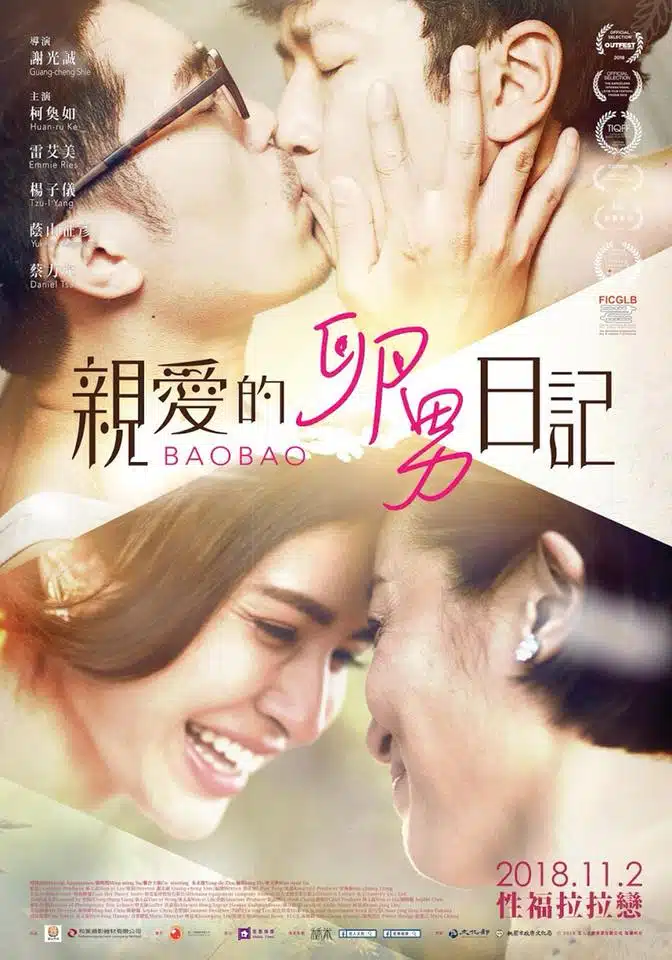
- Title: Bao Bao (親愛的卵男日記, 2018)
- Director: Guang Cheng Shie
- Screenplay: Guang Cheng Shie
- Country: Taiwan
- Genre: Drama, Family, Queer
- Running Time: 97 minutes
- Platform: YouTube (official trailer and select platforms available), overseas independent film streaming services
- Cast: Emmie Rays (as Fang Rong-xin / Cindy), Ke Huan-Ru (as Xu Jie-an / Joanne)
📖 Bao Bao: Unconditional Responsibility and Solidarity Blossoming Amid the Fissures of Loss [No Spoilers]
Cindy and Joanne, a female couple who have built a long marriage in London, England, harbor a desperate desire to have a child. Together with their close friends Charles and Tim, a gay couple, they establish a precise and practical co-parenting plan: to conceive twins through pregnancy and raise one child each.
After countless failures with artificial insemination and IVF procedures, they finally succeed in implanting two embryos. However, early in the pregnancy, they face the tragedy of miscarrying one embryo, and the four individuals’ once-perfect promise begins to spiral into a conflict over ownership surrounding the single remaining child.
As communication breaks down between Cindy, who suffers from the guilt of loss, and Joanne, who seeks practical solutions, Cindy finds the betrayal and anxiety unbearable. At five months pregnant, she chooses to return to Taiwan alone, driving their relationship toward a catastrophe.
🍼 What ‘Luan Nan’ (卵男) Symbolizes: Deconstruction of Gender and Existential Desire
The term ‘Luan Nan’ (卵男) in the film’s original title denotes a man’s desire to enter the domain of caregiving—specifically childbirth and rearing—transcending biological sex, while simultaneously serving as the work’s core metaphor aimed at deconstructing traditional parental roles.
The family that Joanne and Cindy dreamed of is more than just the fruit of romance; it is the result of an existential struggle to prove their own presence outside the institutional framework.
🌀 Miscarriage as an Absolute Fracture and the Cold Grammar of Ownership
The alliance of the four individuals, which seemed most ideal and flawless, ironically collapses all too easily in the face of miscarriage, a natural phenomenon of nature.
The moment one embryo disappears, the relationship bound by love and trust is reorganized under a cold, capitalistic, and legal logic: “Who will own the remaining child?”
Joanne’s exposure of a financial transaction, chosen as a practical escape, leaves Cindy with a profound sense of loss that goes beyond a simple lie, desecrating the emotional sanctuary they had built.
⚖️ On the Cusp of Legalization, Taiwan Faces Institutional Limitations and Isolation
Cindy’s choice to return to Taiwan is not a simple relocation of space, but a voluntary isolation into a gray zone devoid of legal safety nets.
As 2018 was a transitional period just prior to the legalization of same-sex marriage in Taiwan, the child Cindy would give birth to alone was legally situated in a state where protection from either Joanne or the gay couple would be extremely difficult to secure.
Through this blind spot, the film utilizes mise-en-scène and sharp dialogue to expose how institutions restrict an individual’s identity and right to form a family, and how harsh the weight borne by an individual woman within that framework truly is.
🔎 Reinterpretation of the Ending: A Dignified Companionship Arising Above Broken Promises
Instead of showcasing the complete erasure of conflict or a clear legal victory, the ending of the film Bao Bao opts for an aesthetic of lingering resonance, where Joanne returns to Taiwan to stay by Cindy’s side and piece together the broken shards.
This conclusion completely transcends the boundaries of family defined by traditional laws and institutions, presenting a new form of solidarity united solely by the will to take responsibility for each other’s wounds.
While Cindy loses her flawless and secure life in London, she gains the dignity of autonomously protecting her child and identity. Joanne, likewise, relinquishes her instinct for control and earns the qualification to be a true partner.
The unconditional care provided by two women, blossoming where institutional validation is absent, is in itself a flawless declaration of family.
💬 Interpretation of Representation of Women and Polarizing Narrative Points in Bao Bao
Q1. In the latter half of the film, won’t the setup where Cindy returns to Taiwan and seeks out her past male friend cause misunderstandings as a queer narrative, or split audience preferences?
From a critical perspective, Cindy’s actions may appear to be a regression toward a heteronormative narrative or a contrived device implemented for the sake of mystery.
Structurally, however, this device is a tool that projects the gaze of a patriarchal society that relentlessly interrogates the ‘biological origin’ of a child.
Ultimately, the process of uncovering the truth Cindy hid is not a journey to find a biological father; rather, it proves to be a process of autonomous independence to verify the fissures in her relationship with Joanne and become a mother on her own terms, thereby encouraging an open-ended judgment from the audience.
Q2. Does Joanne’s act of engaging in a financial transaction with the gay couple constitute a limitation that weakens the solidarity of the two women’s narrative?
Joanne’s unilateral choice is certainly a point open to criticism, having caused a fatal fracture in the trust between the two individuals.
Yet, this is a structural issue originating from the realistic helplessness and desperation that a queer female couple was forced to mobilize within a patriarchal and heteronormative legal system to protect their child.
Without glamorizing Joanne’s mistake, the film shows the expansion of a more mature female narrative by depicting her journey to Taiwan to confront her wrongdoing and restart her solidarity with Cindy on equal footing.
✨ The Form of Love Left by Bao Bao, Redder Than Blood
The ending of this film clearly points out to us living in modern society that the essence of family does not reside in the presence of biological ties or the validity of legal contracts.
In today’s world, where discussions surrounding same-sex marriage and new family structures remain unceasing, the work intimately traces how love, identity, and a sense of responsibility toward another human being foster an individual’s growth into a parent.
Moving beyond mere institutional recognition, the will to fill each other’s deficiencies is the most resilient bond. Family is not a holy family bound by blood, but a continuous collective of solidarity sustained by a vow to take responsibility for one another’s wounds until the very end.
💌 On the Power to Sustain a Relationship
We begin to love when perfect conditions are met, but what truly protects a relationship is the silence and responsibility demonstrated the moment those conditions collapse.
When all plans go awry and trust is broken, will you reach out to take the other person’s hand again, or will you choose your own secure isolation? Please share your intimate thoughts in the comments.
🎬 Violet Screen’s Recommended Curation
- The Wedding Banquet (2025 Remake)
- Reason for Recommendation: This work reinterprets maestro Ang Lee’s original 1993 film into a contemporary lesbian narrative. It depicts the commotion that ensues when Lee (Lily Gladstone) and Angela (Kelly Marie Tran), a lesbian couple living in Seattle, decide to enter a marriage of convenience to secure funds for IVF treatments. Much like Bao Bao, it addresses the financial and institutional barriers same-sex couples face in their quest to become parents with a realistic yet warm touch, offering excellent food for thought on how the definition of home can flexibly expand in modern society.
- Fragrance of the First Flower (2021–2023)
- Reason for Recommendation: This work stands out for the lingering, delicate texture characteristic of Taiwanese queer narratives. It captures the psychological ripples experienced by Yi-ming and Ting-ting, who were teammates on their high school volleyball team, when they cross paths by chance in the present day, where Yi-ming is married with a family. By meticulously capturing the internal fractures that occur when a woman confined within the framework of a traditional heteronormative ‘normal’ family reunites with her past suppressed desires and identity, it deeply inherits the context of isolation and solidarity among women in Taiwanese society shown in Bao Bao.
To provide a more stable publishing environment, multilingual content, and better communication with our readers, we have moved our official publication to Substack.
All new film reviews and critical essays will be published on our new platform. This website will be closing down soon, so we would greatly appreciate it if you subscribed to our new space.
TODAY'S QUESTION
Which ending has stayed with you the longest?
Your answer isn't saved. Feel free to share it in the comments below.


You May Also Like

Kiss Me Again (2006) – The Expansion of Desire and the Fracturing of Relationships: The Identity Remaining at the End
Love’s Lone Flower (2005): A Sad and Radiant Chronicle of Women Who Bloomed and Faded Alone in the Midst of Turbulent History