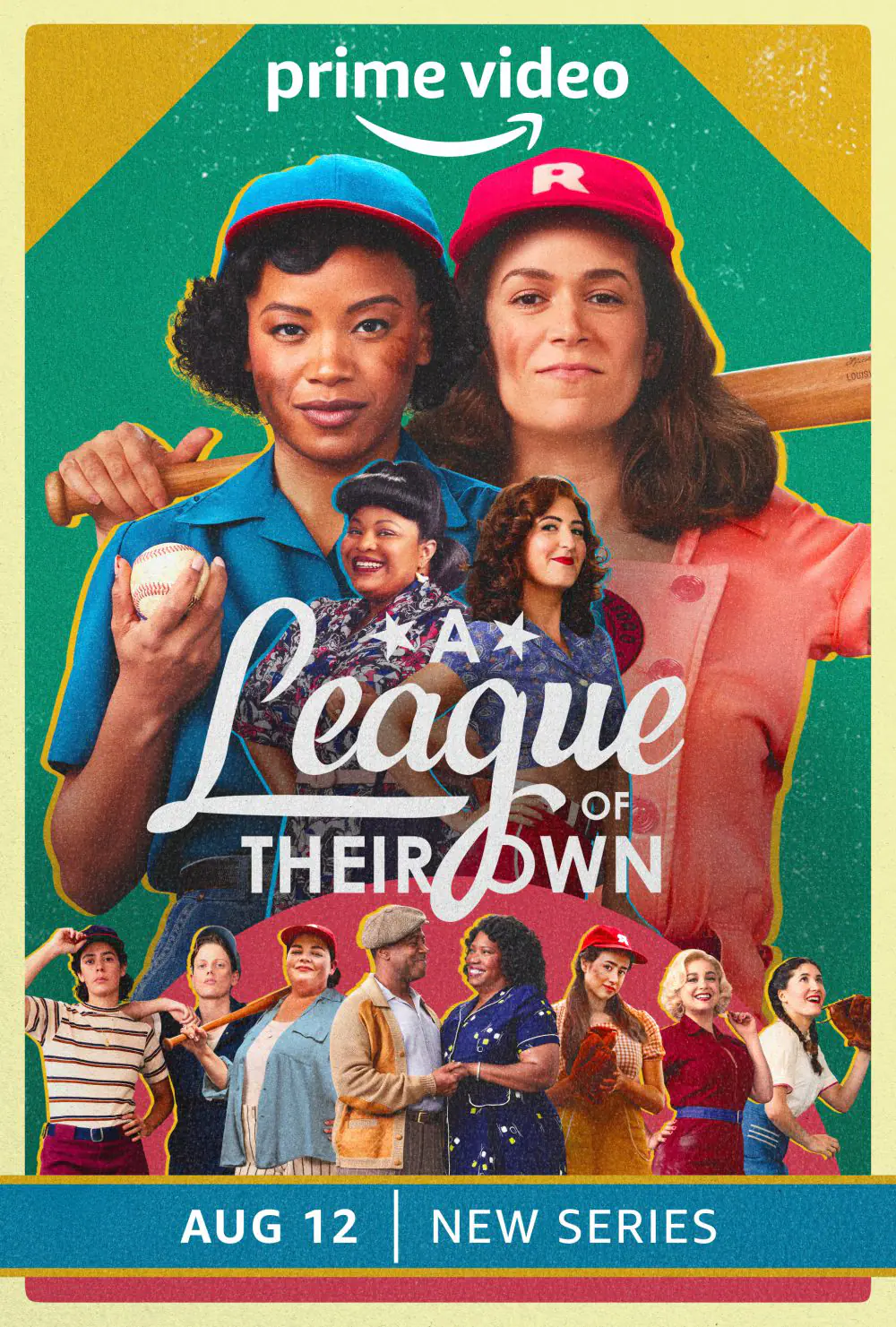
A League of Their Own (2022) Analysis: Solidarity of Desire Beyond the Deficiencies of an Era
We often face moments where we must betray the world most familiar to us in order to become “ourselves.” For some, that world is the fence of a peaceful home; for others, it is the only survival method permitted by society. The women’s baseball league, born in 1943 amidst the gunfire of war, was more than just a sporting venue. It was a private and fierce sanctuary built by women who gathered with their respective deficiencies to finally look their own desires in the face.
🌿 Moments When This Drama Especially Resonates
- When you feel your soul wearing thin while trying to fit your own pace and color into the world’s specifications.
- When you wish to confront the multi-dimensional, complex layers of love hidden behind the name of “friendship.”
- When you are curious about “a space of their own” that blossomed despite a history of social exclusion and discrimination.
- The reason you should read this article to the end is that this narrative is not merely a record of the past, but the warmest consolation affirming the identity of you, living in the present.
🎞 Note Before Watching
This work deals exquisitely and deeply with the struggles of gender identity and issues of racial discrimination faced by women within the historical limitations of the 1940s. It focuses on depicting the essential intimacy of relationships through physical contact and linguistic expression, making it closer to a humanities-based exploration of relationships disguised as a sports drama.
🎬 Series Information
- Title: A League of Their Own (2022)
- Director: Jamie Babbit, Anya Adams, et al.
- Screenplay: Abbi Jacobson, Will Graham, et al.
- Original Work: The film of the same name directed by Penny Marshall (1992)
- Country: USA
- Genre: Sports, Comedy, Drama
- Running Time: Season 1 (8 episodes total, approx. 50–60 minutes per episode)
- Platform: Amazon Prime Video
- Cast: Abbi Jacobson, Chanté Adams, D’Arcy Carden, Gbemisola Ikumelo
📖 A League of Their Own: A Survival Narrative of Women Expanding Beyond the Diamond [No Spoilers]
In 1943, as male players leave for the battlefield during World War II, American professional baseball faces a crisis. To fill this void, the All-American Girls Professional Baseball League (AAGPBL) is established. Carson Shaw, an ordinary housewife from a small town, boards a train for Chicago to find her dream while her husband is away at war.
There, she meets the glamorous and free-spirited Greta, confronting unfamiliar emotions latent within her for the first time. Meanwhile, Max, who possesses exceptional talent but is denied even the chance to try out because she is Black, engages in a desperate struggle to find her own mound outside the league.
The series densely portrays the process of the women who join the Rockford Peaches as they discover one another and find solidarity—even within an oppressive environment that enforces “femininity”—eventually finding their true names beyond the game of baseball.
⚾️ <A League of Their Own 2022> Proves the Perfect Unification of Flawed Beings
This drama brings the “truth in the shadows” to the surface—truths that the 1992 original film could not quite capture. While the original focused on sportsmanship and sisterhood, the 2022 remake expands the narrative’s scope through the core threads of queer identity and racial alienation.
In particular, the relationship between Carson and Greta goes beyond a simple romance, acting as a tool for growth to break out of the mold of self-repression. Much like a catcher coordinating a game for her baseball team, Carson learns how to autonomously coordinate her own life through her relationship with Greta. The psychological tension arising from this process is the core engine driving the entire drama, signaling the creators’ intent to show that “the most personal is the most political.”
🌈 Questions Tossed from the Mound of Identity: The Aesthetics of Interpretation and Symbolism
The “baseball field” in the work is a dual space. On one hand, it is a space of humiliating exhibition where players are forced to wear short-skirt uniforms and makeup; on the other, it is a space of liberation where women release energy while colliding their bodies together.
Max’s narrative, in particular, runs parallel to Carson’s, balancing the work. Max’s attempts to present as male to join a factory team or her encounter with “Uncle Bertie,” who fully affirms their own identity, symbolically illustrate the multi-layered isolation a Black queer woman had to endure in the 1940s. Here, the baseball is not merely a tool for victory but is replaced by a language of struggle thrown to break the world’s walls.
🔎 Reinterpreting the Ending: The Final Hit That Left an Eternal Fissure and Unification
In the Season 1 finale, although the Rockford Peaches lose the championship, what they gained was far greater than the numbers on the scoreboard. The parting kiss between Carson and Greta after the game, and the appearance of Carson’s husband, Charlie, who witnesses it, declares an irreparable structural fissure in their relationship.
This ending does not simply signify the ruin of a love triangle. It is a declarative device signifying that Carson can no longer return to the role-play of being the “obedient wife” of the past. Her unification with Greta was an awakening of the soul that transcended physical union; it implies that after the finale, they will live as entirely different beings, even if they walk separate paths.
Ultimately, their victory is completed not by the game’s result, but at that dignified moment when they are no longer afraid of having their truth discovered by others.
💬 Regarding the Interpretation and Ending of <A League of Their Own>
Q. What do you think of the criticism that the queer narrative is too excessive compared to the original film?
I understand the point of criticism. For audiences expecting the nostalgia of the original, it may feel jarring that private relationships and identity struggles are handled with more weight than the baseball games themselves. However, this was a structurally inevitable choice.
Based on historical evidence that many players in the actual league were queer, restoring the “truth” that the original omitted is the very reason for this work’s existence. The creators went beyond simple reenactment, enhancing aesthetic perfection by recreating a narrative between women—one that was impossible in the 90s—with a 2020s sensibility. While the judgment lies with the reader, this “excess” can be seen as a rightful compensation for the voices that had been erased for so long.
Q. Does Max’s narrative being separated from the team interfere with immersion?
This is a point where structural alienation is sublimated into direction. The setting where Max cannot join the team and lingers on the periphery visualizes the actual “distance of discrimination” that Black women had to experience at the time. The scenes where the two protagonists, Carson and Max, occasionally meet and encourage each other show how marginalized people in different positions can form a loose but solid solidarity. This split narrative structure actually becomes a device that multi-dimensionally showcases the complex power landscape of society at the time.
✨ <A League of Their Own> A Lonely Sprint Toward the Home Run of Identity
This drama borrows the past of 80 years ago to ask us today: “Are you playing as your whole self in your own league?” The solidarity shown by the women in this work is a survival skill that goes beyond mere fellowship, and the heart that refuses to stop throwing the ball even in front of the wall of discrimination is a sublime resistance.
It is far too emotionally dense to be dismissed as a simple sports drama. <A League of Their Own> is a work that proves your flaws are your uniqueness to everyone experiencing a crisis of identity.
True growth begins when you break the rules set by others and construct a new stadium made of your own rules.
⚾️ A Promise Shared in Silence, What Choice Would You Make?
We sometimes fall into the paradox of having to lie to the person we love most to protect what is precious. Just as Carson faced her truth and gave up her previous comforts, is there a loss you would willingly endure to find the “real you”?
Between peace within a stable lie and a storm that is unstable but truthful—to which side will you throw the ball?
🎥 Further Recommendations from Violet Screen (Female Narrative Curation)
- Bad Sisters (2022): A masterpiece that explores the fierce solidarity and survival in the name of family through the lens of black comedy. Highly recommended if you want to taste the essence of “sticky” sisterhood.
- Vida (2018-2020): A hot and intense drama where two estranged sisters return to their hometown after their mother’s death and face her hidden past and their own identities.
To provide a more stable publishing environment, multilingual content, and better communication with our readers, we have moved our official publication to Substack.
All new film reviews and critical essays will be published on our new platform. This website will be closing down soon, so we would greatly appreciate it if you subscribed to our new space.
TODAY'S QUESTION
What genre or mood do you always reach for when you're alone?
Your answer isn't saved. Feel free to share it in the comments below.


You May Also Like
Analysis of Sol and Ji-wan in Nevertheless: A Record of Desire Beyond the Safety Zone of Friendship

Enemies with Benefits (2026): An In-Depth Analysis of an Office Romance Dissolving the Boundaries Between Rivals and Lovers