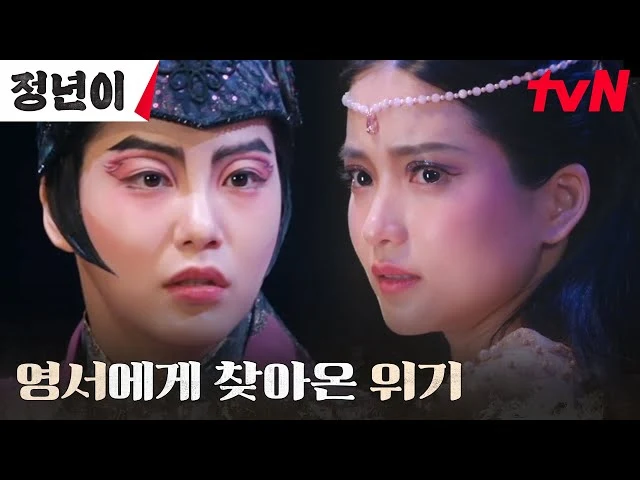
Jeongnyeon (2024) – Immense Desire Named ‘Sori’ and Radiant Isolation
We all willingly burn a segment of our lives to find our own ‘Sori’ (voice/song). While it is a craving for external validation, it is essentially a solitary struggle to confirm the unique imprint one can leave upon the world.
Against the backdrop of the glamorous 1950s Gukgeuk (female classical opera) stage, the drama Jeongnyeon: The Star Is Born asks how one exists as their true self through the fierce solidarity and chilling competition of women breaking their own limits.
🌿 Moments When This Drama Deeply Permeates
- For those who have stayed awake at night, wondering if their talent is a blessing or a curse.
- If you are experiencing the cold growing pains of a close colleague turning into a formidable rival.
- If you harbor a desire to stand on stage not as someone’s shadow, but in your own light.
- Why you must read to the end: Beyond a simple success narrative, one must witness the ripples left by the ‘aesthetics of relationships’—where women push each other up and pull each other down—in the finale.
🎞 Note Before Viewing
Set within an all-female Gukgeuk troupe, this work densely portrays emotional communion and artistic obsession between characters. It is a high-quality narrative drama centered on emotional waves and relational tension rather than physical exposure.
🎬 Drama Information
- Title: Jeongnyeon: The Star Is Born (2024)
- Director: Jung Ji-in
- Screenplay: Choi Hyo-bi
- Original Work: Webtoon Jeongnyeon by Seo Ire and Namon
- Country: South Korea
- Genre: Period Drama, Growth, Narrative
- Runtime: 12 Episodes (approx. 70–80 mins per episode)
- Platform: tvN, TVING, Disney+
- Cast: Kim Tae-ri, Shin Ye-eun, Ra Mi-ran, Jung Eun-chae, Kim Yoon-hye
📖 Jeongnyeon: The Entry of a Prodigy and a Turbulent Tale of Fate [No Spoilers]
In the 1950s, shortly after the Korean War, Yoon Jeongnyeon—who enchanted people with her voice while selling fish in a Mokpo market—is discovered by Moon Ok-gyeong, the era’s greatest Gukgeuk star, and enters the Maeran Gukgeuk Troupe in Seoul. Possessing innate genius, Jeongnyeon immediately draws attention, leading to a sharp confrontation with the established elite trainee, Heo Yeong-seo.
As Jeongnyeon builds a friendship with Hong Ju-ran, her only sanctuary amidst the jealousy of fellow trainees and the unfamiliarity of Seoul, the Gukgeuk stage transforms into a battlefield where individual desires and deficiencies collide. As her pure longing for ‘Sori’ meets era-defining limitations and personal trauma, Jeongnyeon begins to pay a grueling price to become the true ‘Prince of Gukgeuk.’
🎭 Narrative Layers Created by Mirror Twins and the Fall of the Sun
🌊 Yoon Jeongnyeon and Heo Yeong-seo: Interpreting the Perfect Rivalry Born of Deficiency
Jeongnyeon and Yeong-seo are mirrors reflecting one another. While Jeongnyeon possesses an instinctive wildness and a natural-born ‘heavenly voice,’ Yeong-seo symbolizes technical perfection honed through rigorous calculation and practice. Their clash is not merely a question of skill, but an inquiry into the essence of art.
While Yeong-seo erases herself in a desperate search for her mother’s approval, Jeongnyeon betrays the expectations of those around her to protect her own voice. Their competition does not destroy one another; rather, it forms a structure of complementary growth that forces each to recognize their own limits through the other’s existence.
🥀 Moon Ok-gyeong: The Great Sun, Preordained Betrayal, and Isolation
Moon Ok-gyeong is the savior who opened the door for Jeongnyeon, yet she is also the formidable wall Jeongnyeon must eventually overcome. Her sudden departure from the troupe to join the film industry is a painful betrayal for Jeongnyeon, but structurally, it serves as a necessary device for the ‘end of the old era’ and the ‘birth of a new king.’
Ok-gyeong led the heyday of Gukgeuk by consuming herself, yet she departs heartlessly to ensure she does not pass that sense of futility down to Jeongnyeon. Ok-gyeong’s absence is both a crisis for Maeran and a cruel liberation that allows Jeongnyeon to stand tall as an independent artist rather than someone’s successor.
🐚 Dissonant Rhythm with Hong Ju-ran: Solidarity Beyond Friendship and the Aesthetics of Loss
The relationship between Jeongnyeon and Ju-ran serves as the most poignant emotional axis of the drama. Ju-ran was Jeongnyeon’s most fervent supporter, but ultimately, for her own growth and due to realistic constraints, she chooses Yeong-seo over Jeongnyeon on stage, and later leaves the troupe to be integrated into the patriarchal order (marriage).
This symbolizes the social castration that women of the 1950s had to face. The emotion Ju-ran felt for Jeongnyeon was a love that transcended simple admiration—it was a love for the ‘freedom she could never possess.’ Ju-ran’s exit leaves an indelible wound on Jeongnyeon, but that sense of loss acts as a catalyst, adding profound sorrow and han (sorrowful resentment) to Jeongnyeon’s voice, elevating its artistic maturity.
🔎 Reinterpreting the Finale — The Solitary Victory of a King Standing Alone
In the final performance of The Legend of the Twin Pagodas, Jeongnyeon’s portrayal of Asadal is more than a record of success. It is evidence of complete self-reliance, achieved only through her own voice and acting after losing every support system that once sustained her (Ok-gyeong’s guidance, her own voice/physical health).
The reconciliation with Yeong-seo is not the end of competition but respect between peers. The applause pouring onto the empty stage signifies the weight of isolation that Jeongnyeon must now carry. Jeongnyeon gained her voice but lost ordinary happiness; in exchange, she became an immortal legend.
An artist truly achieves eternal life on stage only by using their own ruin as nourishment.
❓ <Jeongnyeon>: Narrative Disputes and Ambiguity of the Ending
Q1. Isn’t Moon Ok-gyeong’s sudden departure an irresponsible character collapse?
Some viewers criticize Ok-gyeong’s exit as narrative abandonment. However, this is a characterization of the historical shift where the genre of Gukgeuk was losing its dominance to the new medium of film. Ok-gyeong was wary of Jeongnyeon becoming a ‘replica’ of herself. Her betrayal must be understood as the most powerful form of discipline, pushing Jeongnyeon to become an independent artist.
Q2. Isn’t the ending, where Hong Ju-ran chooses marriage and leaves, a limitation of a female-centric narrative?
Ju-ran’s choice is not glorified. Instead, her exit vividly demonstrates how easily women of that era were erased by the system despite their talent and dreams. The friendship and love shared by Ju-ran make Jeongnyeon’s success both more brilliant and more tragic. This is not a point for criticism, but an aesthetic device that forces us to face the reality of women imprisoned by their era.
✨ Jeongnyeon, The Lone Voice Blooming Amidst Radiant Sorrow
Ultimately, Jeongnyeon is a report on the loss and isolation inevitably encountered in the process of finding ‘oneself.’ We gain strength through solidarity with others, but in the decisive moment, we must stand in the center of the stage by our own power alone. This work proves that relationships between women can move beyond mere jealousy to become the most powerful engine for sculpting and completing one another’s souls.
True artistic achievement is a painful blessing available only to those who have lost what is most precious.
🎭 Questions Left by the Ripples of ‘Sori’
On the dusty stage, what is the only weapon you have to prove yourself? Do you have the courage to willingly give up your most precious relationships to complete yourself?
💜 Violet Screen Curation
- The Art of Joy (2024): A grand epic of a woman carving out her own desires while resisting convention in early 20th-century Sicily.
- Dickinson (2019–2021): A modern reimagining of genius poet Emily Dickinson’s inner world, sensually depicting the conflict between the artistic self and relationships.
To provide a more stable publishing environment, multilingual content, and better communication with our readers, we have moved our official publication to Substack.
All new film reviews and critical essays will be published on our new platform. This website will be closing down soon, so we would greatly appreciate it if you subscribed to our new space.
TODAY'S QUESTION
Which ending has stayed with you the longest?
Your answer isn't saved. Feel free to share it in the comments below.


You May Also Like

Verbotene Liebe: The Hidden Story of Nina & Erika, An In-Depth Analysis of a Female Narrative Transcending Social Boundaries
Show Me Love The Series: A Structural Review of Solidarity and Love Blossoming Behind a Glamorous Beauty Pageant