Ratched Ending Interpretation & Review: A Tragic Narrative Where Isolated Desire Meets the Salvation of Solidarity
Life is sometimes like a massive fortress built to protect oneself. The higher those walls rise, the deeper the internal isolation becomes, and we survive within them by defining ourselves as “monsters.” The Netflix series Ratched proves, through chilling yet beautiful mise-en-scène, that the only key capable of dismantling those walls is the warm gaze of another and the courage of solidarity.
🌿 The Moment Warmth Seeps Into the Edge of Ratched’s Cold Scalpel
This work is a cruel fairy tale dedicated to all those who have suppressed themselves within the framework of “normalcy” defined by society. To those lost between cold corridors and grotesque surgical instruments, this drama speaks of the power to face a painful past and choose a new future.
- Consolation offered to those who have lived a meticulously calculated life to hide themselves
- The longing for the moment one wishes to end false relationships and face the true self
- The narrative tension generated when social taboos collide with individual desire
The reason to read until the end is that the conclusion Mildred reaches is not mere escapism; it is a record of personal liberation, where the destructive instincts that once defined her are sublimated into love.
🎞 Notes Before Watching
Set in a psychiatric hospital, this work contains elements of medical gore, depicting visual shock and physical mutilation in certain scenes. However, it is explicitly stated that its essence is a relationship-driven narrative dealing with the dense psychological communion and growth of two women.
🎬 Drama Information
- Title: Ratched (2020)
- Directors: Ryan Murphy, Daniel Minahan, et al.
- Writers: Evan Romansky, Ian Brennan, et al.
- Original Source: Based on characters from Ken Kesey’s novel One Flew Over the Cuckoo’s Nest
- Country: USA
- Genre: Thriller, Drama, Crime, Romance
- Running Time: Season 1 (8 episodes total, 50–60 minutes each)
- Platform: Netflix
- Cast: Sarah Paulson, Cynthia Nixon, Finn Wittrock, Sharon Stone, Judy Davis
📖 Ratched: The Encounter Between a Nurse Harboring Secrets and a Woman Craving Truth [No Spoilers]
1947, Lucia—a peaceful coastal town in California. Mildred Ratched, a nurse exuding a mysterious aura, appears at the state psychiatric hospital. Behind her perfect attire and restrained demeanor, she hides a meticulous plan to rescue her brother, Edmund Tolleson, who is incarcerated on death row. As Mildred navigates the hospital’s power structures toward her goal, Gwendolyn Briggs, the governor’s press secretary, appears, and cracks begin to form in Mildred’s rigid world.
For Mildred, hiding herself was a survival strategy; for Gwendolyn, a life behind social status and a marriage of convenience masked a craving for real love. Within the vortex of the massive systems of medicine and politics, the two discover one another. As Mildred’s dark secrets collide with the transparent truth offered by Gwendolyn, the story transcends a simple crime thriller to become an intense journey toward human desire and healing.
🐚 Interpreting the Relationship Between Mildred Ratched and Gwendolyn Briggs: The Transparent Truth That Breaks Oppression
The most radiant point in the narrative of Ratched is the psychological deconstruction and reconstruction Mildred undergoes through Gwendolyn. Having endured horrific childhood trauma, Mildred is a character who blocked “empathy” and chose “control” as a tool for survival. Her perfect uniform is akin to armor, intended to prevent others from glimpsing her inner self. However, rather than condemning the defense mechanisms Mildred has built, Gwendolyn looks directly at the loneliness within them.
The scene where the two eat oysters at a women-only club in Monterey carries a significance beyond a simple date. The act of eating the soft flesh hidden within the shell is a symbolic ritual that eases the emotional closure Mildred has maintained her entire life. Gwendolyn does not hide her sexual orientation, declaring she “can no longer live a lie,” and infects Mildred with her courage. This becomes the decisive turning point that allows Mildred to dream of a life of her own, free from the shackles of her brother, Edmund.
🎭 The Hospital as a Massive Prison and the Freedom That Bloomed Within
Lucia State Hospital is a space that labels social “abnormality” and inflicts violence in the name of treatment. Paradoxically, it is when Mildred reaches the highest point within this space of oppression that she exposes her most vulnerable side to Gwendolyn. When Gwendolyn is shot and stands at the threshold of life and death, the anxiety Mildred displays proves she is no longer an emotionless “angel” or “monster.”
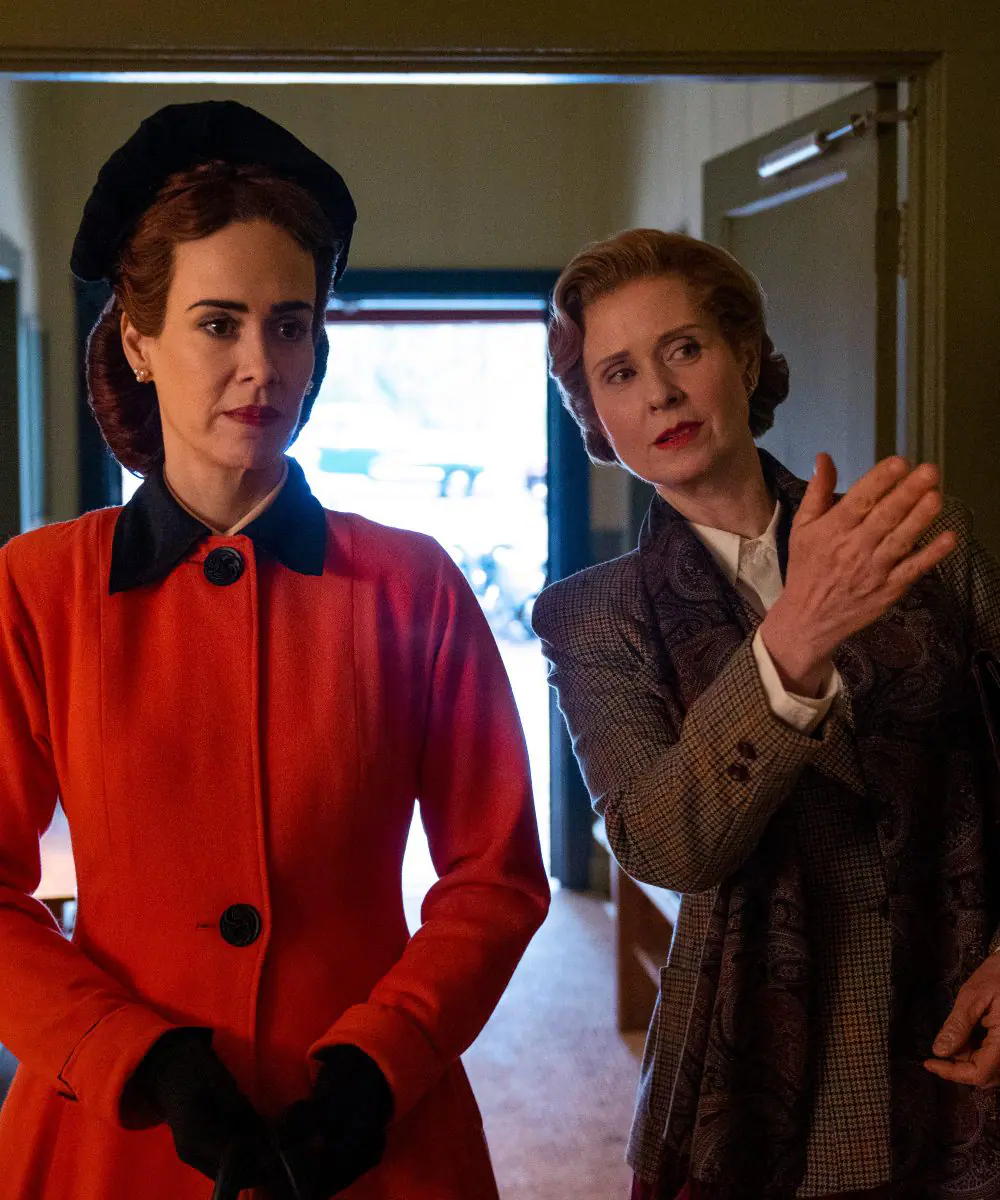
The work depicts the conservative era of the 1940s through aesthetic color contrasts. The hospital’s cold emerald green and the warm orange tones of the spaces Gwendolyn inhabits visually demonstrate how their two worlds merge. The moment Mildred confesses her past to Gwendolyn, she finally gains independence as an individual named “Mildred,” rather than merely Edmund’s sister. Their relationship goes beyond simple romance, embodying a powerful female narrative where they nurse each other’s wounds and save one another from social annihilation.
🔎 Reinterpreting the Ending Formed Under the Sun of Mexico
The choice of Mildred and Gwendolyn to flee to Mexico at the end of Season 1 is not a simple happy ending. It is a declaration of survival by “abnormal beings” who were not permitted to exist in American society at the time. Gwendolyn’s battle with cancer lends a sense of finiteness to their relationship, making the happiness they enjoy in the present all the more desperate. The bright sunlight of Mexico contrasts with the artificial lighting of the hospital, signaling that they have finally reached a utopia where they can live as their true selves.
However, the hint of Edmund’s survival and the looming threat at the conclusion shows that this happiness is built upon a precarious castle that could crumble at any moment. Mildred is no longer her brother’s keeper; she is now in a position where she must confront him to protect her own life and love. This signifies her complete independence from the ghosts of her past while simultaneously suggesting that true freedom comes with its own costs and responsibilities.
Mildred Ratched’s flight is a severance from a chain of sequential trauma; it is the result of a personal reconstruction that chooses the coexistence of order and destruction.
❓ Regarding the Ratched Ending and Characters
Q1. Is Mildred Ratched ultimately a villain or a victim?
The cruel actions Mildred displays early in the series are certainly subject to criticism. She exploits the pain of others for her own ends. However, as the drama unfolds, it is revealed that these actions were survival methods learned through the system. The work does not define her as a simple villain or a pure victim. Instead, it explores how an oppressive environment turns a human into a monster, and how love turns that monster back into a human. Readers will find themselves questioning whether her choices were born of malice or desperate defense.
Q2. What do you think about the criticism that the romance with Gwendolyn feels out of place in the narrative?
Some viewers may feel the romance blooming amidst the tension of a crime thriller is jarring. However, their relationship is the central axis of the work’s core theme: “finding the true self.” Without Gwendolyn, Mildred would have remained eternally trapped in Edmund’s shadow as a component of the hospital system. The romance is not a side plot of the narrative but the only channel through which Mildred recovers her humanity; through this, the drama completes its own independent aesthetic beyond a mere character prequel.
✨ Ratched: The Great Revolution of Love That Breaks the Cycle of Hatred
Ratched asks us: Is it your past that defines you, or the choices you make for the person beside you now? The solidarity between Mildred and Gwendolyn cuts through the prejudices of the era more sharply than a cold scalpel, breathing the warmth of healing into those wounds. Though everyone lives with deficiencies, this work proves with chilling beauty that what fills those voids is the sincere gaze of another.
True salvation begins not with divine forgiveness, but with the certainty that one will not be abandoned even after revealing their darkest abyss.
💬 Between Silence and Confession
When you bared your darkest secret to someone, what was the word you most wanted to hear? Was it “understanding,” or was it the “silence” of them simply staying by your side?
🎙️ Violet Screen Curation: Other Narratives of Solidarity
- Blue Jean (2022): A work dealing with the isolation and growth of Jean, a PE teacher living a hidden life under the Thatcher government in the 1980s. It portrays the societal pressure Gwendolyn would have felt with a more realistic and delicate sensibility.
- Love Lies Bleeding (2024): A female-centric crime thriller where suppressed desire and obsessive love explode. You can experience another variation of the destructive devotion and protective instincts shown by Mildred through intense visuals.
To provide a more stable publishing environment, multilingual content, and better communication with our readers, we have moved our official publication to Substack.
All new film reviews and critical essays will be published on our new platform. This website will be closing down soon, so we would greatly appreciate it if you subscribed to our new space.
TODAY'S QUESTION
Is there a hidden gem you always recommend to friends?
Your answer isn't saved. Feel free to share it in the comments below.


You May Also Like

Verbotene Liebe: The Hidden Story of Nina & Erika, An In-Depth Analysis of a Female Narrative Transcending Social Boundaries

The Morning Show Ending Explained and the Bradley-Laura Relationship: Fissures Left by Isolated Truths