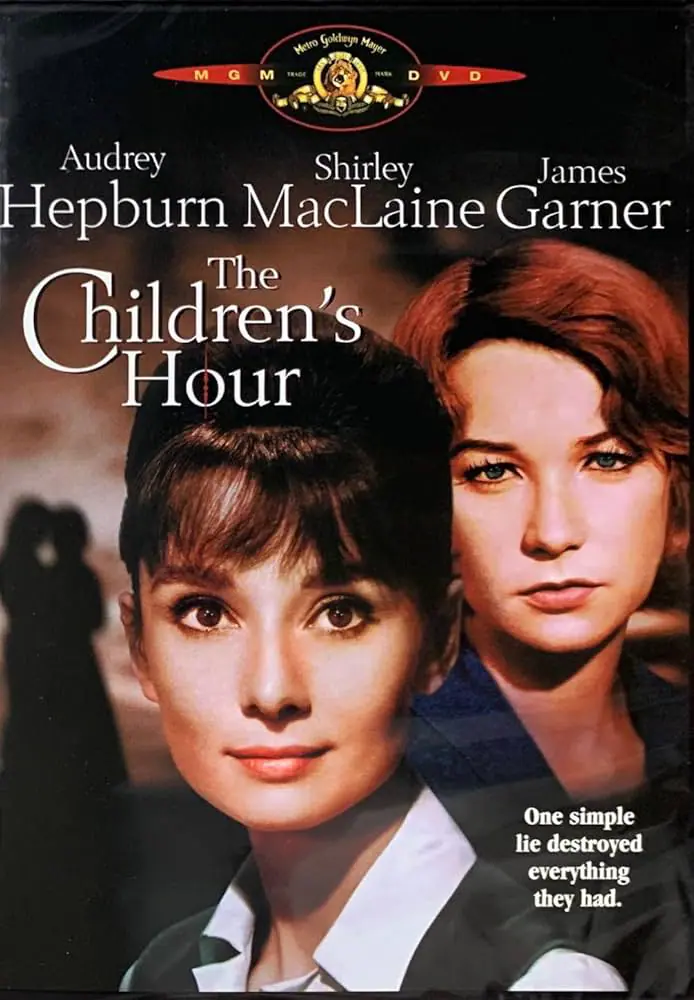
The Children’s Hour (1961) Review: Ruins of Isolation Left When Lies Swallow the Truth
Human language is sometimes sharper than a blade, acting like a poison dispersed into the invisible air. The process by which a single malicious whisper razes a lifetime of achievement and dismantles the firmest of bonds often delivers a chill more profound than any horror film.
Director William Wyler’s 1961 film The Children’s Hour is a work that doggedly tracks how the “destructive power of words” and social “stigma” butcher the soul of an individual. The reason this film remains relevant sixty years later is perhaps because the world we inhabit still defines “difference” as “wrongness,” seeking to confirm its own moral superiority by making a sacrifice of someone.
🌿 Moments When This Film Penetrates Deeply
- To those who have ever doubted the truth within themselves because of the gaze and judgment of others.
- To those who wish to witness how the mechanisms of mob mentality and witch hunts isolate an individual.
- To those who want to experience the restrained yet explosive emotional performances of two legendary actors, Audrey Hepburn and Shirley MacLaine. The reason to read this piece to the end is that this tragedy is not a mere relic of the past, but the most sophisticated mirror reflecting the “hate” of today.
🎞 Notes Before Viewing
This work is a classic psychological drama that generates breathtaking tension solely through the taut psychological confrontation between characters and social pressure, without physical violence or provocative depictions. It stares directly into the cold gaze of the society of that era toward the relationship between two women.
🎬 Movie Information
- Title: The Children’s Hour (1961)
- Director: William Wyler
- Screenplay: John Michael Hayes
- Original Work: Lillian Hellman (Play ‘The Children’s Hour’)
- Country: USA
- Genre: Psychological Drama / Social Drama
- Running Time: 107 minutes
- Cast: Audrey Hepburn (as Karen Wright), Shirley MacLaine (as Martha Dobie), James Garner (as Joe Cardin), Miriam Hopkins (as Lily Mortar)
📖 The Children’s Hour: A Whirlpool of Ruin Crafted by Lies [No Spoilers]
Karen and Martha, best friends since their university days, establish their own private girls’ school after much hardship and place it on a stable trajectory. Karen dreams of a happy future, getting engaged to Joe, a promising doctor, while Martha remains by Karen’s side, dedicated to running the school as a devoted partner.
However, their peace is shattered by a single lie from Mary, a cunning and twisted student. Punished for a minor infraction, Mary invents a shocking rumor that the two teachers are in an “unnatural romantic relationship” to escape her predicament, reporting this to her grandmother and school patron, Mrs. Tilford.
The unverified rumor spreads among parents in an instant, and within a single day, every student leaves the school. In a state tantamount to social burial, Karen and Martha begin a legal struggle to reclaim their honor, but a world seized by prejudice does not grant them even the opportunity for explanation. What the two women face is something more terrifying than a malicious lie: the fundamental fear within human nature and suppressed truths.
🔍 Birth of Malice and a Structural Interpretation of the Witch Hunt
In The Children’s Hour, Mary Tilford—the starting point of the tragedy—functions as more than just a “bad child”; she serves as an agent of social hatred. Mary instinctively knows what adults fear most and which subjects they react to with the most sensitivity. The reason her lie wielded such formidable power was that it touched upon the “latent fear of homosexuality” held by Mrs. Tilford and the society of that time.
This work clearly demonstrates that a witch hunt is completed not by the verification of facts, but by the public’s “desire to believe.” Evidence is irrelevant. Wyler captures with cold and precise mise-en-scène how a collective egoism, wishing to validate its community’s morality by destroying someone, rationally butchers an individual’s life.
🎭 Interpretation of Suppressed Desire and Self-Loathing Embodied by Shirley MacLaine
The character of Martha Dobie is one of the most painful and intense queer portraits in cinematic history. In the early stages of the film, her sensitive reactions and jealous irritation toward Karen’s fiancé, Joe, could be dismissed as simply “not wanting to lose a friend.” However, as the rumors spread and social pressure intensifies, Martha’s anxiety begins to turn inward rather than outward.
While Martha struggles to prove the rumors are false, she is simultaneously horrified by the fact that the “truth” she has hidden all her life is mixed within that lie. The self-doubt of “Is there something wrong with me?” transforms into internalized hatred, applying the moral yardstick injected by society to herself. Through trembling eyes and a raspy voice, Shirley MacLaine perfectly portrays the paradoxical agony where the moment of realizing who one is becomes the beginning of ruin.
🔎 Reinterpreting the Ending: Eternal Cracks and Noble Resistance Left by the Final Walk
Following Martha’s death, the image of Karen Wright (Audrey Hepburn) in the film’s ending elevates the work beyond simple melodrama. Instead of wailing before Martha’s body, Karen dresses neatly in black, composes herself, and walks out of the school. Standing in her path are Mrs. Tilford, who has come to seek forgiveness after belatedly learning the truth, and her fiancé, Joe.
Here, Karen ignores their gaze and walks forward as if nothing had happened, yet with the firmest will in the world. This scene is not the walk of a defeated person begging for society’s forgiveness, but a declaration rejecting the hypocritical society that destroyed them. Karen has lost a loved one, but she has simultaneously reclaimed her selfhood, which had been held hostage by the gaze of others.
Karen’s final steps are the most sorrowful mourning for Martha, who proved her identity through death, and a silent judgment against a world full of prejudice. This ending implies that while the relationship between the two may have been physically severed, it has reached a state of complete spiritual union, leaving an indelible resonance with the audience.
🧐 Interpretation of Key Issues in The Children’s Hour
Q1. Why was Mary’s lie accepted so easily?
The society in the film had already defined homosexuality as a “disease” or a “sin.” Mary’s lie did not create a non-existent fact; it merely set fire to the latent prejudices people already harbored in their hearts. From a critical perspective, one might point out that Mary is portrayed too much as absolute evil, but this should be interpreted as a dramatic device to emphasize the “contagiousness of evil” rather than the banality of evil.
Q2. Are Martha’s confession and death results reflecting the limitations of the era?
Under the influence of the Hollywood Production Code (Hays Code) in the early 1960s, the love of minorities often had to end in death or misfortune. It is difficult for Martha’s suicide to escape the criticism of being a product of such era-specific censorship. However, within the cinematic context, her death is closer to an existential collapse experienced after realizing her true feelings, rather than a mere escape. This forces the audience to ask, “Who killed her?” and holds society responsible for a social murder.
✨ The Children’s Hour, a Declaration of Human Dignity Completed Through Silence
From the original 1930s play to its 1961 film adaptation, The Children’s Hour is a record of a long struggle to speak “the unspeakable.” Today, we witness daily how short sentences on social media define and destroy a person’s character. The message this film delivers is clear: the moment we treat the weight of language used to judge others lightly, we all become potential perpetrators and Mary Tilfords.
The essence of a relationship is built not on the recognition of others, but solely on the truth of those involved. Martha sealed that truth through death, and Karen protected it through life. The true tragedy lies not in the difference of the few, but in the vulgar imagination of the many who cannot allow that difference to coexist.
👣 In the fog of misunderstanding, whose hand will you hold as you walk?
When invisible rumors threaten your precious relationships, can you find the courage to walk silently toward the world like Karen? Between a life of fighting to the end to reveal the truth and a life of severing relationships and going your own way while being misunderstood, which side do you lean toward? Please share your thoughts in the comments.
📽 Violet Screen Recommends: Other Perspectives Piercing the Essence of Relationships
- [The World to Come (2020)] Genre: Period Drama / Romance
- Reason for Recommendation: Set in the mid-19th century American frontier, it deals with the literary and intense bond shared by two women in an isolated environment. If The Children’s Hour focused on social stigma, this work concentrates on the meticulous record of language and emotion blossoming in solitude.
- [Women Talking (2022)] Genre: Drama
- Reason for Recommendation: A masterpiece depicting the process by which women gather to decide their fate through “speaking” amidst collective violence and oppression. It serves as an excellent contrast to The Children’s Hour, proving that language can be a tool for solidarity and liberation rather than destruction.
To provide a more stable publishing environment, multilingual content, and better communication with our readers, we have moved our official publication to Substack.
All new film reviews and critical essays will be published on our new platform. This website will be closing down soon, so we would greatly appreciate it if you subscribed to our new space.
TODAY'S QUESTION
What genre or mood do you always reach for when you're alone?
Your answer isn't saved. Feel free to share it in the comments below.


You May Also Like

Summerland, The Absolute Zero of Tender Solidarity Found in the Sea of Loss
Affinity (2008) – The Interaction of Deception and Longing Within a Closed Circuit of Prison