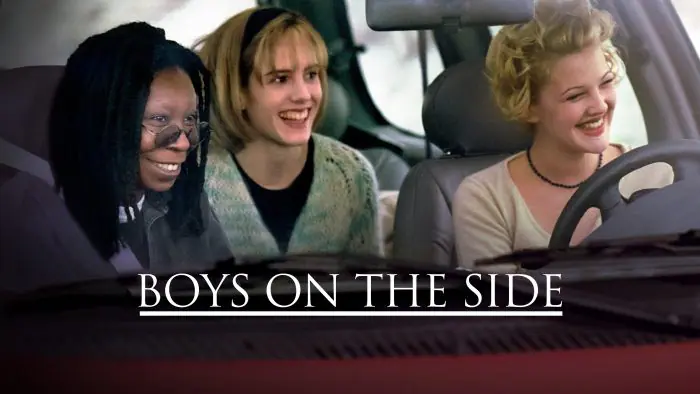
Boys on the Side: Solidarity of Isolated Souls and the Salvation of Chosen Family
In the course of our lives, we form countless relationships, yet it is nearly a miracle to meet someone to whom we can fully reveal the deficiencies lying at the very bottom of our souls. A presence that does not turn away from my distorted reflection in the mirror of the “other,” but instead helps gather those shattered fragments. The film Boys on the Side tenaciously tracks how three women, having cast off the rigid shackles of blood relations, become each other’s salvation upon the uncertain space of the “road.”
This work does not merely stop at praising female friendship. It is a philosophical journey that asks what the ultimate dignity a human can offer another is, amidst the painful realities of social stigma, physical dissolution, and unrequited affection.
🌿 Moments When This Film Settles Deep Within
- For those who have felt a harrowing sense of emotional isolation, as if left entirely alone in the world.
- For those who believe in the liberation of a “chosen relationship” over the obligations imposed by the name of “family.”
- For those who believe that loving someone is enough, even if that love does not necessarily reach a sexual conclusion.
- This is why you must see how the final sentence of this text will serve as a comforting punctuation mark in your own life.
🎞 Note Before Viewing
This work captures the sensibilities of the mid-90s and densely tackles concerns regarding illness (AIDS), domestic violence, and sexual identity. It is a human drama that focuses on the dialogue between characters and subtle emotional fluctuations rather than provocative depictions.
🎬 Film Information
- Title: Boys on the Side (1995)
- Director: Herb Ross
- Screenplay: Don Roos
- Country: USA
- Genre: Drama, Road Movie, Queer
- Running Time: 117 minutes
- Platform: Officially licensed streaming services and VOD
- Cast: Whoopi Goldberg (as Jane), Mary-Louise Parker (as Robin), Drew Barrymore (as Holly), Matthew McConaughey (as Abe)
📖 Boys on the Side: A Chance Encounter Born of Shared Wounds [No Spoilers]
Jane (Whoopi Goldberg), a cynical lesbian singer performing in New York nights, loses her job and plans to head West. Robin (Mary-Louise Parker), a neat and conservative real estate agent, answers Jane’s newspaper ad for a travel companion. The journey gains momentum as they are joined in Pittsburgh by Jane’s friend Holly (Drew Barrymore), completing a trio of starkly different women.
However, an accidental incident involving Holly’s abusive boyfriend forces the three women to become “fugitives” rather than mere travelers. Upon reaching Tucson, Arizona, they face the fatal secrets each has hidden: Robin’s battle with AIDS, Jane’s unrequited love, and Holly’s unstable future. Their communal life in a foreign land begins to evolve into a new form of family that existing social norms have failed to define.
🔒 Interpreting the Precarious Boundary Between Queer Longing and Friendship
The most captivating yet painful element of this film is the nature of the feelings Jane harbors for Robin. While Jane does not hide her identity as a sexual minority, she carefully manages her feelings for the heterosexual Robin. The scene where Jane sits at the piano and sings “Superstar” solely for Robin is an indispensable pinnacle in the analysis of this film.
Here, the melody of the Carpenters is not mere background music; it represents Jane’s devoted desire dedicated to an unreachable counterpart. By not allowing the relationship to rush into a premature romance, director Herb Ross instead perfects the most sublime form an emotion called love can take—affirming the very existence of the other and witnessing their dissolution (death) until the very end.
⚖️ The Fissure Created by the Stigma of AIDS and Shared Secrets
Against the chronological backdrop of 1995, Robin’s AIDS diagnosis carries weight far beyond a simple medical condition. It was a social death sentence and a cause of extreme alienation. The moment Robin confesses her illness, the relational structure of the three shifts from “travel companions” to a “community sharing life and death.”
A point of note is the mistake Jane commits due to her obsession with protecting Robin. Her act of exposing Robin’s illness to a man Robin was interested in is both a destruction of trust and a manifestation of selfish fear—the fear of losing a loved one. Through this fissure, the film painfully proves that true solidarity involves discarding the arrogance of trying to control the other’s weaknesses and instead respecting the way of life they have chosen.
🔎 Reinterpretation of the Ending: Affirmation of Life More Sublime than Judicial Judgment
In the latter half of the film, the sight of the three women standing in court due to Holly’s past incident illustrates the moment their “chosen family” clashes with the world’s systems. However, the true conclusion of this film does not lie in a legal verdict. In the gaze they share while holding hands leaving the courtroom, there is a conviction that even if Robin’s physical body slowly fades, the time they shared will be immortalized forever.
In a situation where Robin’s death is foretold, what Jane and Holly gain is not the “sorrow of loss” but the “courage to love.” Through her own dissolution, Robin taught her two friends how to connect deeply with others, and Jane chose the dignity of guarding Robin’s end rather than fulfilling her own unrequited love. This ending declares that the relationship between the two has reached a total union of souls beyond physical union.
For those who have chosen one another, death is not a parting, but a process of one being eternally migrating into the memory of the other.
❓ Boys on the Side: Limitations and Values of 90s Female Narratives
Q1. What is your view on the criticism that Jane’s lesbian narrative is disappointing because it does not lead to a romance with Robin?
While it may be seen as a limitation of mainstream 90s cinema, structurally, it actually secures the work’s originality. This is because the film focuses on how two women with different sexual identities can form a deep emotional bond, moving away from the obsession that all queer narratives must reach a sexual conclusion. This can be viewed as an aesthetic choice to utilize queerness not merely as a romantic tool, but as a device to broaden the spectrum of human relationships.
Q2. Isn’t there criticism that Holly’s (Drew Barrymore) character is a typical “nuisance” type?
Holly’s actions in the beginning may appear immature and impulsive. However, she is the character who most honestly reveals her desires—the craving for family. Holly’s pregnancy and growth provide the keywords of “life” and “future” to a road trip otherwise filled with pain. Her immaturity is closer to a structural necessity that shows how imperfect humans gather to complement one another and become resilient.
✨ Boys on the Side: A Great Solidarity Where Marginalized Lives Become the Center
Just as the title suggests, this film places men on the “Side” while situating women’s lives and voices at the “Center.” It demonstrates the explosive power of emotion that occurs when people face one another simply as human beings, stripping away labels such as social minority, patient, or victim of violence. The reason this work remains valid thirty years later is likely that we still long to be someone’s “unconditional ally.”
True family is not an accident of blood, but a product of the will decided in the midst of pain—the decision never to let go of one another.
💬 Who is your “chosen family”?
If there is a presence that recognizes my sorrow even in silence, it is a blessing that cannot be traded for anything in the world. What kind of courage are you exercising right now to call the person beside you “my family”?
📽 Violet Screen Recommendations: Other Perspectives Deepening Female Narratives
Sunny (2011) or SoulMate (2016): These films vary the emotional texture of Boys on the Side with an Eastern sensibility, beautifully depicting the complex and subtle attachments between women that remain unchanged through the long passage of time.
Fried Green Tomatoes (1991): A warm classic capturing the records of friendship, solidarity, and the resilient love hidden within women across generations.
To provide a more stable publishing environment, multilingual content, and better communication with our readers, we have moved our official publication to Substack.
All new film reviews and critical essays will be published on our new platform. This website will be closing down soon, so we would greatly appreciate it if you subscribed to our new space.
TODAY'S QUESTION
What's your favorite line from a WLW movie or show?
Your answer isn't saved. Feel free to share it in the comments below.


You May Also Like

Two Weddings and a Funeral: Female Solidarity and Authentic Lives Hidden Behind a Facade

Siebzehn (Seventeen) Review: The Precarious Female Narrative and Emotional Fractures of a 17-Year-Old Youth