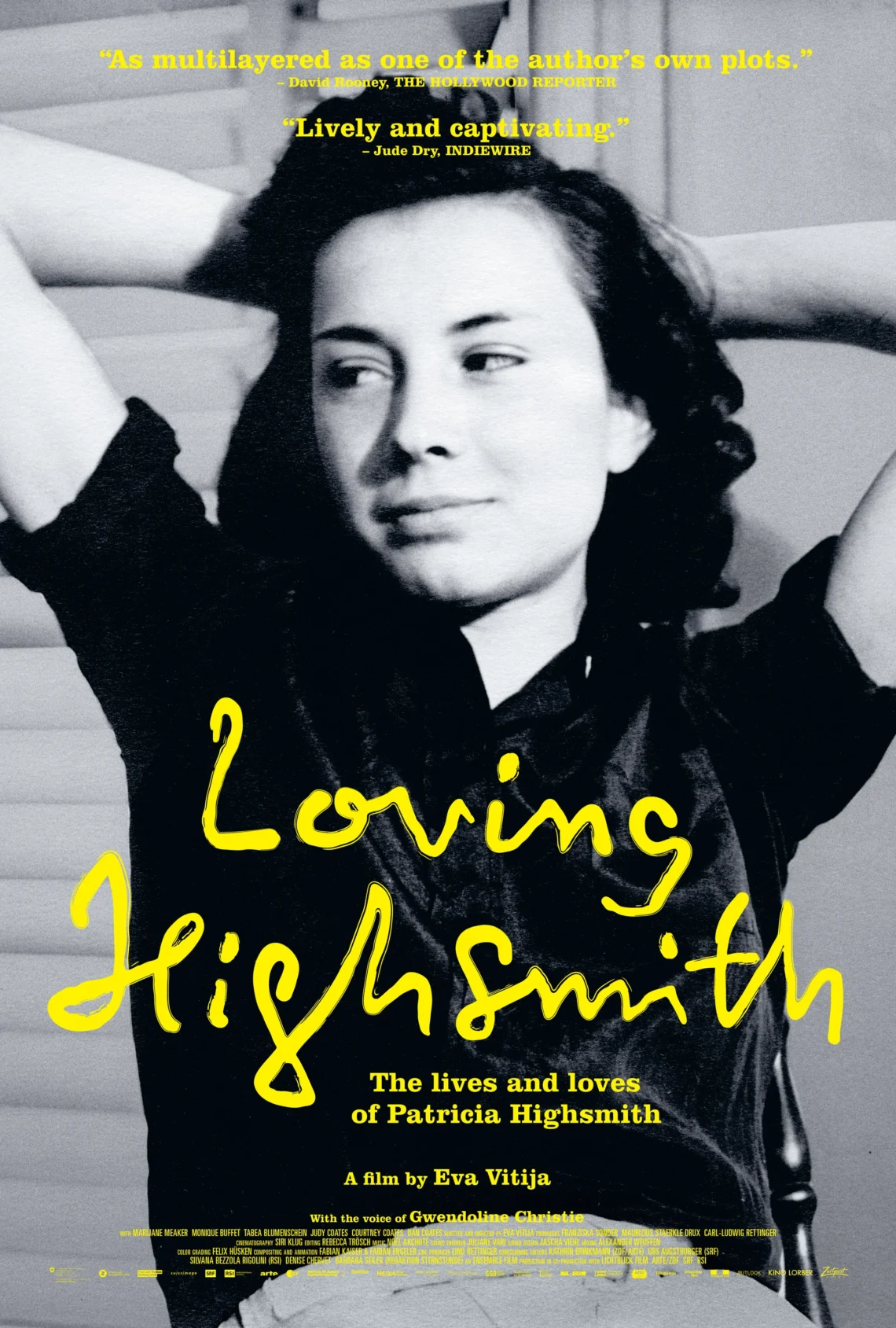
Loving Highsmith 2022: A Record of Desire and a Deep Interpretation of an Isolated Soul
It is said that all great sentences begin with a deficiency. For those who have ever pressed ink firmly into paper to record truths they dared not utter beneath the smooth surface of daily life shown to others, this film becomes a mirror that transcends a simple documentary. Patricia Highsmith lived her entire life hidden behind the title “Queen of Crime.” Yet, behind the cold thrillers she released to the world, lay hidden records of a burning love that was never once fully permitted.
🌿 Moments when this film resonates particularly deeply
- When you wish to encounter the abyss of a human being who was truthful only before her diary, having cast off her social mask.
- When you wish to witness the chilling process of how the blessing of talent coexists with the curse of solitude.
- When you wish to confirm the desperate will of a woman who insisted on writing a “happy ending” even within a repressive era.
- When you seek the consolation of knowing that the darkness within you is by no means yours alone, you must read until the end.
🎞 Notes before viewing
This work is a documentary based on the private records of the master of crime fiction, Patricia Highsmith. Rather than physical exposure, the narrative centers on the subject’s complex psychological state, the emotional communion between women, and the tension wrought by the pressures of the era.
🎬 Movie Information
- Title: Loving Highsmith (2022)
- Director: Eva Vitija
- Screenplay: Eva Vitija
- Original Work: Patricia Highsmith’s diaries and personal records (Diaries and Notebooks 1941-1995)
- Country: Switzerland, Germany
- Genre: Documentary, Biography
- Running Time: 83 minutes
- Platform: Apple TV, Mubi (varies by region)
- Cast: Gwendoline Christie (Narrator), Marijane Meaker (Self), Monique Buffet (Self), Tabea Blumenschein (Self)
📖 Loving Highsmith: Tracing the Truth as the Secret Diaries Open [No Spoilers]
The film unfolds based on the vast collection of Patricia Highsmith’s diaries and notebooks made public in 2015. It traces the chronicle of persistent longing and frustrated love toward women hidden behind her public life as a cynical thriller writer. In the conservative atmosphere of 1950s American society, where she had to conceal her sexual identity, Highsmith turned to her diary as her sole sanctuary.
The work interweaves interviews with the women who were her lovers with Highsmith’s own voice, demonstrating how an individual sublimates their pain into art. It calmly depicts how the fundamental deficiency rooted in her love-hate relationship with her mother constructed her literary world, and what the true nature of the “love” she ultimately sought within it was.
🖋️ An Interpretation of Longing Hidden Within the Fortified Walls of the Diary
For Patricia Highsmith, writing was not merely a profession but a defense mechanism for survival. The “double life” and “identity confusion” frequently exhibited by characters in her representative works are direct projections of the social oppression the author herself experienced. Through 8,000 pages of diaries, the film restores her truth, which was permitted only in the most private of spaces.
The sentences she wrote are like sharp blades, but their points were always directed toward herself. Highsmith tried to undergo treatment to fit into the category of “normalcy” demanded by society, yet she continuously recorded her adoration for women in her diary—a quintessential example of a fragmented self. This internal rupture was transposed into the generic devices of crime and suspense in her works; through this documentary, we discover that the starting point of all that cynicism was, in fact, an agonizing loneliness.
🎞️ Lovers Preserved in Black-and-White Imagery and the Shadows of an Unrecorded Era
This film illuminates an era through the reminiscences of the women who were Highsmith’s lovers. Even amidst the vibrant atmosphere of 1950s New York, they had to preserve their feelings for one another under the name of “secrets.” Director Eva Vitija cross-cuts Highsmith’s handwritten manuscripts with archival footage of the time, visually manifesting how forbidden love both erodes an individual’s soul and ignites a creative spark.
In particular, Highsmith’s sketches and drawings convey a density of emotion that she could not fully capture in prose. The time she spent sketching the faces of the women she loved was her only passage for self-salvation in a world where communication with others was severed. Through this process, the film restores Highsmith not merely as a “famous author” frozen in time, but as a fragile yet resilient individual who constantly desired to be loved.
🔎 The Conclusion Between Recorded Sentences and the Unrecorded Life
At the film’s conclusion, we encounter the elderly Highsmith living alone with her cats in a secluded house in Switzerland. Leaving behind numerous lovers and brilliant fame, what she chose was voluntary isolation. The ending of this documentary suggests that the sentences Highsmith spent her life recording did not ultimately lead her to complete peace, while simultaneously implying that this very isolation was the final resistance she could hurl at the world.
Her life held greater meaning in the process of longing for love than in its achievement. Leaving behind countless diaries, her life confirms the sorrowful truth that while recorded sentences are eternal, human longing can never be satisfied. What she lost was a mundane connection with others, but what she gained was a chilling literary permanence that pierces the hearts of readers across generations. Highsmith’s life clearly engraves the portrait of an artist that is only perfected within unyielding solitude.
❓ Loving Highsmith: Interpreting the Author’s Darkness and Aesthetic Issues
Q. How do you view the criticism that the film overly beautifies or omits Highsmith’s negative aspects, such as her racism or hateful remarks?
The fact that this work treats Highsmith’s late-life vitriol and antisemitic tendencies somewhat lightly is certainly a valid subject for criticism. However, director Eva Vitija’s intent is not to verify the author’s morality, but to trace the causal relationship between the social oppression that silenced her and her warped inner self. While maintaining a critical perspective, one must adopt an aesthetic stance that observes how an individual’s madness and deficiency led to great literary achievement.
Q. What impact did the “happy ending” of Carol have on Highsmith’s actual life?
Highsmith granted the peace she could never obtain in reality to her fictional characters. Breaking the convention of the time, which required queer novels to end in ruin, and choosing a “happy ending” instead was her most courageous act of resistance against the world. Even if her own life ended in isolation and alcohol dependency, that literary victory served as a structural support for numerous readers, both contemporary and subsequent, enabling them to endure life.
✨ Loving Highsmith: The Dignity of Solitude Remaining After All Masks are Cast Aside
Beyond the biography of a genius writer, this film asks how an individual preserves the self in an era where their essence is denied. The numerous crime novels Highsmith left behind were, ultimately, the screams of a human being who was robbed of the “right to live as oneself.” Even in modern society, we still live wearing the masks of others’ gazes and social expectations.
Highsmith’s life questions us: between the sentences you wrote to show someone and the sentences you left only for yourself, where does the real you reside? Her solitude was not a trace of a failed life, but the final front line of human dignity for one who sought to protect her truth until the end.
The film calmly declares the cruel truth that while art blooms using pain as its material, the party to that pain must shiver in the cold for a lifetime.
🗨️ What is the truth you have hidden in silence?
We sometimes choose silence instead of speaking our truth to protect ourselves. However, the moment that silence is transformed into sentences, as Highsmith did, solitude gains power.
Between remaining as the “normal self” demanded by society and existing as the “truthful self” despite the loneliness, which do you find more unbearable?
📽 Violet Screen Curation: Following Other Narratives of Longing
- Vita & Virginia (2018): A work that depicts the relationship between Virginia Woolf and Vita Sackville-West, who exchanged literary inspiration, through sensory mise-en-scène. One can encounter the love of a fascinating author distinct from Highsmith.
- The World to Come (2020): Set in the 19th-century American frontier, it deals with the intellectual and emotional communion shared by two women in an isolated environment. The density of emotion blooming amidst the era’s oppression is outstanding.
To provide a more stable publishing environment, multilingual content, and better communication with our readers, we have moved our official publication to Substack.
All new film reviews and critical essays will be published on our new platform. This website will be closing down soon, so we would greatly appreciate it if you subscribed to our new space.
TODAY'S QUESTION
Which character has comforted you lately?
Your answer isn't saved. Feel free to share it in the comments below.


You May Also Like

Unpregnant: A 900-Mile Road Trip Proving the Dignity of Choice and the Reconstruction of Friendship
Moonlit Winter Ending Interpretation and Plot: Reclaiming Desire from Frozen Time