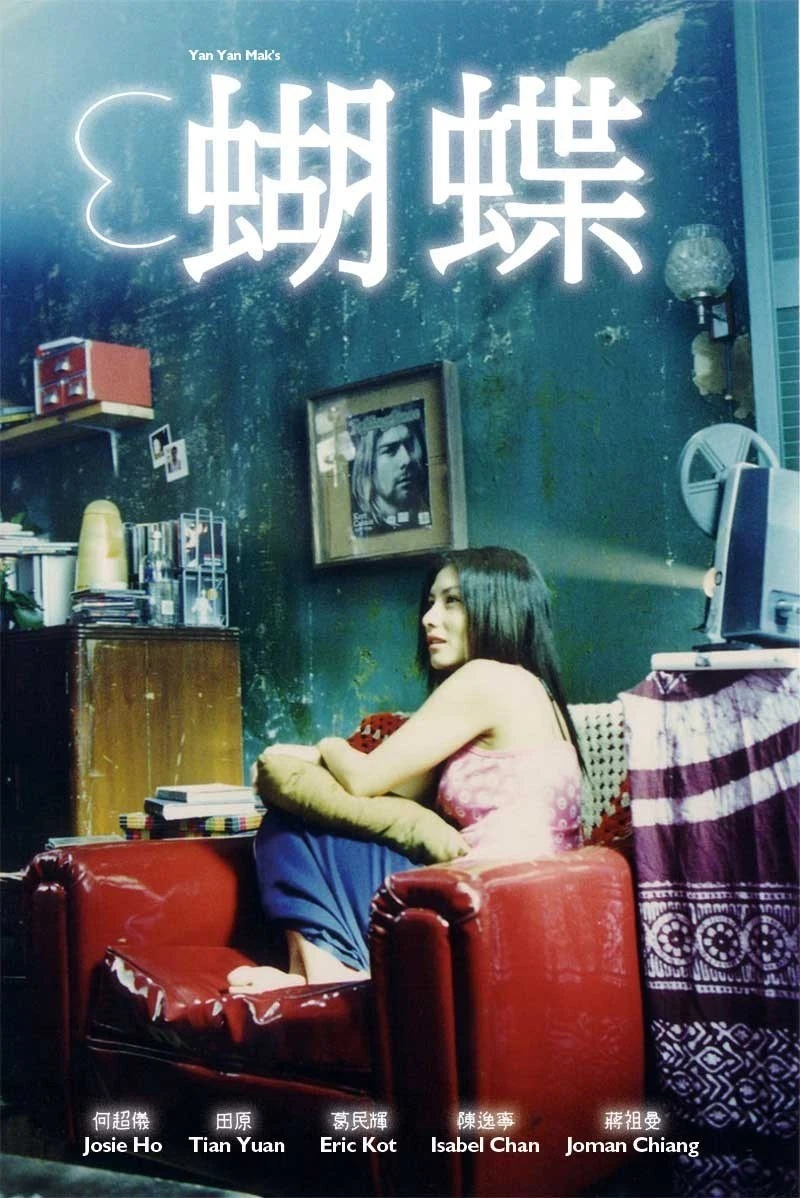
Butterfly (2004) Ending Analysis Review: The Narrative of Choice to Unfold Folded Wings
Sometimes, people learn to live the lives others expect of them rather than the lives they truly want. While faithfully executing the roles of a good housewife, a tender mother, and a dedicated teacher, one may fail for a long time to ask what her own heart truly desires. The Hong Kong film 《Butterfly》 does not portray Adie as a woman lonely for lack of love, but rather as one who lost herself because she was forced to live by erasing the memory of having loved. Meeting a new woman allows Adie to simultaneously confront her past first love and her present desire. What makes this work special is the collision within a single woman’s life of the loss of first love, the social role of marriage, motherhood, and sexual identity.
🌿 The Moment This Film Seeps In Most Deeply
- If you have ever failed to escape the memory of someone you loved and let go, you will discover how old wounds shape present choices in the relationship between Adie and Jin.
- If you are someone who loves your family yet refuses to give up your own life, the conflict Adie faces between love and motherhood will feel intimately familiar.
- If you are looking for a narrative centered on love between women, the unique relational structure where past first love and present romance intersect is well worth noting.
- If you enjoy stories grappling with the tension between social expectations and individual identity, observe how the political upheaval of Hong Kong in 1989 connects with the private life of a woman.
- And the reason you must read until the end is that the final choice in this film demonstrates how much loss accompanies the act of reclaiming one’s true self.
🎞 Note Before Watching
- Rather than explicit physical depictions, the narrative focuses deeply on the characters’ subtle breaths, gazes, and the undercurrents of suppressed emotion.
- It is an emotion-driven art film that probes the essence of human connection and intense relational tension without relying on sensational devices.
- It densely explores the desolate yet beautiful ripples of relationships forged at the intersection of historical turmoil and personal internal repression.
🎬 Film Information
- Title: Butterfly (《蝴蝶》 / 胡蝶, 2004)
- Director: Yan Yan Mak (麥婉欣)
- Screenplay: Yan Yan Mak (麥婉欣)
- Original Work: The Mark of Butterfly (《蝴蝶的記號》) by Chen Xue (陳雪)
- Country: Hong Kong
- Genre: Drama, Romance
- Runtime: 124 minutes
- Platform: Verified via Hong Kong DVD and Blu-ray releases.
- Cast: Josie Ho (何超儀), Tian Yuan (田原), Eric Kot (葛民輝), Joman Chiang (蔣祖曼)
📖 Butterfly 蝴蝶: Synopsis and Intersecting Narrative of Past and Present Love [No Spoilers]
Adie (Josie Ho), a thirty-something teacher, is an ordinary married woman with a husband, Ming, and a young daughter. One day, she happens to encounter a young singer, Yip (Tian Yuan), at a supermarket. Drawn to Yip’s free-spirited nature, Adie awakens emotions she has long suppressed. Adie continues her meetings with Yip while beginning to conceal her outings from her husband. Meanwhile, flashbacks reveal that during her high school years, she shared a deep love with a female friend, Jin, lasting for about three years. Family opposition and the political upheaval of China in 1989 also impacted their relationship. As current romance, past separation, the love affair of female students at school, and parental discord intersect, Adie faces choices surrounding her life and family.
🦋 Butterfly 蝴蝶 Analysis — Why Past First Love Awakens Present Desire
Memories of love do not simply vanish; they remain in different forms. What matters in the relationship between Adie and Jin is not merely the fact that she once loved a woman. Their love is connected to the period when Adie expressed her truest self most openly. The three years spent with Jin were a time when Adie experienced not only how to love, but also who she truly was. However, once her family discovered their relationship, Adie was placed in a position where she had to choose between love and family. Ultimately, she chose her family and left Jin. What Adie relinquished at that moment was not just a romantic partner. She also abandoned the possibility of a life where she could govern her own emotions. This explains why adult Adie is so swiftly drawn to Yip. Although Yip is not identical to Jin, she enables Adie to re-experience sensations lost long ago. Yip is simultaneously a new love and an entity that resurrects Adie’s former self.
The love between the two women exists in different temporal dimensions. Jin and Yip play distinct roles in Adie’s life.
- Jin is the person with whom Adie first acknowledged and loved her same-sex desires.
- Yip is the person who forces Adie, trapped within the roles of marriage and motherhood, to recognize her desire once again. The relationship with Jin encompasses youthful passion and a political era. Conversely, the relationship with Yip involves the realistic choices of an adult woman. This temporal contrast transforms the film’s flashbacks into a device far richer than simple nostalgia. The termination of a past love does not mean that love remains isolated from present existence. Adie confronts the shape her present life has taken precisely because of past choices.
🪞 Butterfly 蝴蝶 Analysis — The Structural Choice Forged by Marriage and Motherhood
A good husband does not necessarily equate to a happy marriage. In this film, Ming is not portrayed as a stereotypical villainous husband. He cares for their daughter, participates in domestic life, and shows consideration for his wife. He also provides a financially stable existence. Consequently, Adie’s choice becomes far more complex. Had her husband been violent or irresponsible, the justification for leaving the marriage could be found externally. Yet Ming is a man striving to preserve his family. Adie possesses no definitive reason to hate her husband. Nevertheless, the fact remains that her married life fails to satisfy her authentic desires. Here, the film poses a crucial question: Being a good spouse to someone and living a life true to oneself are not necessarily the same thing.
Are motherhood and sexual identity mutually exclusive? Adie loves her daughter. The reality that her choice might separate her from her child causes her immense agony. What makes this work intriguing is that it does not position women’s same-sex desire in direct opposition to motherhood. Adie can love her daughter while also loving women. The problem does not lie in the incompatibility of the two emotions, but in the fact that the familial and social structures of the time pressured her to choose between them. When Ming confronts his wife with the ultimatum regarding divorce and their daughter, private romance expands into the realm of family power dynamics and parental custody. Here, Adie’s choice transcends mere accountability for infidelity; it becomes an event where the right to govern one’s own life collides with the reality of motherhood.
🕊 Butterfly 蝴蝶 Analysis — Self-Identity Symbolized by Butterflies and Flight
The process of escaping a cocoon is never purely liberating. The film’s title, Butterfly, denotes a butterfly. A butterfly must undergo transformation within its cocoon before emerging to fly. Yet that process is far from safe. Adie’s life mirrors this trajectory. She maintains a stable existence within social roles as a married woman, a teacher, and a mother. Yet that stability rests on the price of concealing her genuine emotions. Meeting Yip allows Adie to discover the possibility of breaking away from the routine she has maintained for so long. Yet choosing freedom does not erase past wounds or practical responsibilities. Even as the butterfly takes flight, the arduous process of breaking free from the cocoon remains. For Adie, that process manifests as separation from family, the potential loss of her daughter, and the termination of her marriage.
Spatial contrast revealing a woman’s life Spaces of contrasting character appear repeatedly throughout the film.
- The School: A space where Adie performs her social role as a educator. It is simultaneously the site where a female student couple’s love and conflict unfold.
- The Home: A stable space housing her husband and daughter, yet also a place where Adie must conceal her feelings.
- Yip’s Living Space: A realm displaying the possibility of living according to the desires of two individuals rather than prescribed family rules.
- Macau: A location holding the remnants of her past with Jin, where Adie confronts long-standing questions anew. This spatial differentiation illustrates the persona Adie currently inhabits. She performs different roles depending on the location, yet none of these roles fully coincide with her authentic self.
🏛 Butterfly 蝴蝶 End Analysis — The Self That Had to Be Reclaimed Before Love
The reunion with Jin is not an encounter meant to revert to the past. The scene where Adie encounters Jin again in Macau marks a critical turning point in the work. For a long time, she believed Jin’s ordination as a Buddhist nun was her own responsibility. She assumed Jin chose a life severed from the world because Adie chose her family and left Jin behind. However, Jin explains that her ordination cannot be explained solely by her separation from Adie. Jin, too, possessed her own life, convictions, and internal turmoil. Through this encounter, Adie views her past relationship through a renewed lens. She accepts that she bears no obligation to shoulder the outcomes of Jin’s life as consequences of her own choices. Their reunion serves not as a reconciliation, but as the conclusion of a long-postponed farewell.
What Adie gained and lost in the ending Adie ultimately departs from her marriage with her husband. What she gains is the sensation of determining her desired life by her own agency. Conversely, what she loses is the domestic stability she maintained until now and the possibility of living alongside her daughter. This explains why this ending cannot be casually labeled as happy. Adie has acknowledged her identity, yet that choice does not restore all relationships. Her future with Yip remains unconfirmed. The film refuses to conclude with the notion that a woman who chooses love automatically finds happiness within that new love. Instead, it leaves behind the loss that must be borne in the wake of choice.
The most vital significance left by the ending In the final moments, Adie remarks, in essence, that though she has lost much throughout her life and now even her child, she has finally acquired herself. This line permeates the entire work. In the past, she preserved her family by leaving Jin. In the present, she leaves her marriage to safeguard her identity. Both choices entail loss, but the final choice is executed in a direction that at least refuses to negate herself. The conclusion of Butterfly is not a victory for romance, but a declaration that the right to govern one’s own life will not be surrendered to others. The film leaves unaddressed how Adie and Yip will live hereafter. Because of that open ending, the audience imagines Adie’s life post-choice—where she chooses herself for the very first time—rather than merely fixating on the couple’s future.
🔎 Butterfly 蝴蝶 In-Depth Questions — Questions on Endings and Female Representation
Q1. Did Adie truly love Yip, or was she simply seeking a replacement for Jin? Both interpretations remain viable. Because her relationship with Yip progresses rapidly, critics might argue it represents a temporary emotion projecting the past figure of Jin. However, Yip is a distinct individual from Jin, possessing her own lifestyle and musical aspirations. Adie’s attraction to Yip stems from more than mere reminiscence. The film declines to definitively categorize whether their relationship is a repetition of the past or a novel romance. The audience is left to judge whether Adie’s emotions, initiated by past memory, can mature into contemporary love.
Q2. Ming is not a bad husband—why did Adie choose divorce? This point is precisely where viewer reception may diverge. Ming is a devoted husband who attends to the household and cares for their daughter. Consequently, certain viewers may perceive Adie’s actions as an irresponsible choice regarding her family. Conversely, the film demonstrates that satisfaction within marriage and sexual identity do not necessarily align. The mere possession of a fine husband and a stable lifestyle does not obligate Adie to suppress her intrinsic desires. Nevertheless, the film insufficiently details the post-divorce custodial issues and the practical burdens Adie must assume. This aspect may be regarded as a narrative limitation of the work.
✨ Butterfly 蝴蝶 Review — Never Losing Yourself Is the Beginning of Love
The paramount characteristic of this work is that it refuses to depict Adie simply as a character who abandons her husband to choose another woman. In the past, she sacrificed love; in the present, she attempts to suppress her desires. Though Jin and Yip appear in different eras, their respective relationships serve as catalysts transforming how Adie perceives herself. Furthermore, by linking the 1989 Tiananmen Square incident and the political atmosphere of Hong Kong to private romance, the work illustrates that even personal love remains subject to the forces of era and society. Yet the film fails to fully illuminate how the relationship between Yip and Adie evolves subsequently, or how the bond with her daughter mends. Consequently, the ending imparts a dual resonance of liberation and loss. Ultimately, this film reveals that the journey is not about selecting a lover, but about becoming an individual capable of choosing one’s own life. Can a relationship sustained by a denial of oneself ever truly be a happy one?
💬 Between Love and Self, What Must We Protect? If loving someone requires abandoning oneself, how long can that relationship endure? In moments when you, like Adie, must choose between domestic stability and your own identity, what would you choose to safeguard, and what would you let go of?
💜 Violet Screen Curation: Two Women Between Choice and Silence
- Fire (1996)
- Recommendation reason: It portrays two women bound by duty within a large traditional Indian family who draw close to one another. You can encounter a texture similar to the domestic silence found in Butterfly.
- Portrait of a Lady on Fire (2019)
- Recommendation reason: A film where a female painter and a woman on the eve of marriage come to know one another through gaze and memory. It aligns with the lingering resonance of Butterfly in its depiction of how remembering love transforms a life.
TODAY'S QUESTION
Is there a film whose ending you wish had gone differently?
Your answer isn't saved. Feel free to share it in the comments below.


You May Also Like

Foxfire (1996) Review: The Destructive Fascination of Female Solidarity and Queer Subtext

Tell It to the Bees: Whispers of Bees Crossing a Season of Oppression, the Solidarity of Two Isolated Women