Twenty Five Twenty One: Youth Looted by an Era, an Interpretation of Growth Born from Radiant Deficiency
We all pass through our own respective “eras.” For some, an era is an opportunity; for others, it reigns as a predator that plunders dreams. Set in 1998, amidst the colossal waves of the IMF crisis, the story of those struggling to piece together shattered dreams is more than a mere retro romance—it is a persistent pursuit of something we have lost.
Rather than glorifying the immaturity of youth, this work asks how that immaturity leaves behind hardened scars as it collides with the world’s jagged edges, and how those scars ultimately form a person’s identity. Despite foreshadowing the end of the relationship before its beginning, the reason we cannot help but become immersed in the process is perhaps that we discover within it our own most burning “deficiencies.”
🌿 Moments When This Drama Deeply Permeates
- For those who wish to find the courage to stand again when the dreams sustaining their world have collapsed due to external forces.
- For those who long for the subtle yet burning sense of solidarity provided by a rival, a colleague, and the most intimate of strangers.
- For the moments when you need the pure consolation offered by the process of “us in those days” rather than a successful outcome.
- The reason to read to the end: To discover the true meaning of a “dignified farewell”—one that acknowledges a relationship’s expiration date while preserving its value, rather than viewing it as a simple failure of first love.
🎞 Notes Before Watching
This work focuses on dialogue, psychological distance, and the pressure of the era rather than physical contact or provocative settings. As it depicts the fierce solidarity and growth of women through the medium of fencing, it is optimized for viewers who prioritize relational density.
🎬 Series Information
- Title: Twenty Five Twenty One (2022)
- Director: Jung Ji-hyun
- Screenplay: Kwon Do-eun
- Country: South Korea
- Genre: Drama, Youth, Romance
- Runtime: 16 Episodes (Approx. 70–80 minutes per episode)
- Platform: Netflix, TVING
- Cast: Kim Tae-ri, Nam Joo-hyuk, Kim Ji-yeon, Choi Hyun-wook, Lee Joo-myung
📖 Twenty Five Twenty One: A Narrative of Solidarity Blooming Atop the Debris of Looted Dreams [No Spoilers]
In 1998 South Korea, the IMF economic crisis shatters the world of eighteen-year-old fencing prodigy Na Hee-do. When her high school fencing team is disbanded due to budget cuts, Hee-do devises a reckless plan to transfer to Taeyang High School, home to her idol and rival, Ko Yu-rim. In the process, she meets Baek Yi-jin, who has transformed overnight from a wealthy socialite’s son to the breadwinner of a ruined family.
Hee-do, with a characteristic cheerfulness that refuses to yield even before a cynical world, gives Yi-jin the strength to stand again, while Yi-jin sincerely cheers for Hee-do’s reckless dreams, leading them to form a special bond. Meanwhile, her meeting with the long-admired Yu-rim takes an unexpected turn, leading to a cold and sharp rivalry that ignites sparks of conflict. Yi-jin, forced by the era to become an adult, and Hee-do, who fought the era to protect her dreams like a child. Along with Yu-rim, who must face her at the tip of a blade on the fencing piste. In an age of loss, they begin to create their own radiant season as they witness each other’s wounds.
🤺 A Confession Shared via the Blade: Interpreting the Relationship Between Hee-do and Yu-rim
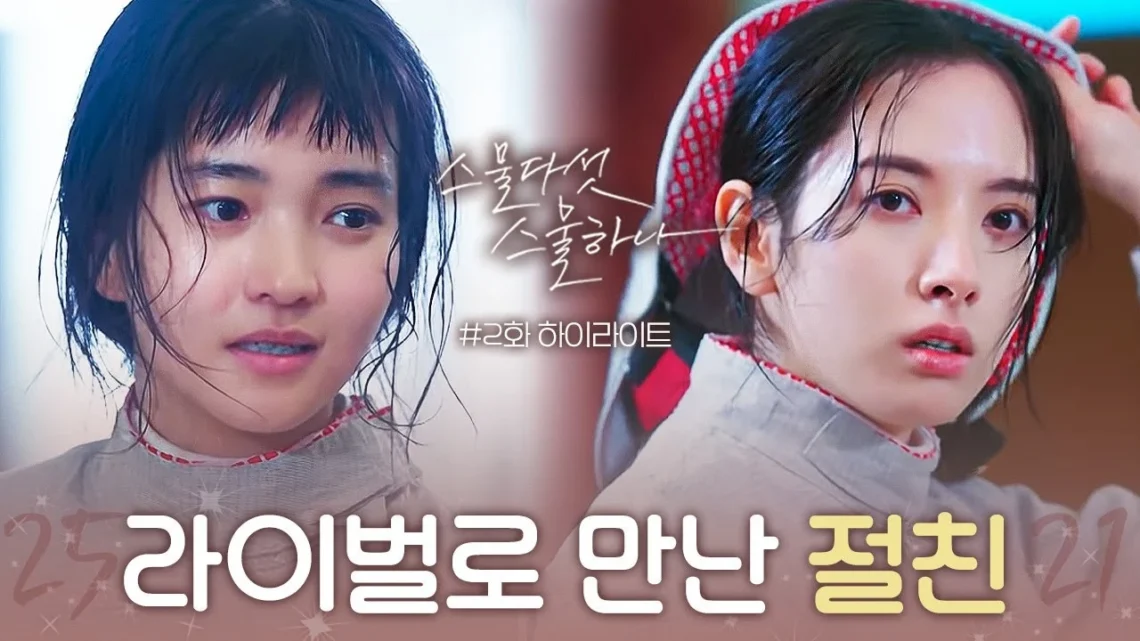
The most dazzling achievement of this drama lies in the relationship between Na Hee-do and Ko Yu-rim. The two are not competitors seeking to destroy one another, but rather mirrors of growth through which they recognize and expand their own limits.
The act of clashing blades on the fencing piste is not a mere sporting match. It is an internal confession that cannot be expressed in words and the only method of communication to understand each other’s solitude. In particular, the process through which Hee-do comes to understand the weight of poverty and responsibility carried by Yu-rim directly subverts the “jealousy and envy” clichés often consumed in female-centric narratives. Their relationship eventually converges not into proving “who is superior,” but into a deep bond of “you were the only one looking at me when no one else understood.”
🕰 The Era as a Predator: A Review of Lost “Innocence”
In this work, 1998 is not merely a background utilized to stimulate nostalgia. The era plunders dreams, dismantles families, and forcibly demands maturity regardless of the characters’ will. The character of Baek Yi-jin is an archetype of youth hit directly by the era. His agony is rooted not simply in economic deprivation, but in a sense of loss—the realization that he can never return to the innocence of those days.
The reason Hee-do’s positivity could save Yi-jin was not because she ignored the era, but because she independently produced the values of “encouragement” and “faith” that the era had stolen. From a critical perspective, this drama persistently asks what price an individual must pay to protect their humanity amidst massive social upheavals.
🔎 Reinterpreting the Ending: The Dignity of Farewell Faced at the End of a Seemingly Eternal Summer
While many viewers debated the conclusion of this work, structurally, this separation is both inevitable and a completed form of love. The breakup between Na Hee-do and Baek Yi-jin occurs not because their feelings for each other cooled, but because they passed the period of pure encouragement that sustained them as the weight of life and responsibility caught up to each.
The framing device of the adult Hee-do reflecting on her past suggests that the youth we have passed through is never disconnected from the present. Hee-do lost Yi-jin, but through the memories shared with him, she gained the “way to love herself.” Their ending is not a failure of a relationship, but a dignified farewell where each fulfills their best possible role for the other and exits honorably into their own paths.
The separation of Na Hee-do and Baek Yi-jin is not the extinction of a relationship, but the most sublime choice to return each other to their own worlds for the sake of mutual growth.
💬 FAQ on the Ending and Representation of Female Characters
Q1. What are your thoughts on the opinion that the ending, where Baek Yi-jin and Na Hee-do do not end up together, feels futile?
The core of this criticism stems from the collapse of the romantic fantasy expected by the audience. However, from the beginning, this drama was talking about a “time we thought would last forever” rather than “eternal love.” The appearance of middle-aged Hee-do from the mid-point of the series already implied a separation, breaking the stereotype that love only has meaning if it bears fruit. Rather, this ending reflects the weight of reality, elevating their love from a taxidermied memory to a vivid part of life.
Q2. How should we interpret Ko Yu-rim’s decision to naturalize and the narrative surrounding it?
Yu-rim’s naturalization is depicted as a very bold yet realistic choice within the social atmosphere of the time. Her path of choosing her family’s welfare over her status as a national hero reflects modern values where individual life and love take precedence over the grand narrative of the state. The public’s criticism and Hee-do’s solitary support for Yu-rim clearly demonstrate the power of solidarity between women that transcends social standards.
✨ Twenty Five Twenty One: A Tribute to All the Seasons We Have Lost
This work asks us: Was it the era that took away your most brilliant days, or was it your own self that became fearful? Hee-do’s recklessness and Yu-rim’s fortitude are the very things we discarded first as we became adults.
Though cloaked in the guise of romance, this drama is fundamentally a record of the establishment of identity. Love is merely the most powerful catalyst encountered in that process. The reason we weep at their farewell is not just because the two separated, but because we realize that we, too, can never return to that summer where we cheered for someone and threw ourselves forward so passionately.
The completion of youth is proven not by achievement, but by the number of scars that allow one to affirm life even after passing through loss.
🤺 At the end of the season you’ve passed through, what kind of scars do you carry?
Some bent themselves to protect love, and some sent love away to protect themselves. Have you ever cheered for someone or something so fiercely that you wouldn’t feel ashamed before your past self? Or do you wish to comfort your current self, who has become an adult far too soon?
📽 Violet Screen’s Curation: Two Worlds, Similar yet Distinct
- Jeongnyeon: The Star is Born (2024): Set against the backdrop of a 1950s female traditional opera troupe (Gukgeuk), this drama depicts a burning narrative of two naturally gifted women growing as artistic rivals and colleagues while breaking through the limits of their era.
- Mine (2021): An elegant chronicle where two women in the closed space of a conglomerate family join hands to protect what is “theirs” instead of destroying each other.
To provide a more stable publishing environment, multilingual content, and better communication with our readers, we have moved our official publication to Substack.
All new film reviews and critical essays will be published on our new platform. This website will be closing down soon, so we would greatly appreciate it if you subscribed to our new space.
TODAY'S QUESTION
What genre or mood do you always reach for when you're alone?
Your answer isn't saved. Feel free to share it in the comments below.


You May Also Like
Special Ops: Lioness (2023) — A Devastating Melodrama of Two Women Broken Under the Pretext of State Cause

Play Park (2026) Review: The Gravity of Solidarity and Love Blooming in the Cold War of Capital