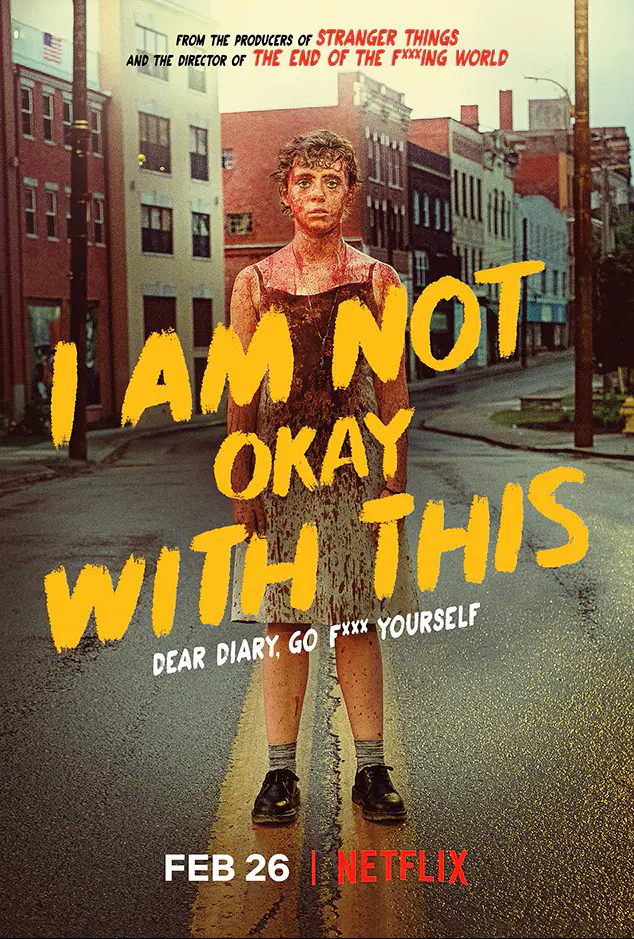
I Am Not Okay with This: Ending Interpretation and the Eruption of Repressed Desire
Everyone harbors an unspoken monster within their heart. Especially for girls navigating the tunnel of adolescence, that monster often manifests as shame, anger, or an indefinable, immense thirst. The Netflix Original Series I Am Not Okay with This transposes these universal “growing pains” into the extreme metaphor of superpowers, forcing us to confront the inner darkness we wish to ignore.
🌿 Moments it seeps in deep
- For those who have spent an evening suffocating under the weight of a secret only they know.
- For those who have singed their fingertips on the heat of “love” hidden behind the safe word “friendship.”
- For those who have felt the impulse to deviate from the orbit of “normalcy” defined by the world.
- Therefore, as you read to the end of this piece, you must confirm that protagonist Sydney’s destructive awakening was not a mere accident, but an inevitable “liberation.”
🎞 Note before watching
This work depicts the physical and psychological changes of an adolescent girl with somewhat raw and direct direction. While it includes gory visuals involving blood and coarse language, these are explicitly intended as devices to maximize the characters’ suppressed emotions and relational tensions.
🎬 Film Information
- Title: I Am Not Okay with This (2020)
- Director: Jonathan Entwistle
- Screenplay: Jonathan Entwistle, Christy Hall
- Original Work: Based on the graphic novel I Am Not Okay with This by Charles Forsman
- Country: 🇺🇸 USA
- Genre: Dark Comedy, Coming-of-age, Sci-Fi, Drama
- Runtime: Season 1 (7 episodes total, approx. 20–30 mins each)
- Platform: Netflix
- Cast: Sophia Lillis (as Sydney Novak), Sophia Bryant (as Dina), Wyatt Oleff (as Stanley Barber), Kathleen Rose Perkins (as Maggie Novak)
📖 <I Am Not Okay with This> Synopsis: A girl’s precarious borderline disguised as ordinary [No Spoilers]
17-year-old Sydney Novak, living in a small town in Pennsylvania, leads a precarious daily life amidst grief and anger following her father’s sudden suicide. Conflict with her mother, responsibility for her younger brother, and alienation at school further isolate her. Her only sanctuary is her best friend Dina, but as Dina begins dating the popular schoolboy Brad, Sydney’s sense of alienation curdles into jealousy and a feeling of defeat.
The moment she loses the ability to control her emotions, Sydney realizes she has developed mysterious superpowers—the ability to destroy or move objects. This power erupts without warning whenever Sydney’s anger and shame reach a breaking point, leaving destruction in its wake. Sydney becomes a ticking time bomb, caught between the confusion of her identity, indefinable feelings for Dina, and her increasingly potent superpowers. Can she master this immense power and mend her crumbling relationships?
💥 Visualization of Repressed Identity: A Symbolic Interpretation of Powers in <I Am Not Okay with This>
The superpowers Sydney wields in the series are by no means heroic. They are closer to physical screams—repressed desires and unspoken truths tearing through the flesh. This power manifests particularly when Sydney becomes conscious of her affection for Dina or when she is positioned as the underdog in social hierarchies.
Sydney’s power is closely linked to her “femininity” and “identity.” The embarrassment of starting her first period and the confusion of discovering her sexual orientation merge with this uncontrollable energy. This is a mise-en-scène that drastically visualizes the physical and psychological changes experienced by adolescent girls. Sydney’s acts of breaking walls and toppling library shelves can be interpreted as an unconscious resistance against the social norms and patriarchal family environments that confine her.
👭 Sydney and Dina: The Safety of Friendship and the Longing Beyond
The core axis sustaining the narrative of this series is the relational structure between Sydney Novak and Dina. Dina is both the sole bridge connecting Sydney to the world and the mirror that most painfully reflects Sydney’s own deficiencies. Sydney loves Dina, but she fears social ostracization the moment that love transcends the category of “friendship.”
The tension arising from their relationship reveals an asymmetry of power that goes beyond a simple youth romance. The contrast between the popular, sociable Dina and the gloomy, impoverished Sydney triggers a destructive possessiveness in Sydney, a desire to monopolize Dina. The eruption of Sydney’s power when Dina is with Brad is a tragic self-defense mechanism for someone who wants to be loved but feels unworthy of it. Their relationship delicately portrays the process where the longing to “be understood” eventually overwhelms the fear of “being found out.”
🔎 Reinterpreting the Ending — A Blood-Soaked Prom, the End of Shame
The ending of I Am Not Okay with This delivers an unforgettable shock to viewers. At the prom—what should have been the most glamorous moment—Sydney’s diary is exposed. Just as her greatest vulnerabilities, her “love for Dina” and the “existence of her powers,” are about to be publicized, Sydney’s rage leads to the brutal result of blowing off Brad’s head.
While this scene appears to be an homage to the film Carrie, its meaning is quite different. While Carrie sought revenge for bullying by others, Sydney’s explosion is an unconscious blockage intended to prevent her internal truth from becoming a laughingstock for others. Brad’s death is not a mere murder; it symbolizes the destruction of the “normal, male-centered order” that was suffocating Sydney.
The scene following the climax, where Sydney flees to a watchtower in the woods and encounters a mysterious figure, suggests she has now deviated from the order of human society and entered a new stage of existence. She has lost her life as an ordinary girl, but in exchange, she has become an independent agent who fully possesses her own immense power and dark desires.
Sydney’s explosion is not a mere emotional excess, but a structural rupture signaling the birth of a new self that cannot be explained by existing social grammar.
❓ Deep FAQ on the Ending and Narrative Structure of <I Am Not Okay with This>
Q1. How should we accept this ending given that Season 2 was cancelled?
While many fans expressed regret over the cancellation of Season 2, this unfinished ending actually strengthens the thematic consciousness of the work. The setting—ending with Sydney encountering a mysterious figure without having fully controlled her power—reminds us that the chaos of our lives also continues without clear answers. The work focuses on “state” rather than “resolution,” and Sydney’s journey is only truly completed within the viewer’s imagination.
Q2. What are your thoughts on the criticism that Brad’s death was too violent?
From a narrative perspective, Brad’s death is an essential device showing that Sydney has crossed a point of no return. Brad represents the “social superiority” and “Dina’s affection” that Sydney cannot have. The direction of his head exploding is a visual maximization of Sydney’s repressed unconscious flatly rejecting patriarchal authority and violent normalcy. Though it may be unethical, it provides a perfect aesthetic emotional catharsis.
✨ <I Am Not Okay with This>: A Tribute to All “Outsiders” Who Reject Normalcy
This drama is more than just a story about a girl with superpowers. It is a record for everyone who fights the fear that their existence will not be accepted by the world. The pain Sydney Novak suffers is not unique; it is the cost of solitude we all had to pay to become adults.
The work asks us: Is the monster hidden inside you doing okay? When you desperately want someone, or when you are angry at the world, how are you releasing that energy? Sydney eventually smiles while covered in blood. It may be the relieved smile of someone who finally no longer needs to hide herself.
True growth begins not by meeting the expectations of others, but by the courage to fully embrace even one’s most hideous and powerful self.
💭 Between silence and explosion, which choice will you make?
We sometimes suppress our true feelings to protect a relationship, and in that process, we experience the gradual collapse of our inner selves. Between facing the truth by destroying everything like Sydney, or staying within a safe relationship while wearing an appropriate mask—which do you believe is a “healthier survival”?
📽️ Violet Screen Curation: Other Depths of Female Narrative
- The Wilds: A modern castaway story about a group of girls stranded on a deserted island after a plane crash, exploring their survival and the complex, subtle psychological hierarchies between them.
- Get Even: A suspenseful high-school series where solidarity and betrayal intersect, centered on “DGM,” a secret society of four girls formed to expose injustices within their school.
To provide a more stable publishing environment, multilingual content, and better communication with our readers, we have moved our official publication to Substack.
All new film reviews and critical essays will be published on our new platform. This website will be closing down soon, so we would greatly appreciate it if you subscribed to our new space.
TODAY'S QUESTION
Is there a hidden gem you always recommend to friends?
Your answer isn't saved. Feel free to share it in the comments below.


You May Also Like

The Loyal Pin: A Narrative of Noble Aspiration Piercing Through Oppressive Eras
Blank The Series: An Interpretation of the Thai GL Drama—A Brilliant Fissure Bloomed from Suppressed “Desire”