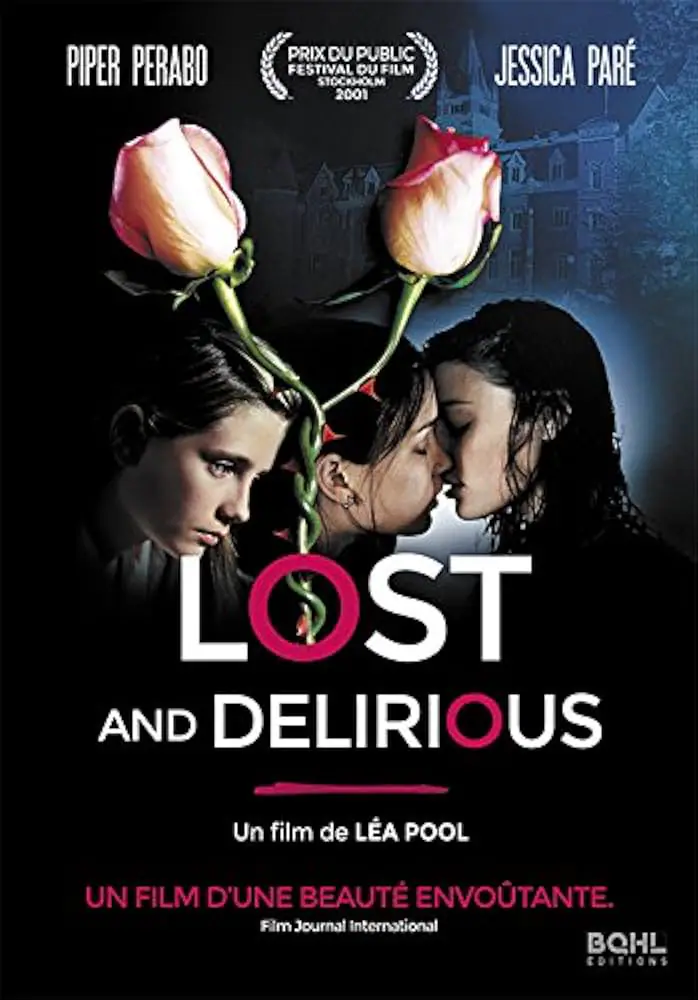
Lost and Delirious Review: The Flight of Madness and Obsession in a Secluded Forest
When love becomes one’s sole salvation, it often assumes a destructive nature. Within the enclosed environment of a boarding school—a physical vacuum—three girls confront distinct forms of isolation. One seeks the warmth of a lost mother; another craves the only person who can validate her identity; and yet another retreats behind the rigid walls of social order.
Lost and Delirious possesses an emotional density too profound to be confined within the simple framework of a “queer film.” It is a brutal coming-of-age narrative demonstrating how human desire, in its purest form, can be shattered when it collides with the cold gaze of reality.
🌿 Moments when this film resonates deeply:
- When you seek insight into a growth process where a lover’s denial stings more than the judgment of the world.
- When you wish to witness the tragic sublimity chosen by a pure soul unable to compromise with reality.
- When you want to feel the chilling process of solidarity as those who have experienced the pain of loss tend to one another’s wounds.
The reason to read until the end is to understand that Paulie’s madness was not mere obsession, but a final flight to prove her own existence.
🎞 Notes Before Viewing
This work deals with the unstable psychology and identity confusion of adolescence, including deep emotional communion and physical intimacy between characters. It is an emotion-driven drama focusing on the internal collapse of characters and the dynamics of their relationships rather than provocative depiction.
🎬 Film Information
- Title: Lost and Delirious (2001)
- Director: Léa Pool
- Screenplay: Judith Thompson
- Original Work: The novel The Wives of Bath by Susan Swan
- Country: Canada
- Genre: Drama, Romance
- Running Time: 103 minutes
- Platform: DVD, select VOD (varies by region)
- Cast: Piper Perabo (Paulie), Jessica Paré (Tori), Mischa Barton (Mary)
📖 Lost and Delirious Synopsis: Secret Cracks and Catastrophe in a Forest Boarding School [No Spoilers]
Mary ‘Mouse’, a 14-year-old girl sent to a foreign private boarding school following her mother’s death and her father’s remarriage, meets her roommates Paulie and Tori. The free-spirited, charismatic Paulie and the elegant Tori, who comes from a conservative background, open a new world for Mouse. However, Mouse soon senses an unusual current flowing between the two.
Late-night kisses on the rooftop and an impenetrable bond shared only by the two of them bring both envy and confusion to Mouse. Yet, their peaceful paradise begins to tremble violently when their relationship is exposed due to a minor mistake. Tori, unable to fail her parents’ expectations, begins to distance herself by vehemently denying Paulie. Having lost Tori—the sole root of her existence—Paulie is consumed by uncontrollable rage and madness.
As the perspectives of the one trying to protect love, the one trying to hide it, and the observer watching it all entwine, the story hurtles toward an irreversible conclusion.
🦅 The Flight of Symbolism: The Meaning of Paulie’s Hawk and Wildness
Throughout the film, Paulie devotedly cares for and trains an injured peregrine hawk. This hawk is not merely a hobby; it is a powerful mise-en-scène embodying Paulie’s internal self. A hawk is a being that must fly freely in the sky, yet it can be tamed by human hands or fall due to injury.
Paulie’s obsession with the hawk stems from her own status as an adoptee who has lost her roots; her love with Tori was the only “sky” sustaining her. When Tori pushes her away for pragmatic reasons, Paulie rejects the rules of civilized school life and attempts to return to a wild state.
Her actions—smashing mirrors and throwing dining hall carts—are a desperate retribution against a world that denies her, as well as a projection of her fragmented ego. This serves as an inevitable foreshadowing of her departure from the world, ultimately using the gestures of a bird rather than human language.
🏢 The Aesthetics of Enclosed Space: The Boarding School as a Great ‘Willow Cabin’
Perkins Girls’ College, the setting of the film, symbolizes a beautiful but suffocating isolation. The “Willow Cabin,” which Paulie shouts of while quoting Shakespeare, is the sanctuary for the uncompromising love she dreams of. However, the school is a microcosm governed by class, reputation, and familial order.
Tori attempts to survive by conforming to the order of this space, whereas Paulie seeks to destroy or transcend the space itself. Director Léa Pool maximizes the visual conflict between disciplined civilization (Tori) and untamed nature (Paulie) by contrasting the antique hallways of the boarding school with the lush forest. Within this structure, the ending is not merely an individual’s choice but a process of an alien entity, unacceptable to the system, being pushed out.
🔎 Reinterpreting the Ending — The Final Fall as a Proof of Existence
In the film’s finale, Paulie’s choice to leap from the roof is not simple suicide or surrender. It is the most powerful declaration proving that her love was never a “nightmare” or a “delusion.” When Tori hides within the masculine power represented by Jake, Paulie experiences an extreme loss where her very existence is negated.
The moment she leaps from the roof while calling to her hawk, the screen projects her not as a falling human, but as a soaring bird. The Shakespearean lines quoted by Paulie elevate her death from tragic extinction to mythical sublimation.
This conclusion leaves a fracture of “eternal guilt” in their relationship while simultaneously achieving a complete love that preserves Paulie’s existence within Tori’s memory. By disappearing, Paulie finally gains a freedom that cannot be tamed by anyone.
Paulie’s death is the most active proof of existence chosen by a subject who refused to be defined by others.
❓ Regarding the Ending and Narrative Structure of Lost and Delirious
Q. Does Paulie’s extreme choice feel overly sentimental or irresponsible?
From a modern perspective, Paulie’s actions could be seen as “gaslighting” or “obsession.” Specifically, the process of pushing Tori without respecting her will is a point of contention. However, this work focuses on the “Sturm und Drang” of emotion itself rather than rational judgment. To Paulie, Tori was not just a lover, but her only “witness” in the world. If one understands the existential terror of a being who has lost their witness, her madness is sublimated into an aesthetic tragedy.
Q. Is Mary (Mouse)’s role in the film limited to that of a mere observer?
Mary is the character who grows the most through this tragedy. Mary, who was trapped in silence following her mother’s death, earns the name “Mary Brave” as she watches Paulie’s flame-like love and subsequent ruin. She begins to find her own voice, inheriting Paulie’s legacy. Ultimately, this is also a somewhat cynical coming-of-age film depicting the process of Mary’s reconstruction through Paulie’s destruction.
✨ Lost and Delirious: A Requiem for All Unnamed Loves
This film exposes the destructive power of love and the harrowing loneliness hidden behind it in their rawest forms. The reason this work is still discussed twenty years later is that we all, at least once in our lives, face a moment of desire where we want to stake everything on someone—or feel we must do so to survive. The confrontation between Tori, who succumbed to the gravity of the social gaze, and Paulie, who tried to fly against that gravity, remains a recurring issue of identity and compromise in modern society.
Love sometimes preserves its purity entirely only by destroying someone.
🕊 What kind of ‘hawk’ lives inside you?
How far can you throw yourself to protect a relationship? Will you choose stability by hiding in silence, or will you soar, crying out the truth even if it means breaking?
💜 Violet Screen Curation: The Depth of Other Women’s Narratives
- Water Lilies (2007): The debut feature of director Céline Sciamma, sensorially depicting the tangled desires of teenage girls and the power structures of the gaze.
- 3 Generations (2015): A drama that exquisitely portrays the generational conflict and solidarity between a teenager seeking their identity and the family watching over them.
To provide a more stable publishing environment, multilingual content, and better communication with our readers, we have moved our official publication to Substack.
All new film reviews and critical essays will be published on our new platform. This website will be closing down soon, so we would greatly appreciate it if you subscribed to our new space.
TODAY'S QUESTION
If you could say one thing to someone today, what would it be?
Your answer isn't saved. Feel free to share it in the comments below.


You May Also Like
Flat Girls Review: Female Narratives Blocked by Class Barriers, the Collapse of First Love, and Interpretation of the Hidden Ending
Between the Seasons (2018): The Aesthetics of Isolation Breathed by Hidden Identity and Lack of Solidarity